

Such information helps companies target customer communications, marketing campaigns, and special offers. Today, customer loyalty is paramount because the customer is in the driver’s seat when it comes to making a choice about how to interact with a service provider. This is true across many industries. The buyer has many more channel options and is increasingly researching purchase decisions and making buying decisions from a mobile device.
Big data has the potential to change the way companies manage customer relationships by offering businesses powerful new tools, capable of identifying sales opportunities and analyzing customers’ responses to products, by combining internal data with comments made on social networks.
Following are the 3 steps to determine how you can use big data to gain customer loyalty
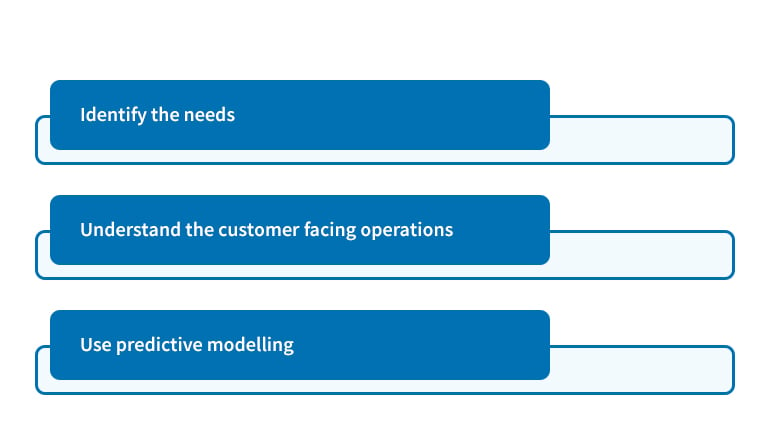
Identify the needs
Each customer has unique needs. Customer analytics tools enable companies to analyze that data and gain buying pattern insights. It also enables you to deliver personalized customer messages. Big data analysis offers companies a way to identify those shoppers who are the most valuable as returning customers. This is an excellent way to retain customers.
Understand customer facing operations
Online, consumers are sharing brand information via social media as well as researching and learning about products. Offline, they’re evaluating, testing, and brand associating. And they’re using mobile devices to compare merchandise and prices while shopping in an actual store. Analytics companies such as RetailNext offer real-time store monitoring to understand shoppers better. It also helps to capitalize that information. It includes features like video-tracking customer movements, recognition technology to determine gender and identify unique visitors across multiple store visits. Thus, it will provide proof of how the company is performing in terms of service, sales, and marketing.
Use Predictive Modelling
Predictive models and analysis are typically used to forecast future probabilities. Applied to business, predictive models are used to analyze current data and historical facts in order to better understand customers, products, and partners and to identify potential risks and opportunities for a company. Predictive analytics will allow a company to forecast how customers are going to respond in the future based on their past behaviours and their segmented demographics. Or, a consumer products company could predict how well a certain demographic will respond to a new marketing initiative based on past purchasing behaviour.
Using big data and CRM analytics, one can find associations, recognize patterns and identify trends. This allows a company to shape customer experiences for increased engagement and greater profits. It is a great way to bring the perspective of the customer into business decisions.
Thus, by incorporating these factors into big data, you can ensure customer loyalty.