

Wohler’s Report 2014 says that 3D printing or additive manufacturing makes up to less than 2% of the entire manufacturing market. It is because this technology, also termed by the industry as a ‘maker’s revolution’, is already running headlong into several obstacles.
One of the major obstacles is that it requires very high-level machinery, costing several million dollars each. 3D printing produces items that are less ‘resistant’ than classic moulded parts. Also, due to layer by layer build-up, a structural weakness in the 3rd (vertical) dimension is created. These are some of the common problems faced by companies while implementing 3D printing.
Apart from these problems, we wanted to know the areas of concern and the risks that professional users of 3D printing perceive as the top challenges:
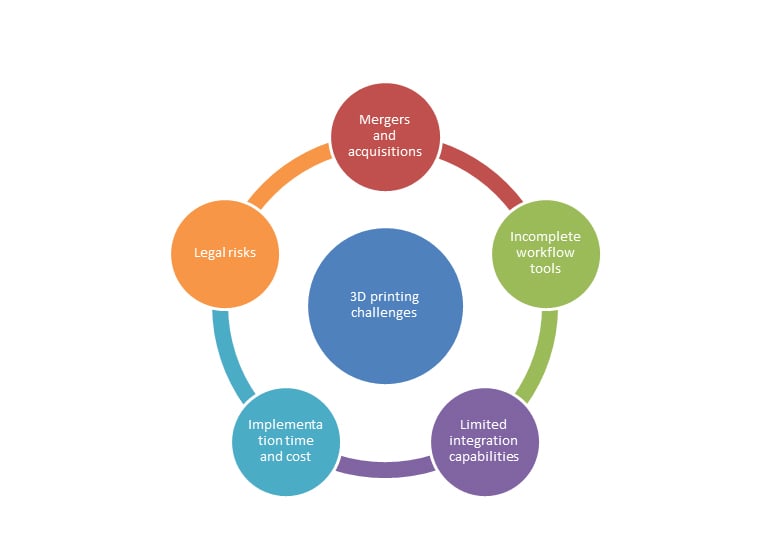
1. Mergers and acquisitions (M&As)
In such a proliferated environment, M&As are frequent and some amount of consolidation is inevitable. M&As can create uncertainty among customers. In such situations, you must proceed with caution when you evaluate potential vendors in the market for viability. You must ensure that their focus remains aligned with your needs.
2. Incomplete workflow tools
An incomplete set of 3D print workflow tools won’t allow you to complete several tasks. You must be aware of all the 3D print workflow and manufacturing software vendors that provide you with lesser number of features.
3. Limited integration capabilities
Most organizations have an existing production environment into which they’d like to integrate their 3D print workflow or manufacturing with. Due to lack of integration capabilities, evaluating this software becomes difficult. You should be wary of COTS tools that focus solely on 3D printers without the ability to add non-3D print devices.
4. Implementation time and cost
Before deploying any kind of 3D print workflow software or manufacturing software, you must consider the time to implement and cost requirements. The implementation process for 3D print workflow software can be a large and arduous task. Also, while manufacturing a product by 3D printing, the time taken by a product to evolve is depended on the number of layers to be printed. This process can last for hours and even days.
5. Legal risks
3D printing can lead to legal risks. Take an example of a safety helmet manufacturer that sells the CAD file and a helmet produced in 3D printing. This production reveals a flaw following an accident; who would you consider responsible in this situation? It could be the original model manufacturer or the printer manufacturer. Such legal risks can slow down the growth of 3D printing adoption in organizations.
3D printing is said to be a $4 billion business, set to quadruple by 2020. But, some of these factors are slowing down the growth of 3D printing in the industry. All new technologies come with risks and possible drawbacks. If you want to implement 3D printing software in your company, you must first analyse all these challenges and move forward with right tools and approach.