How simple AI-based scheduling and real-time analytics can cut citizen wait times at DMV offices, starting now.
No one likes waiting at the DMV. Whether it is to renew a license, register a vehicle, or take a test, citizens brace for long lines, unpredictable delays, and a frustrating experience. For the DMV, that has become a public-perception problem.
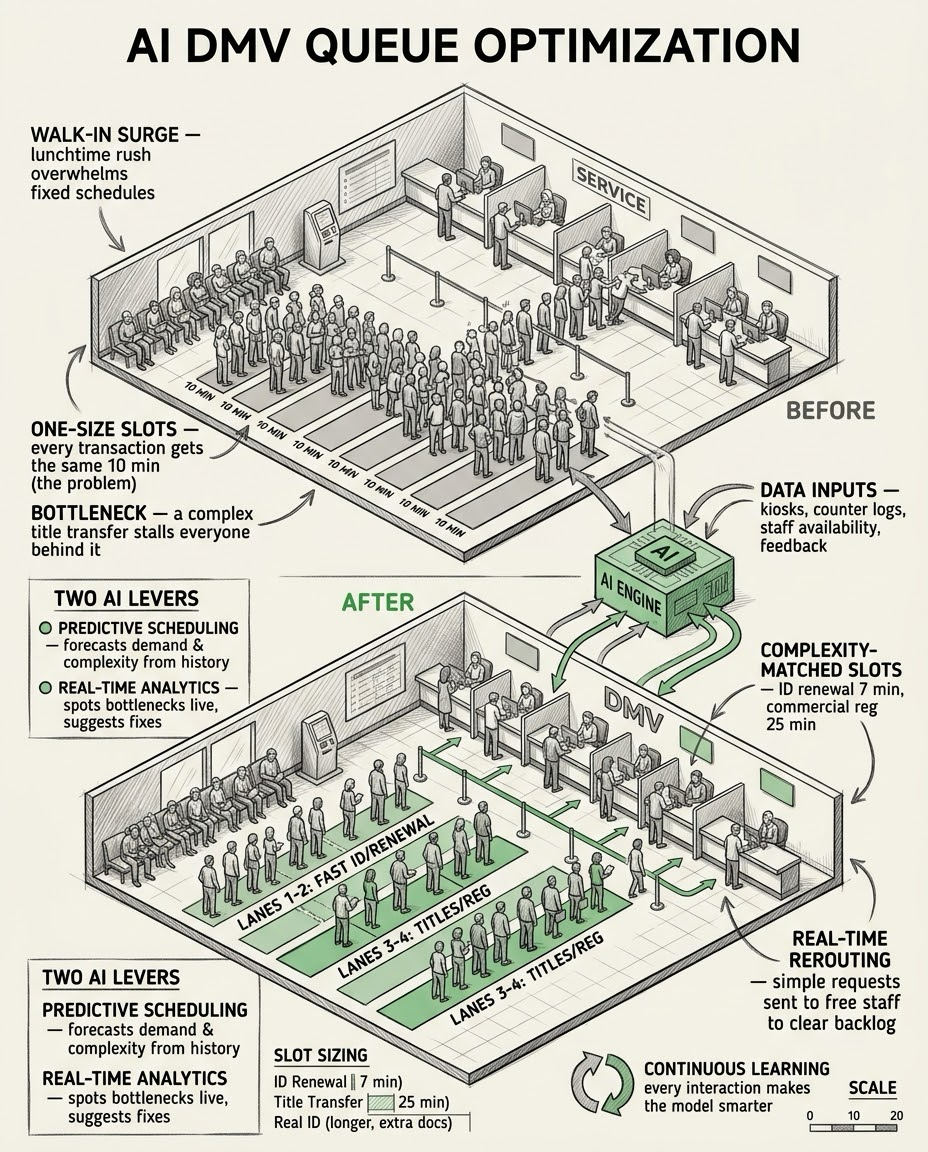
What makes DMV wait times so frustrating is their unpredictability. Offices handle a wide range of transactions, some quick and straightforward, others requiring multiple checks and extended time with staff. Most appointment systems, even when well intended, treat every transaction the same. The reality is more nuanced: certain transactions take longer or need specialized knowledge. New vehicle registrations and out-of-state transfers, for example, routinely run past their allotted windows, causing ripple effects that cascade through the day.
Walk-in traffic complicates it further. Even with scheduled appointments, a sudden rush of unscheduled visitors, often around lunchtime or late afternoon, can quickly overwhelm available staff. Traditional systems can’t adapt on the fly to changing conditions like a demand spike or an unexpected staffing shortage. So even good scheduling deteriorates into chaos, leaving citizens frustrated and employees stretched.
AI offers a practical way for the DMV to manage that traffic and change the experience.
Identifying the Gap
DMV transactions vary in time, documentation, and eligibility requirements. Citizens arrive with very different needs, often unannounced, and service windows can’t always adapt fast enough. Many DMVs already run appointment systems, yet those systems haven’t ended long queues or unpredictable waits. Here is why:
- Every appointment slot is the same length, regardless of complexity.
- The systems don’t adapt to swings in walk-in traffic or staff availability.
- There is little coordination between scheduled and unscheduled visits.
So when a citizen with a complex title transfer is booked into the same 10-minute slot as someone renewing a license, the delay spills into the next appointment. Worse, when a surge of walk-ins throws off the schedule, people with appointments wait just as long as those without. In most cases this is not a technical failure. It is a coordination and prediction problem.
The Solution: AI’s Two High-Impact Levers
| AI lever | What it does |
|---|---|
| Predictive scheduling | Uses historical data to forecast service demand and appointment complexity |
| Real-time analytics | Pulls data from check-ins, counters, and back-office systems to suggest corrective actions instantly |
To move past the limits of the traditional appointment system, DMV operations can use two high-impact levers: predictive scheduling and real-time analytics. Together they bring intelligence and adaptability to environments where static planning falls short.
Predictive scheduling
Predictive scheduling uses AI trained on historical operational data: service times by transaction type, peak-hour traffic, no-show trends, even regional patterns. The system learns, for instance, that Real ID enrollments take longer because of extra document verification, or that late-afternoon appointments are more likely to run late. It then tailors the schedule to match, adjusting time slots, pacing staff, and even limiting certain services during high-pressure windows. The result is a realistic, capacity-aligned schedule that prevents bottlenecks before they start.
Real-time analytics
Even the smartest schedule can’t account for real life, a staff member calling in sick or a printer breaking down. That is where real-time analytics comes in. It gathers and synthesizes data from multiple points, digital check-in kiosks, counter service logs, staff-availability trackers, and customer feedback, to give DMV managers a moment-to-moment picture of operations.
If three back-to-back appointments all need extensive document checks, the system spots the forming bottleneck and proactively suggests adjustments, like temporarily routing simpler requests such as standard renewals or address updates to available staff to clear the backlog. When disruptions hit, a sudden staff shortage, a printer out of specialized forms, or a rush of walk-ins after a local news segment, it flags the issue immediately and prompts managers to act: reallocate staff from less-affected services, send digital wait-time updates to citizens, or extend appointment intervals to stop the cascade. That turns reactive crisis management into proactive, informed decisions, improving both operations and the citizen experience.
Workflow Automation and Intelligent Planning for DMV Operations
As DMVs evolve into more virtual, data-connected institutions, AI becomes even more useful. With services moving online and digital channels feeding centralized systems, there is a wealth of real-time data DMVs can put to work with AI.
1. Staff resources align with demand
One of the most persistent DMV challenges is deploying staff well across the day. AI-driven systems analyze both historical service trends and current in-branch activity. The platform might recognize that license renewals spike between 9 and 11 AM on Mondays, while written tests peak near closing, then recommend staffing patterns that match that flow. In practice, that creates a more responsive workforce: staff spend more time on meaningful service, fewer citizens wait, and managers stop micromanaging shifts to chase pressure points.
2. Appointment durations match service complexity
In most DMV systems, every appointment gets the same slot, whether it is a quick address update or a complex title transfer. That one-size-fits-all model is a key driver of cascading delays, as longer transactions run over and push back everyone after them. AI replaces it with slot durations based on transaction complexity. By analyzing past records, the system learns how long each service typically takes, factoring in day of week, time of day, and regional trends. A commercial vehicle registration might get a 25-minute window, while a basic ID renewal gets 7. The schedule runs more predictably because each citizen is given the time they actually need.
3. Continuous learning improves planning
Unlike traditional systems built on hard-coded rules or static reports, AI scheduling engines evolve. Every interaction, appointment outcome, and counter-performance signal adds to a growing dataset that refines future decisions. The benefit is long-term: the more the system is used, the smarter it gets. Managers no longer guess at trends or wait for quarterly reviews to make changes. They get a self-improving model that adapts as citizen behavior, policy, or staffing constraints change.
In the end, AI is not only a way to fix operational issues. It is a way to change how the public experiences and perceives the DMV. By consistently reducing variability, it builds credibility and, over time, restores trust in public service. That is the kind of measurable, citizen-facing AI we help public agencies put into production at Allerin.