As cities work to become not just connected but genuinely intelligent, AI has moved from futuristic luxury to foundational need. From traffic lights to parking meters, smart is getting smarter. AI is changing how cities manage infrastructure, respond to real-time conditions, and serve residents with more precision and speed. It offers the promise of smoother commutes, safer intersections, and more sustainable urban mobility.
Take Los Angeles’ ATSAC system, one of the largest automated traffic networks in the country. On paper it is a model of smart-city infrastructure. In practice it shows the challenge many cities face: layering modern AI on top of aging foundations. That challenge gets sharper with massive events like the 2028 Olympics on the horizon and autonomous vehicles arriving fast. Smaller cities are experimenting too. Easton, Maryland, for example, is easing downtown congestion with smarter parking. And Easton is not alone. Austin, Denver, and Miami are also increasing their investments in AI for traffic and mobility.
Pilot projects across the country have shown that AI systems can optimize signal timing, reduce congestion, and support multimodal transport. Moving from pilot to full-scale deployment is where it gets hard. The technology is mature, but the path to citywide adoption is full of roadblocks that are bureaucratic, technical, financial, or social. Here are the major hurdles U.S. cities hit when they try to scale AI traffic systems.
Data Silos and Legacy Infrastructure
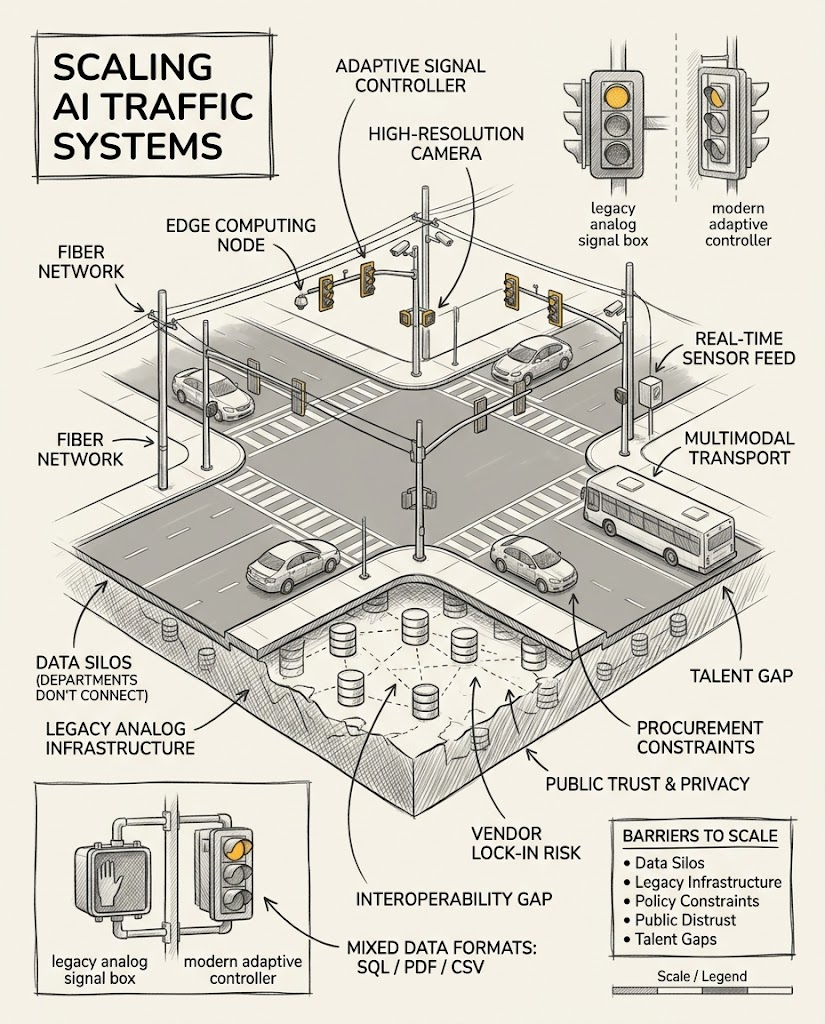
AI runs on data, but in many U.S. municipalities data is fragmented across agencies and locked in outdated systems. Traffic signals may be managed by one department, public transit by another, and road conditions by a third. Those silos make it hard to aggregate and analyze the real-time data AI needs to work.
Lack of interoperability across departments
City departments often operate as independent silos. Transportation runs one system, transit uses another, and emergency services have their own platforms. Each was likely built at a different time, by a different vendor, for a different purpose. So when a city tries to introduce AI, or even a single dashboard that connects data across departments, it hits a wall. These systems do not speak the same language, and they were never designed to talk to each other. Data gets trapped, and insights that could help, like traffic conditions rerouting emergency vehicles, never surface.
Data formats vary wildly
The patchwork of formats, from structured SQL databases to freeform PDFs, is a nightmare for any AI system trying to build a unified view. AI needs structured, normalized, ideally real-time data. Instead it gets a puzzle with mismatched pieces and no edge pieces to guide it. Because these datasets were never meant to integrate, there is often little metadata to explain what they mean. Even when the data is shared, it is not usable without heavy manual work, which slows any intelligent automation.
Legacy infrastructure
AI traffic systems need modern foundations: high-resolution cameras, edge computing, fiber networks, and adaptive signal controllers. Most U.S. cities still run on aging, analog infrastructure that is poorly suited to AI, and retrofitting it with smart sensors and real-time communication is expensive and logistically complex.
Boston’s Project Green Light, a Google AI initiative, shows both the promise and the ceiling. Google reports the program can cut stops by up to 30% and intersection emissions by up to 10% by smoothing signal timing. But it is a data-and-recommendation tool, not full adaptive signaling. It suggests timing changes from Google Maps data rather than running the hardware in real time, so it is a low-barrier first step, not a complete fix. True adaptive signaling still needs more expensive hardware and continuous maintenance.
Policy Constraints, Public Acceptance, and Talent Gaps
City governments follow strict procurement rules, and for good reason. Those standards protect fairness, accountability, data security, and the public from fraud or underperformance. At the same time, public acceptance of AI infrastructure is mixed. Concerns about surveillance, data privacy, and job displacement can generate pushback, and political leaders may hesitate to back projects whose returns are long-term rather than immediately visible.
Small vendors may not meet procurement standards
Many boutique AI firms lack the resources or certifications to win large municipal contracts. Traditional RFP processes favor proven vendors and established solutions, which can shut out startups. Worse, procurement contracts rarely account for the iterative nature of AI, where models need ongoing updates, retraining, and recalibration. Without flexible, performance-based contracts, cities risk buying AI systems that stagnate or go obsolete within a few years.
Public distrust
Public trust is essential, and earning it takes transparent communication about both the benefits and the safeguards. In Philadelphia, AI-powered cameras for traffic violations sparked debate about surveillance and privacy, and the city worked with community groups to address concerns and add transparency to the rollout.
Other automated-enforcement programs show what happens without that care. In 2025, the Miami-Dade Sheriff’s Office suspended a school-bus camera citation program after billing and citation errors left residents unable to pay the correct amount or appeal within the required window. Programs like this rebuild trust only when accuracy and a clear appeals path come first.
Technical talent gaps and vendor lock-in
Deploying and maintaining AI traffic systems needs data science, machine learning, cybersecurity, and civil engineering skills. Most city departments lack that talent in-house and struggle to compete with the private sector for AI specialists, which leaves them reliant on vendors, raises costs, and erodes institutional knowledge.
Vendor engagement is often high during a pilot. You get white-glove service, fast bug fixes, and direct access to engineers. Once talk turns to citywide rollout, that support can drop off, especially with smaller or early-stage vendors. And when a city builds its system around one provider’s proprietary code, exclusive formats, or closed APIs, it risks lock-in. If that vendor shuts down, gets acquired, or pivots, the city’s system can become unusable. Lock-in is not just a budget issue, it is a strategic risk. Cities need systems they can grow with, not systems they are trapped in.
Navigating the Road Ahead
AI traffic management can reshape urban mobility by cutting emissions, improving safety, and making cities more livable. But pilots alone are not enough. Without deliberate investment in infrastructure, policy reform, vendor capacity, and public trust, smart mobility stays limited to a few blocks instead of whole cities.
What cities can do to bridge the pilot-to-scale gap
| Action | Benefit |
|---|---|
| Adopt open standards | Easier interoperability and future-proofing |
| Create AI oversight boards | Builds trust and transparency |
| Standardize data privacy frameworks | Reduces legal risk |
| Involve communities early | Prevents delays and supports inclusive design |
Until these systemic issues are addressed, many smart-traffic systems will stay confined to pilots, effective in isolation but unable to scale across a city. Done well, AI-driven traffic systems can become a cornerstone of sustainable, equitable cities. Getting there takes more than promises and plans, and that is the work we help public agencies do.
Sources: Google: Project Green Light · GovTech: Miami sheriff pulls school bus cameras over significant errors