
According to the UN, by 2030, the world will see 43 megacities with more than 10 million inhabitants each. By 2050, the UN projects that around 2.5 billion more people will reside in urban environments, many in developing countries.
In the midst of revolutionary advances in technology, urban infrastructure is undergoing a sweeping transformation. Although roads, utilities, and other foundational systems remain vital, the advent of intelligent infrastructure is giving cities a level of adaptability once considered impossible. Governments are recognizing the importance of integrating advanced ICT (Information and Communications Technology), IoT (Internet of Things), and various data analytics solutions into roads, bridges, tunnels, and even everyday public services. These systems monitor real-time conditions and user behavior, enabling public agencies to fine-tune energy usage, optimize traffic flows, and deliver essential services with far greater efficiency.
Progressive leadership has highlighted how intelligent infrastructure can make travel safer and more efficient. For more than two decades, the Federal Highway Administration (FHWA) and the U.S. Department of Transportation have championed these innovations. Some forward-thinking U.S. cities serve as early adopters of these technologies, providing glimpses of what the future may hold for urban spaces around the world.
- Seattle, Washington: Home to tech giants Amazon and Microsoft, Seattle is renowned for its wide-scale implementation of smart city initiatives, from adaptive traffic lights to sophisticated data analytics that inform public transportation planning.
- San Francisco, California: The “SFpark Project” revolutionized smart parking solutions by leveraging sensors and dynamic pricing. This pilot has inspired other cities to manage limited parking resources more effectively.
- New York City: With initiatives like “Midtown in Motion,” New York focuses on real-time traffic monitoring and adaptive signal control, and is expanding the use of electric vehicles (EVs) and bike-sharing programs to reduce congestion and pollution.
Building Blocks of Intelligent Infrastructure
Cities that aspire to become “smart” typically focus on three foundational areas:
- Transportation Systems
- Energy Management Systems
- Public Safety and Security Systems
Each of these pillars benefits tremendously from the introduction of digital solutions, advanced analytics, and continuous real-time monitoring.
Smart Transportation Systems
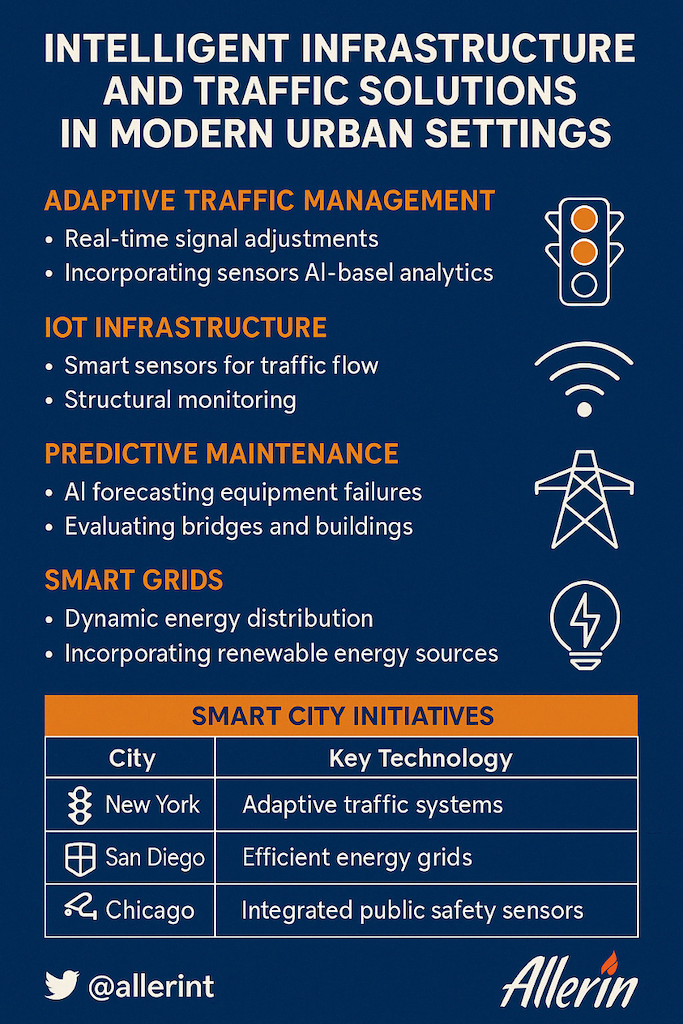
From dynamic traffic lights that adjust in real time to bus-tracking systems that inform riders of exact arrival times, smart transportation technology lowers emissions, boosts safety, and promotes the use of public transit. New York’s “Midtown in Motion” is an illustrative example, using sensor data, cameras, and GPS to coordinate traffic lights so that buses and cars move more efficiently. In tandem, the MTA’s Bus Time system offers real-time bus locations, saving commuters from guesswork and reducing congestion on already-busy streets.
Energy Management Systems
Smart energy grids allow for more efficient electricity distribution, reduced waste, and straightforward integration of renewables such as solar and wind. In San Diego, an advanced grid constantly recalibrates distribution in response to live data on consumption spikes. This approach helps prevent blackouts, lowers operating costs, and facilitates the adoption of rooftop solar and other decentralized energy sources. As a result, the city aims to reach 90% renewable energy usage by 2030, with ambitious expansions in energy storage and metering.
Public Safety and Security Systems
Smart systems extend well beyond traffic flow and energy. Security-focused infrastructure includes real-time alerts, video surveillance, and acoustic sensors that can detect gunfire or other disturbances. Chicago’s Operation Virtual Shield integrates thousands of cameras monitored in real time. The city also deploys ShotSpotter technology to pinpoint gunfire, immediately alerting law enforcement to potential criminal activity.
Bridge and Building Structural Monitoring
One area poised for significant advancement is the monitoring of bridges and buildings—critical assets that, if left unmaintained, can put communities at serious risk. AI-enabled sensors can evaluate the integrity of concrete, steel, and other materials by measuring stress, vibration, and microfractures. This data is transmitted to centralized platforms, where machine learning models anticipate failures or detect anomalies well before they escalate into major threats.
Drone-based inspections equipped with AI-powered cameras provide supplementary perspectives—particularly in hard-to-reach or hazardous areas. With these automated checks, agencies not only improve safety but also optimize maintenance schedules and budgets by prioritizing repairs based on real-time data rather than guesswork.
Traffic Management & Violation Detection
Real-time traffic management does more than just smooth out commutes; it also aids in the detection and enforcement of traffic violations. Whether it’s speeding, illegal parking, or unauthorized lane usage, intelligent systems use a combination of sensors, cameras, and AI-driven analytics to identify violations as they happen. In states like California, The California Department of Transportation leverages AI to monitor traffic bottlenecks, quickly dispatching roadside assistance or adjusting digital signage to guide drivers away from accidents.
Adaptive signal control is another cornerstone of modern traffic solutions. By analyzing real-time data from sensors, GPS signals, and traffic cameras, agencies can dynamically modify signal timings, reducing congestion and enhancing road safety. Beyond local improvements, these advanced systems help regional planners better allocate resources, analyze long-term trends, and develop comprehensive transportation policies that cut down on travel times, emissions, and public frustration.
Modern Air Traffic Management
Air travel remains a vital aspect of national and international connectivity, yet it is also subject to some of the most rigorous safety and regulatory requirements. Recent events, including the widely publicized DC crash involving a small aircraft, underscore the delicate balance between safety, efficiency, and the need for real-time oversight in airspace management.
Smarter air traffic solutions employ sensor arrays, radar upgrades, and AI-driven analytics to monitor aircraft positioning, flight paths, and potential conflicts in real time. Predictive modeling can alert air traffic controllers to potential safety threats—such as rapidly changing weather or unauthorized flight maneuvers—while advanced data-sharing platforms ensure that agencies communicate effectively across multiple jurisdictions. Over time, these intelligent air traffic systems could drastically reduce the risk of accidents, ease congestion around major airports, and streamline rescue or response protocols in the event of emergencies.
The Role of AI in Infrastructure Development
Artificial Intelligence is transforming the way urban spaces are designed, built, and maintained. Areas benefiting most from AI integration include:
- Maintenance Reminders: Instead of waiting for roads or bridges to fail, AI uses sensor data and historical patterns to anticipate when critical infrastructure may need repairs. This model moves municipalities toward proactive rather than reactive upkeep.
- Automated Inspection & Compliance: AI-powered drones and robots inspect high-risk or inaccessible areas of buildings, wind turbines, and roadways, identifying corrosion and other structural deficiencies with higher speed and accuracy than traditional methods.
- Document & Design Verification: AI can cross-check infrastructure designs against regulatory requirements, reducing delays and cost overruns that stem from overlooked compliance issues.
By incorporating AI into these domains, government agencies can ensure safer, more resilient cities. Predictive analytics, in particular, helps allocate resources efficiently and spares taxpayers from soaring maintenance bills by catching vulnerabilities early.
Challenges of Implementing Intelligent Infrastructure
Despite the promise of smart cities, the path to full-scale deployment is not without hurdles. Many existing roads, bridges, and utilities were built decades—or even centuries—ago, making retrofits complex and expensive. Managing privacy is also paramount: data collection must happen in a way that helps city planners and agencies improve services while respecting citizens’ personal information. Furthermore, human behavior remains unpredictable, and factors ranging from economic shifts to cultural norms can influence how people use infrastructure, adding yet another dimension to planning and adoption.
- Integration with Legacy Systems: Retrofitting older structures to accommodate modern sensors, digital networks, and IoT devices requires coordination between city planners, private utility companies, and regulatory bodies.
- Data Privacy and Security: Comprehensive monitoring—whether it’s traffic flow or energy consumption—can raise legitimate concerns about data ownership and usage.
- Cost and Funding: Both the initial investment and ongoing maintenance of intelligent infrastructure can be substantial, requiring long-term budgets and justifications that go beyond annual fiscal planning.
These challenges have prompted research into system designs that securely handle large volumes of data, as well as the development of standards for interoperability between old and new systems. Local governments worldwide are beginning to explore public-private partnerships that help share costs and responsibilities across stakeholders.
The Roads of the 21st-Century Economy
Reliable infrastructure—now equipped with advanced features like edge computing, NextG wireless, and assured positioning—will be the backbone of economic growth. Intelligent Transportation Systems already offer scalable solutions for everything from autonomous cars to connected logistics fleets. In this environment, infrastructure takes on a dual role as both a public utility and a strategic national asset—similar to the transformative impact of electrification in the early 20th century.
Resilient grids, adaptive traffic controls, and integrated data networks allow cities to grow in a manner that is both sustainable and future-proof. These interconnected systems do more than just smooth out traffic jams; they create jobs, reduce carbon emissions, and help communities adapt to evolving challenges—be those population growth, climate concerns, or rapid shifts in technology.
Intelligent infrastructure sits at the heart of modern urban development, promising safer roads, cleaner energy, more responsive public services, and better crisis management—on the ground, across bridges, and even in the skies. While the complexities of updating legacy systems and safeguarding privacy are real, adopting AI, IoT, and data-driven insights has become vital for government agencies striving to meet rising public expectations. As various municipalities have shown, strategic investments in smart infrastructure pay dividends in safety, efficiency, and long-term sustainability.
When cities leverage these innovations—integrated sensor networks, AI analytics, proactive maintenance, and more—they are not just solving today’s congestion problems. They are paving the way for a resilient, forward-thinking future, one in which growing populations can thrive amid finite resources, heightened security needs, and ever-changing mobility demands.