

Surveillance and intelligence have always been the backbone of defense. For years, people have handled these tasks, making critical decisions in high-pressure situations. But humans have limits—fatigue sets in, blind spots happen, and reactions take time. That’s why technology isn’t here to replace human judgment, but to strengthen it, making defense smarter, faster, and more reliable.
For good reason, computer vision in the military is getting a lot of attention. It can help make missions safer and more effective, improving overall success. Recent advancements have introduced new techniques in image and video analysis, achieving impressive results that enhance these capabilities even further. Research shows that computer vision models like YOLOv5 can achieve impressive results in military target detection. For example, one lightweight algorithm reached an average precision of 98.4% when tested on a self-created dataset. This means it accurately identifies military targets like tanks, helicopters, and submarines.
With its potential to improve operations, computer vision has the power to transform military tactics in several ways. From improving situational awareness on the battlefield to transforming training methods, computer vision is reshaping defense operations and the future of national security. That being said, let’s dive deep into all the other nuanced applications computer vision offers defense and the military.
A Closer Look at How Military Operations Are Evolving with Computer Vision
Over the years, computer vision has come a long way. What started as a tool for object recognition has now evolved into a powerful intelligence system capable of analyzing vast amounts of visual data with remarkable accuracy. This shift, driven by machine learning, has significantly improved automation and precision in military surveillance.
From monitoring restricted airspace to securing coastlines, computer vision is transforming defense operations in multiple ways. For example, naval surveillance systems use machine learning to analyze sonar, radar, and satellite data, achieving 87% accuracy in detecting unauthorized vessels. These systems continue to improve over time, adapting and learning from new data.
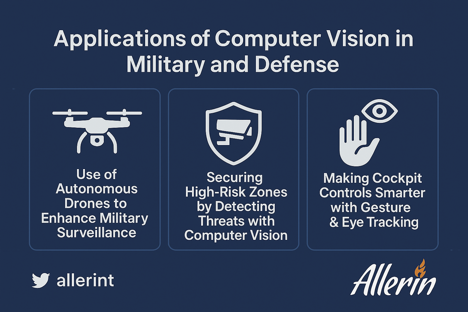
Beyond naval defense, computer vision is being integrated into various military applications.
1. Autonomous Drones Enhancing Military Surveillance
Autonomous surveillance drones powered by computer vision are changing the way the military monitors threats. They scan vast areas, identify potential threats, and deliver real-time intelligence through advanced image recognition and motion tracking. With high-resolution cameras and infrared sensors, they operate day and night across forests, oceans, and cities, giving defense teams a faster, clearer view of their surroundings.
As drones capture live video, AI analyzes each frame, detecting unusual activity based on movement, object shapes, and heat signatures. Computer vision libraries like OpenCV help them track objects, navigate complex environments, and identify potential threats quickly. If they spot something suspicious—like an unauthorized vehicle or unusual movement—they flag it and send detailed alerts to command centers. With precise location data, defense teams can respond swiftly and prevent risks from escalating. Even in tough conditions, these drones provide critical insights that enhance security and emergency response.
Additionally, these drones use thermal imaging to detect heat differences, spotting people, vehicles, or hidden objects even in darkness or bad weather. AI analyzes heat patterns to distinguish normal from suspicious activity. For search and rescue, they scan for body heat to locate missing persons quickly. In security operations, they identify concealed threats like hidden weapons or camouflaged intruders by detecting unusual heat signatures.
A strong example of this technology is Audril Industrie’s Bolt and Bolt-M drones. The Bolt handles surveillance, intelligence gathering, and search-and-rescue, while the Bolt-M is built for munitions delivery. Both use AI to coordinate with other systems, completing tasks efficiently with minimal human control, allowing military teams to focus on strategy.
2. Securing High-Risk Zones by Detecting Threats with Computer Vision
Military bases, airports, and critical infrastructure require continuous monitoring to prevent unauthorized access and security breaches. Traditional surveillance has its limitations, but AI-powered vision systems provide a smarter, more adaptive approach.
Using deep learning models like Convolutional Neural Networks, these systems break down video feeds into patterns and features, allowing them to recognize threats more accurately. Smart motion detection makes security more reliable by differentiating normal activity—like authorized staff passing through checkpoints—from real threats, such as someone trying to sneak in. Computer vision embedded with ML can reduce false alarms by 88%, helping security teams focus on real risks. In border surveillance, thermal cameras and radar track movement in real-time, accurately identifying whether it’s a person, vehicle, or animal.
Additionally, object detection models add another layer of security by recognizing unattended bags, hidden weapons, or unauthorized individuals. Thermal and infrared imaging enhance accuracy by detecting unusual heat patterns, even in poor visibility. When a threat is detected, the system instantly alerts security teams with location details and images. By detecting threats early, this technology plays a key role in protecting military bases and other sensitive locations.
3. Making Cockpit Controls Smarter with Gesture and Eye Tracking
Flying a plane is already complex enough, having to juggle with countless buttons and touchscreens. This is where computer vision steps in to help military pilots. Gesture and eye-tracking technologies are now making cockpit interactions more seamless, helping pilots focus on flying rather than manually handling numerous switches and screens. For example, Airbus Defense and Space has successfully tested gesture-based controls for fighter jets, allowing pilots to operate systems with just a wave of the hand.
At the core of this technology are depth-sensing cameras, such as stereo vision cameras or Time-of-Flight (ToF) sensors, which capture real-time 3D images of the pilot’s hands. These images are then processed using deep learning models like CNNs and RNNs, which classify gestures based on predefined patterns. Skeleton tracking algorithms further refine the process by mapping hand and finger positions, and distinguishing between gestures like swiping, pinching, or pointing.
Additionally, gesture recognition combined with eye-tracking, like in the PEGGASUS project, helps pilots by giving real-time feedback on their actions. Eye-tracking technology monitors where the pilot is looking, while gesture recognition detects hand movements. When combined, the system ensures that a pilot’s gestures align with their actions. For example, if a pilot reaches for a virtual switch but their gaze is elsewhere, the system can provide visual or audio cues to confirm or correct the action. This reduces errors, improves reaction time, and enhances situational awareness, especially in high-pressure scenarios.
As threats advance, so does the need for smarter defense. Computer vision is no longer just a tool—it’s changing the way warfighters operate, making missions safer and more effective. From AI-powered drones to real-time threat detection, these systems give military teams faster intelligence and greater control in high-risk situations.
Looking ahead, the future of defense will be even more connected. AI-driven vision systems will work alongside technologies like augmented reality and edge AI, helping pilots control systems with gestures, soldiers gain instant battlefield insights, and commanders make quicker, data-backed decisions.
With AI handling high-risk and repetitive tasks, warfighters can focus on strategy and mission success. It’s about strengthening, ensuring faster responses, better security, and a stronger defense for the future.