
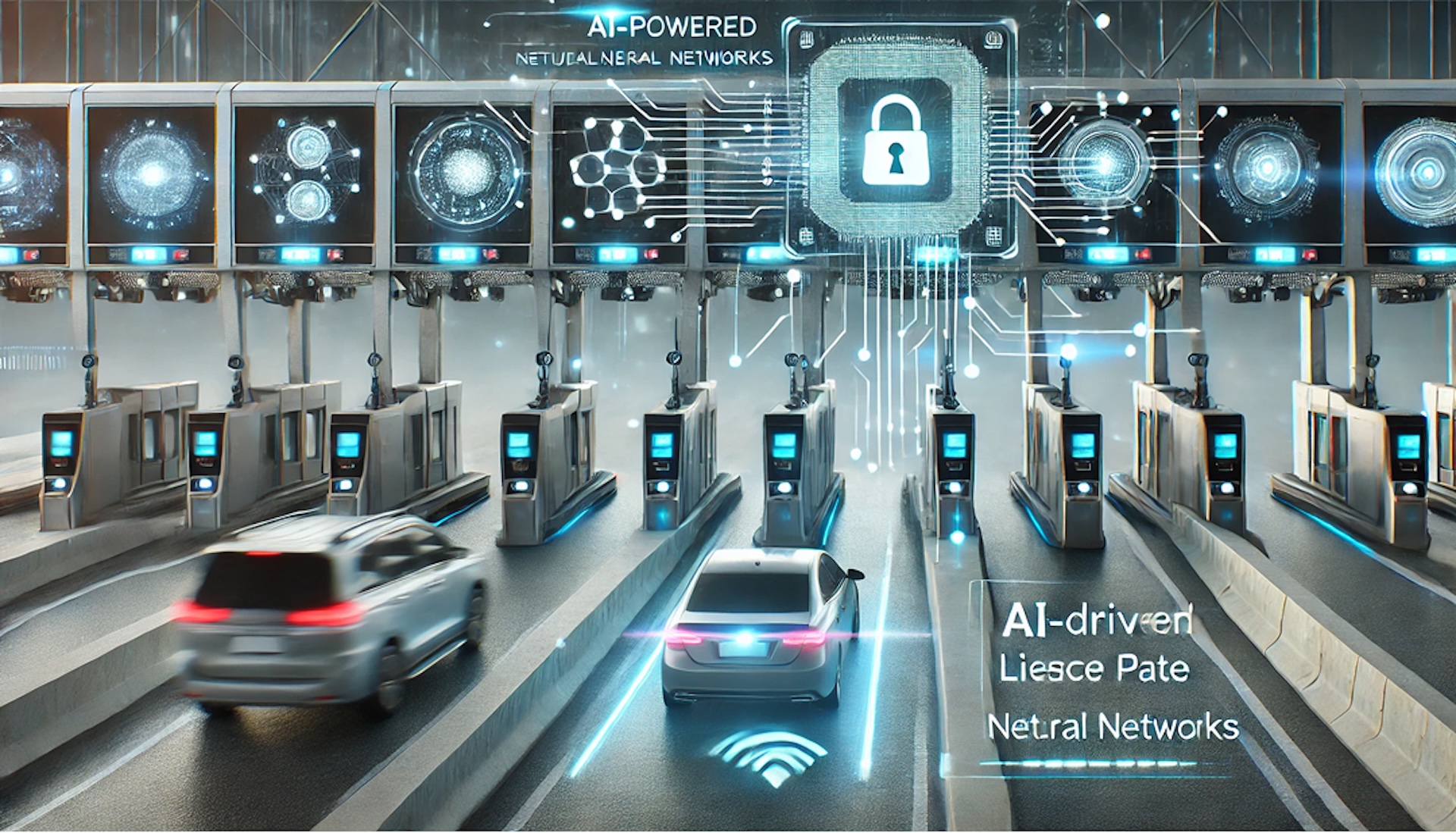
 Toll agencies across the country face persistent challenges with revenue loss and inefficiencies. In the US alone, toll authorities lose around $2.24 billion every year due to issues like unreadable license plates, incorrect billing, unpaid invoices, and confusing payment systems. These inefficiencies are worsened by outdated technology and manual payment collection practices, which again limits the adoption of modern solutions that could actually streamline operations and enhance revenue assurance.
To overcome these challenges, toll agencies are increasingly exploring innovative strategies to improve operational efficiency, and one such promising technology is CNN, a powerful AI system that is great at identifying patterns and recognizing objects in visual data.
CNNs Explained: How They Work and What They Do
A Convolutional Neural Network (CNN) is an AI system inspired by the way the human brain’s visual cortex interprets and processes images. Just as the brain processes visual information from our eyes, recognizing shapes, patterns, and objects to help us understand our surroundings, a CNN analyzes images by detecting patterns and features at multiple levels.
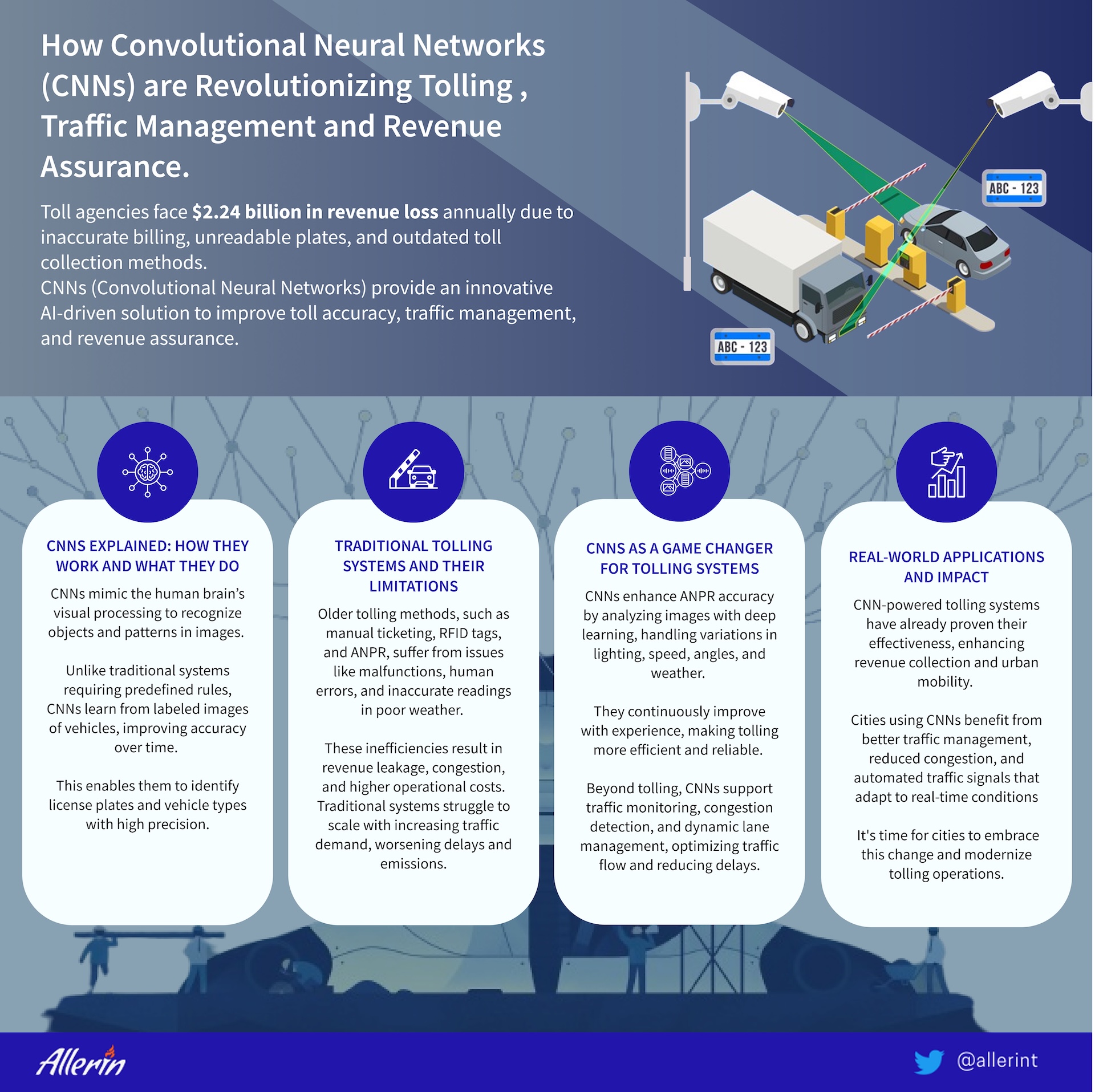
Just like the brain’s neurons work together to interpret what we see, a CNN uses layers of artificial neurons to break down an image and identify key elements, such as edges, textures, and shapes. With traditional programming, you’d need to create a detailed set of rules for each vehicle type—defining shapes, sizes, and specific features—a time-consuming and often impractical task. CNNs here can simplify the process by learning from examples. By being exposed to thousands of labelled images of cars, trucks, and other vehicles, as well as non-vehicle objects, CNNs gradually identify and understand patterns. They start by detecting basic features like edges and curves, then combine these to recognize complex shapes like wheels or windshields. Over time, this builds the ability to identify full vehicle types with impressive accuracy.
Traditional Tolling Systems and Their Limitations
Traditional tolling systems have long relied on methods like manual ticketing, RFID tags, and Automatic Number Plate Recognition (ANPR) to process tolls and identify vehicles. While these systems have worked fine in some cases, they come with significant limitations. For example, RFID tags can malfunction, manual toll collection is slow and prone to human error, and ANPR struggles with accuracy in poor weather or when license plates are obscured. This often leads to incorrect toll charges, missed revenue, and unnecessary inefficiencies.
The real challenge for toll agencies, however, has always been revenue leakage and the high administrative costs of managing these issues. On top of that, traditional systems struggle to scale with the ever-growing volume of traffic, leading to bottlenecks at toll booths, long wait times, and frustrated drivers. Manual payment methods, where toll collectors interact directly with drivers, further contribute to congestion, increased emissions, and opportunities for errors or unauthorized payments. All of these inefficiencies make it clear that traditional tolling systems are not equipped to meet the demands of modern traffic management, leaving toll agencies grappling with both operational and financial challenges.
CNN as a Game Changer for Tolling Systems
CNNs are truly a game changer for tolling systems, especially when applied to Automatic Number Plate Recognition. Traditional ANPR systems often rely on basic image processing, which can struggle in poor conditions like bad lighting or fast-moving vehicles. But CNNs take this to the next level by using deep learning, allowing them to analyze images in a much more advanced way. They can spot patterns in the data and learn from them, which means that they can identify license plates with far greater accuracy, even when plates are partially blocked or vehicles are speeding by.
Apart from that, CNNs can handle variations in fonts, weather conditions, and angles, drastically reducing the chances of misreads and making toll-collection systems more reliable and efficient. With time, as CNNs learn from a vast number of images, they continue to improve, adapting to new situations and providing a level of precision that traditional ANPR systems simply can’t match. This ability to keep learning is essential for keeping tolling operations efficient and ensuring accurate revenue collection.
However, CNNs don’t stop there—they also play a major role in wider traffic management solutions. By analyzing video feeds from traffic cameras, CNNs help monitor traffic flow and detect congestion in real-time. They can also give us important insights into vehicle density and movement patterns, allowing cities to respond quickly to changing traffic conditions.
CNNs also are used for dynamic lane management, detecting incidents, and even automating traffic signals. This means cities can optimize traffic flow by adjusting signal timings based on the number of vehicles on the road, ultimately reducing wait times at intersections and helping drivers get where they need to go more efficiently.
Real-world examples have already shown the power of CNNs in action. Pilot projects have highlighted how CNN-powered systems can improve traffic management by providing valuable insights into vehicle behavior and helping to optimize traffic signals based on what’s happening in real-time. In short, using CNN technology in tolling systems does more than just improve revenue collection—it also plays a big part in creating smarter, more efficient traffic management solutions. This dual benefit makes this technology a key player in building more advanced urban transportation networks, tackling challenges like urban mobility and revenue assurance while boosting overall system reliability and efficiency.
As we move toward smarter cities and more efficient transportation systems, embracing advanced technologies like CNNs is no longer a choice but a necessity. The challenges toll agencies face—long queues, missed revenue, and inefficiencies—can be solved with the power of AI and deep learning. If you’re in charge of traffic management or toll operations, it’s time to rethink traditional methods and invest in innovative solutions that not only enhance revenue assurance but also make our daily commutes smoother. Don’t let outdated systems hold you back. It’s time for cities to embrace the change and step into a future where convenience and efficiency seamlessly coexist!