
 License Plate Recognition (LPR) technology has transformed how public security systems operate. For key sectors such as city infrastructure, law enforcement, and transportation, it replaced manual tasks like visually inspecting license plates and entering data with automated processes powered by Optical Character Recognition (OCR). This shift brought efficiency and scalability to vehicle tracking and management. Today, 93% of US police departments in cities with populations over one million use this technology.
But citizens now expect increasingly seamless experiences. Moreover, in cases of serious incidents, they also need reliable protection. As cities grow, a crucial question arises: Is continued reliance on OCR-based LPR technology becoming too costly? And can cities, law enforcement, and enterprises harness it to work faster, better, and smarter?
This question becomes even more pressing as rising inefficiencies and hidden costs stand at odds with the government’s increasing focus on maximizing efficiency.
The Hidden Costs of OCR-based License Plate Recognition Systems
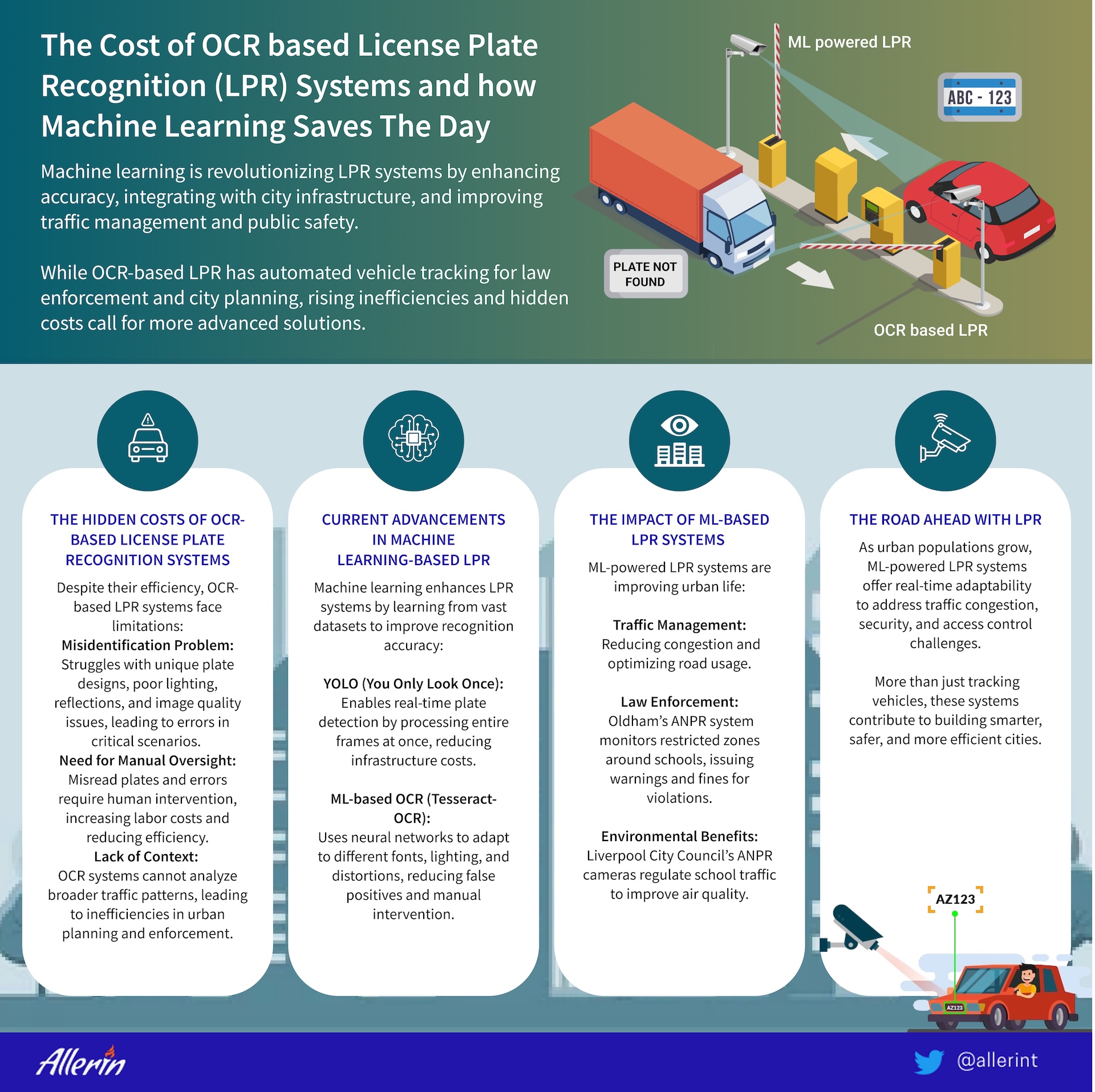
OCR-based LPR (License Plate Recognition) systems are designed to streamline the process of reading vehicle plates quickly and efficiently. They do this by capturing the text of a license plate and try to match it with a database. However, despite their apparent simplicity and around 80%-90% accuracy, these systems falter in multiple ways.
The Misidentification Problem
In real-world conditions, many variables can impact the effectiveness of OCR. For instance, they struggle with handling unique or irregular license plate designs, such as those featuring custom graphics, unusual fonts, or plates with complex symbols that do not match with the given database. Factors like low-quality images, obscured plates, reflections, and varying lighting conditions can trigger a ‘miss-location’ problem. This is because these systems run on fixed rules and templates, which make it difficult to work on variations in plate fonts, lighting conditions, and image quality.
As a result, the system may either misidentify the plate number or fail to recognize it altogether. This can have dire consequences in critical applications like law enforcement.
Imagine a scenario where a vehicle is moving at high speed during the night. The license plate may be poorly lit, or there could be reflections from streetlights or headlights, obscuring part of the plate. In this case, the OCR system might struggle to capture the full plate number accurately. It could result in either a missed reading or a false positive where the system mistakenly identifies a legitimate vehicle as stolen. On the flip side, it fails to flag a stolen vehicle, allowing it to continue undetected.
The Need for Manual Oversight
The system may seem fast, but it still requires manual intervention to ensure accurate plate readings. Issues like misread plates, long toll booth queues, or errors at automated checkpoints cause delays that impact thousands daily. These setbacks drive up labor costs and slow processing, undermining the efficiency the system was meant to deliver. As a result, the need for manual oversight and validation can diminish the benefits of automation and lead to avoidable expenses.
Lack of Context
Additionally, OCR-based LPR systems have a fundamental limitation: they cannot interpret the context or relationships between data points. This becomes a challenge when integrating license plate data with broader traffic management systems for more complex applications.
Wasted public time and resources are costly. For frontline sectors like city infrastructure, law enforcement, and transportation, inefficiencies not only drive up costs but also cause public frustration and erode trust.
This is where Machine Learning comes into the picture. (or a video)
Current Advancements in Machine Learning-based LPR
Machine learning empowers License Plate Recognition (LPR) systems by enabling them to learn from vast datasets of plate images. ML-driven models like YOLO and Tesseract-OCR with deep learning enhancements enable dynamic adaptation, improving detection and recognition accuracy.
YOLO
YOLO (You Only Look Once), an AI-based object detection model, brings real-time processing to plate detection. Unlike older systems that scanned images sequentially, YOLO processes entire frames at once, making it highly efficient for real-world applications like traffic monitoring and toll systems. Moreover, since YOLO is lightweight, it can run on edge devices (e.g., cameras with built-in AI), reducing infrastructure costs.
ML-based OCR
Once the plate is detected, Tesseract-OCR, now enhanced with machine learning, improves character recognition. It no longer depends solely on predefined templates but instead adapts to new fonts, patterns, handwriting, and environmental distortions using neural networks. This significantly reduces false positives and the need for manual validation.
Through iterative training, the models learn to differentiate between characters, even under poor lighting or occlusions. Over time, they refine their accuracy by continuously learning from new data, allowing LPR systems to adapt to different license plate formats, angles, and environmental conditions. In this way by integrating machine learning, LPR systems can evolve into adaptive, efficient, and scalable solutions.
The Impact of ML-based LPR Systems
In many ways, ML based LPR systems have already started to reshape urban life. They’re becoming essential in traffic management, helping cities reduce congestion by automatically tracking vehicles, optimizing traffic flow, and offering real-time insights into road usage.
Oldham is the first council in Greater Manchester to utilize ANPR technology for enforcing traffic restrictions around school streets. The ANPR camera limits vehicle access by monitoring vehicles entering the restricted area during school drop-off and pick-up times. First-time offenders receive a warning, while repeat violations result in fines. The system allows to exempt residents, businesses, school staff, emergency vehicles, blue badge holders, and waste vehicles, provided they have valid permits.
What’s even more impressive is how these systems are leveraged to improve the quality of human lives. By integrating with other smart city technologies, LPR systems can not only read plates but also provide actionable insights that support better decision-making.
For instance, as part of the ‘School Streets’ project, the Liverpool City Council has installed ANPR cameras in several congested school neighborhoods. The aim is to improve the air quality of the neighborhood by restricting vehicle movements during specific hours of the day.
The Road Ahead with LPR
With urban areas growing rapidly and vehicles multiplying exponentially, effective traffic management and law enforcement depend on technology that can keep up with these dynamic challenges. ML-powered LPR systems provide real-time accuracy and adaptability, which is crucial as cities face evolving needs like managing overwhelming congestions, strengthening security, and improving access control in high-traffic zones and promoting safer roads.
And let’s not forget the bigger picture. ML-powered LPR is not just about cars and roads. It is about creating a better urban experience. It gives policymakers the insights to plan smarter cities, helps law enforcement keep communities safer, and even improves our daily lives by saving time and reducing frustration.
This is how we can create roads that truly become ‘the safe way’ forward.