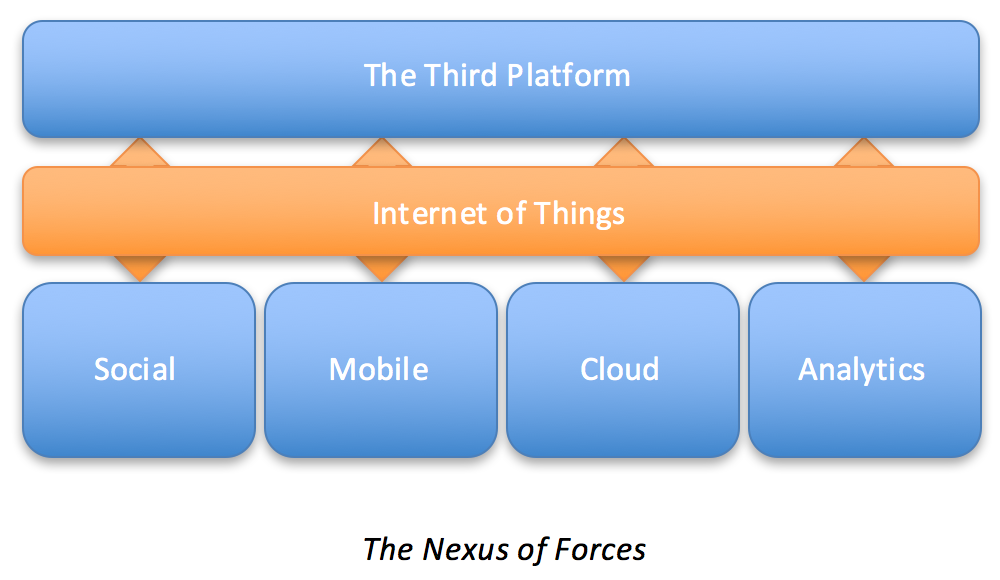
Gartner uses the term “Nexus of Forces” to describe the convergence and mutual reinforcement of social, mobility, cloud, and information patterns that drive new business scenarios.
Gartner says that, although these forces are innovative and disruptive on their own, together they are revolutionizing business and society, disrupting old business models and creating new leaders. Gartner sees the Nexus as the basis of the technology platform of the future.
The Third Platform
The third platform is defined as the inter-dependencies between mobile computing, social media, cloud computing and information/analytics (Big Data) and possibly the Internet of Things (IoT). Gartner claims that these interdependent trends are transforming the way people and businesses relate to technology.
The first platform is the mainframe computer system, which began in 1950s and continues today. The second platform is the client/server system, which began in mid-1980s with PCs tapping into mainframe databases and applications.
The four pillars
It is generally accepted that there are four pillars in the third platform, with IoT being one of the accelerators.
- Social Technology
According to Gartner, social technology is any technology that facilitates social interactions and is enabled by a communications capability, such as the Internet or a mobile device. This extends to all social technologies that make social interaction possible. Examples are social software (e.g., wikis, blogs, social networks) and communication capabilities (e.g., web conferencing) that are targeted at and enable social interactions. A VoIP service would be considered a social technology.
- Mobile Technology
Mobility gives everybody access to Big Data via mobile services. A company representative on the road or working from home will have instant access to data through his or her mobile device with the third platform whenever and wherever they need it. For example, a school that gives every student a tablet with which he or she can access a virtual classroom whenever they want to.
- Analytics (Big Data)
The concept behind big data is to maximize the utility of all data. An executive at a company that streamlines its business functions with the third platform would have easy access to all of the data, including sales figures, personnel information, accounting data, financials and so on. This data can then be used to inform more areas of the business.
- Cloud Services
The heart of the third platform lies in cloud services. Cloud services make it possible to access Big Data with mobile devices from outside the office. This differs greatly from the first platform, where computer networks consisted of large mainframes. All of a company’s employees had access to the data in the mainframe but they could only access it through their desktop computers. In the second platform, a company’s employees could access the data in the mainframe as well as outside data, via an Internet connection.
Leaders
There are many firms that have developed and are constantly enhancing the third platform. Some of them are listed below.
- 3rd Platform (IDC)
- SMAC or SMAC Stack (Cognizant)
- Idea economy (HPE)
- Nexus of forces (Gartner)
The third platform will allow all of a company’s IT solutions to be available through the cloud, accessible via a variety of mobile devices. Data storage, servers and many IT solutions, which are on-site, can then be completely cloud based.