


Many businesses now understand what AI and machine learning is. They have learned that by introducing AI in business, they can use data to make predictions and it is the fuel behind image recognition, speech processing, and other tasks that have business implications for marketing. Although the significance is clear, introducing AI in business can be a daunting task.
So how can businesses get started with AI? Here are four ways.
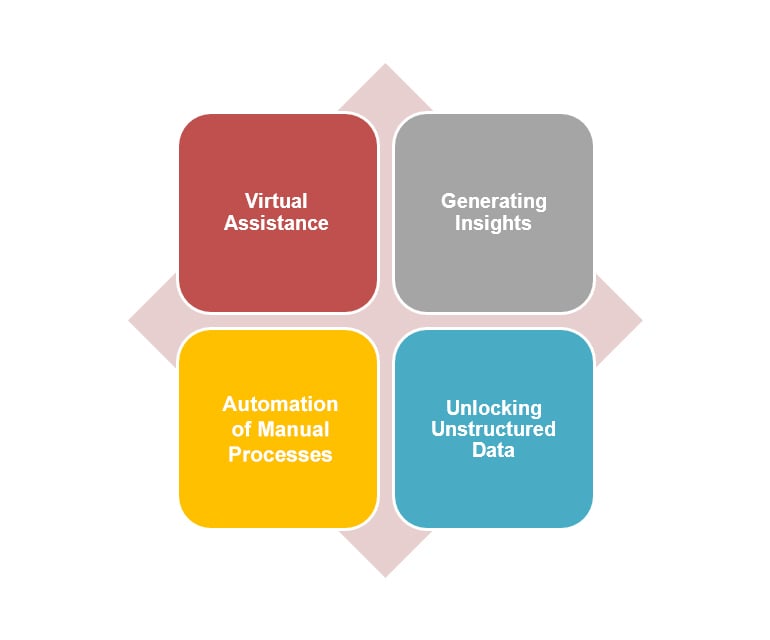
Introducing AI in Business Tip #1: Virtual Assistance
The first and simplest way to use artificial intelligence is for virtual assistance. Today many people have already had the experience of speaking into a phone and searching for answers to basic questions, such as directions to the nearest gas station. Now, companies are developing and deploying chat bots for enhancing customer service. Their aim is to blend human customer service with machine driven assistance. For example, when there is a spike in demand for customer service, like when the cable service unexpectedly goes out, an artificial intelligence service can be used for answering simple questions, for example, ‘when is the service expected to resume?’ When AI systems are deployed in this way, human customer service can actually become more response-enhanced, by allowing human agents to focus on more thorny problems.
Introducing AI in Business Tip #2: Generating Insights
Data is now being called the new oil, as it is essentially the raw material of the digital economy. Previously it used to be trapped in a vast maze of incompatible database and protocols. Now data is becoming a fungible commodity that can be accessed by new technology platforms like Hadoop and Spark. But, data can be largely useless without effective machinery to transform it into something valuable, and that is the role machine learning is beginning to play. Today’s artificial intelligence systems can not only take in billions of data points and analyze them in minutes, but they can also learn from the insights derived from that data, and get better over time. What makes artificial intelligence systems so powerful is that they have the ability to learn. This ability of AI allows these systems to adapt when market behavior changes as well as continually improves performance.
Introducing AI in Business Tip #3: Automation of Manual Processes
One of the constant issues faced by companies throughout the rise of technology is the automation of work. First, labor saving machines such as tractors and home appliances were introduced and later industrial robots and basic systems were developed for automating things like travel reservations. Today, more advanced robots are being developed using AI that can work alongside humans in factories. Artificial intelligence is now quickly automating routine cognitive processes much as industrial era machines automated physical work. For example, smart algorithms are replacing junior lawyers for legal discovery and companies are using AI systems for performing routine journalistic work, such as summarizing box scores and financial reports.
Introducing AI in Business Tip #4: Unlocking Unstructured Data
Traditionally, data that was analyzed by companies was structured data. Companies were reasonably good at deriving insights from structured data, like sales from a cash register or answers to a consumer survey. But, companies soon realized that structured data represents only a small part of the information. In fact, it has been estimated that 80% of digital data is unstructured. AI systems can be used to analyze this unstructured data. For example, an energy company that needs to lay a gas pipeline can use an AI system to know what was built there before, how has the area been used, what problems had arisen in the past and more.
Today we have access to mountains of data, but practically we have little ability to derive insights from most of it. By implementing AI, companies can develop the potential to harness this data and derive its full benefits. With AI, we are now entering a new era of cognitive collaboration in which machines are becoming far more than just agents to perform tasks, but help us to understand the world and take better decisions.