

Most of the times, organizations face difficulty when they have to decide which licensing model would be more cost-effective for them, in the present scenario as well as in the future.
Collaboration with Procurement Department
The relationship between data and analytics leaders and technology procurement leaders is meant to be an extension and not a replacement of holistic enterprise procurement strategy. The data and analytics leaders, business analysts and data scientists might not be able to understand the challenges that are associated with purchases falling out side of the organization’s procurement strategies. The technology procurement vendors, on the other hand are usually not aware of trends in the analytics markets or specific needs of business units. Therefore, it becomes important for analytics leaders to identify vendors within each LOB so they can be made into trusted advisors through recurring meetings and sharing information on market disruptions and procurement strategies.
Review licensing metrics
It is necessary that data and analytics leaders review the licensing metrics offered by the vendors in order to determine which ones are the most cost effective and in-line with the current sourcing strategies. Any new analytics software is usually purchased in small numbers of desktop or user-based license. Vendors follow a strategy that once their product is rolled out, its benefits will be observed by others. As it gets clear that the software can help fulfill requirements and increase productivity, more licenses would be purchased. Although this practice has many positives which are associated with periodically adding small numbers of licenses to fulfill demand, such as flexibility and reduction in shelf ware, there are some areas which need to be monitored.
For example, suppose the procurement department of your company follows the traditional procurement cycle and procures a software for 300 people at the list price of $300,000. The vendor gives a discount of 45%, making the total licensing cost come down to $165,000. On the other hand, if the procurement department does not follow the traditional cycle and purchases licenses in small units, the scene is bit different. They will then buy licenses according to the land-and-expand tactic used by the vendor and instead of spending $165,000, they will go on to spend more than $250,000. This is because the discount amount over successive purchases decreases.
The data and analytics leaders need to understand that most analytics vendors, who use land-and-expand sales, also offer multiple licensing metrics. They need to ask vendors to provide proposals illustrating their licensing metrics. This will help them access the costs for user-based licensing in a better way.
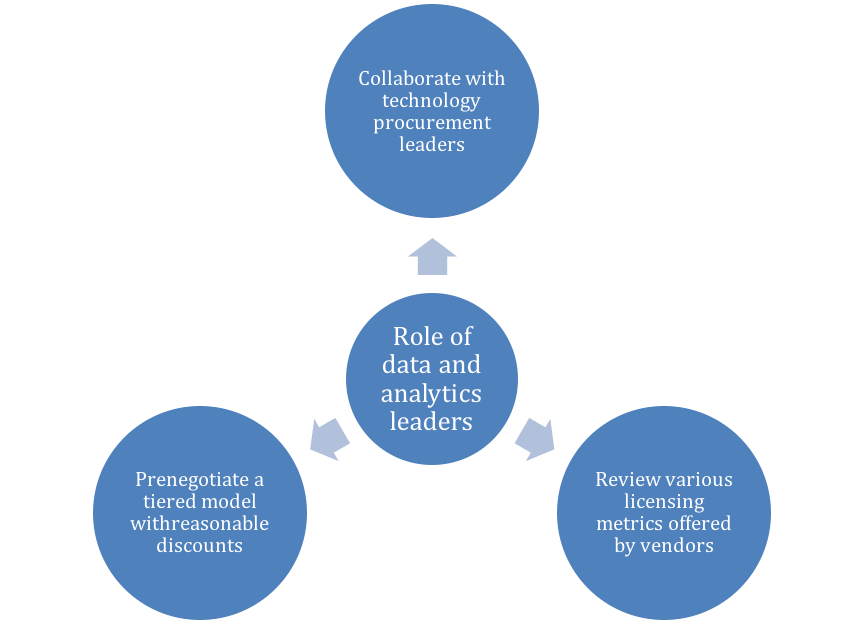
Data and analytics leaders should now learn to become enablers and not inhibitors in the eyes of business analysts and citizen data scientists who are interested in acquiring a software. They must try to become trusted advisors throughout the business and be receptive to an adaptive sourcing strategy.