

In ancient times, documents were painstakingly handwritten. The printing press in the 15th century accelerated reproduction. The 20th century saw typewriters streamline creation. And then, computers emerged, heralding word processing and introducing digitization to the world.
As digitization became more widespread, a need arose to convert all the existing paper or analog documents, right from ancient times, into digital formats. This was essential for effectively managing information and maximizing its potential. So, human resources were used to manually enter data and convert paper documents into digital formats that could be stored and accessed easily.
Well, turns out that the process, while convenient for documents of a limited size, is not efficient when dealing with large volumes of data, even with the support of Optical Character Recognition (OCR) technology. Converting physical documents into digital ones became time-consuming, prone to errors and costly as the number of documents rose.
Thus, recognizing the need for a more efficient way of converting physical documents into digital ones, businesses have started to explore how artificial intelligence (AI) can be employed to automate document processing. This is known as intelligent document processing.
What Is Intelligent Document Processing?
Simply put, intelligent document processing is the use of AI technology to process large volumes of physical documents into digital files automatically. Intelligent document processing utilizes a combination of machine learning algorithms and optical character recognition (OCR) to recognize printed text, handwriting, data tables, barcodes and other information present in documents.
In addition to converting physical documents into digital formats, intelligent document processing enables businesses to accurately extract, classify and store relevant data from documents. This not only saves time but also helps streamline the document process by eliminating manual labor and errors.
This is especially useful for organizations that need to process thousands of documents on a daily basis, such as banks and insurance companies. Furthermore, with the use of AI-based natural language processing (NLP) techniques, intelligent document processing can extract even more precise data from documents. This includes customer information such as names, addresses, phone numbers and email addresses.
Benefits of Using Intelligent Document Processing
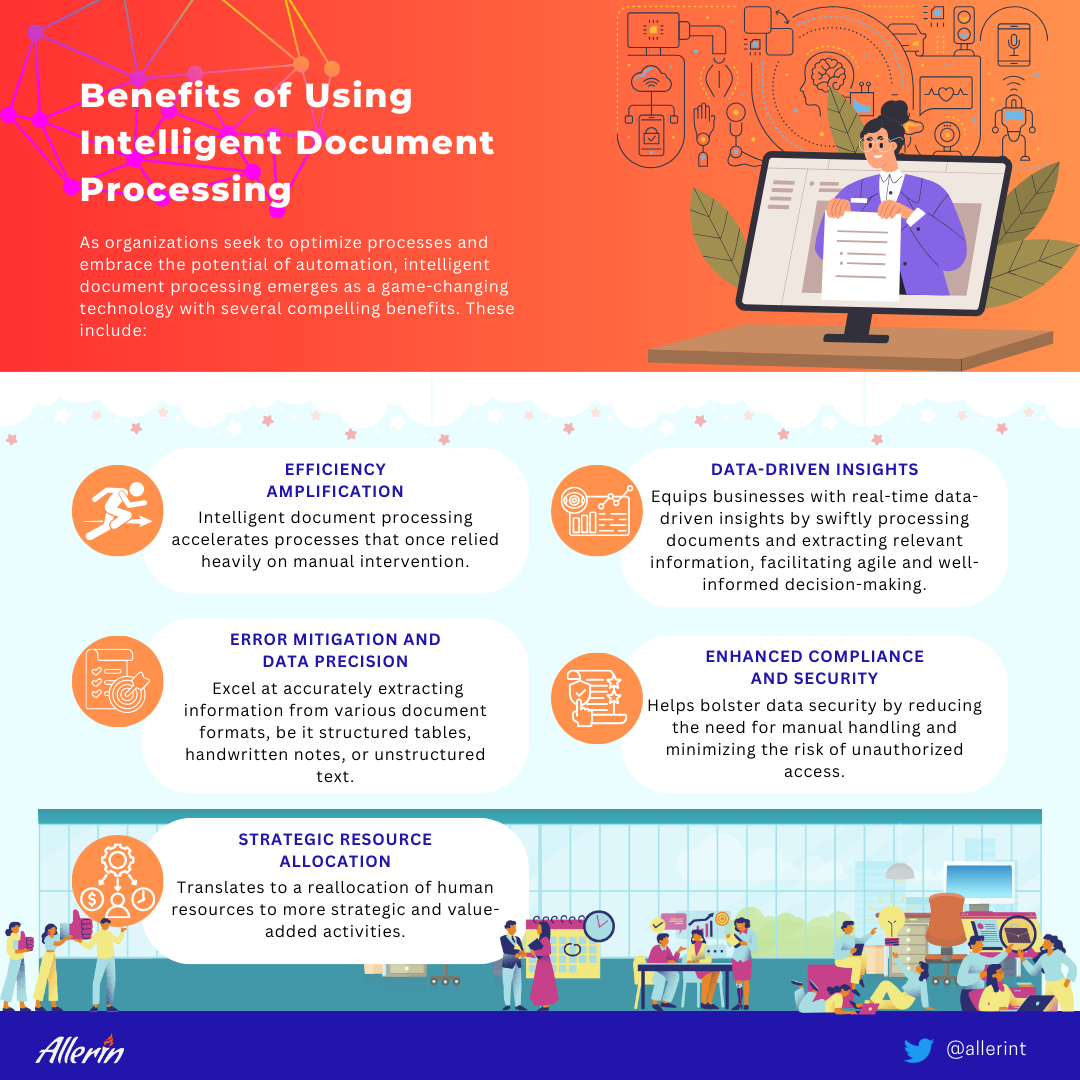
As organizations seek to optimize processes and embrace the potential of automation, intelligent document processing emerges as a game-changing technology with several compelling benefits. These include:
Efficiency Amplification
One of the primary benefits of intelligent document processing is its capacity to magnify operational efficiency. By automating repetitive and time-consuming tasks like data entry, document sorting and information extraction, intelligent document processing accelerates processes that once relied heavily on manual intervention. This results in reduced processing times, minimized bottlenecks and an overall streamlined workflow.
Error Mitigation and Data Precision
Manual data entry is prone to errors, which can lead to cascading problems throughout an organization. Intelligent document processing’s advanced algorithms excel at accurately extracting information from various document formats, be it structured tables, handwritten notes, or unstructured text. This level of precision drastically reduces data entry errors and eliminates the need for extensive manual data validation.
Strategic Resource Allocation
Intelligent document processing’s automation of routine tasks translates to a reallocation of human resources to more strategic and value-added activities. Employees can now focus on tasks that require critical thinking, creativity and problem-solving skills. This not only enhances job satisfaction but also unlocks the potential for innovation and business growth.
Data-Driven Insights
In the digital age, data is a valuable asset that drives decision-making. intelligent document processing not only extracts data efficiently but also transforms it into actionable insights. By swiftly processing documents and extracting relevant information, intelligent document processing equips businesses with real-time data-driven insights by swiftly processing documents and extracting relevant information, facilitating agile and well-informed decision-making. This is particularly crucial in industries where rapid responses can determine success, such as healthcare.
Enhanced Compliance and Security
Regulatory compliance and data security are paramount concerns for organizations across industries. Intelligent document processing plays a pivotal role in ensuring compliance by accurately processing and documenting critical information according to established guidelines. Furthermore, the automation of document management processes helps bolster data security by reducing the need for manual handling and minimizing the risk of unauthorized access.
Current State of Intelligent Document Processing
Intelligent document processing technologies are currently at the forefront of automating document-related tasks across various industries. Understanding the current state of this technology is essential in unlocking its full potential and ensuring successful implementations.
-
Document Capture
This involves scanning physical documents or ingesting digital ones into a digital format. Modern capture technologies use Optical Character Recognition (OCR) and image processing to convert physical documents into machine-readable text.
-
Data Extraction
Intelligent document processing solutions employ advanced algorithms and data extraction techniques to identify and extract specific data points from documents, such as names, dates, addresses, or numerical values.
-
Document Classification
These systems categorize documents based on predefined criteria, such as document type, content, or purpose. This classification helps in routing documents to the appropriate workflows.
-
Workflow Automation
Many intelligent document processing technologies integrate with workflow management systems to automate the flow of documents and data within an organization. This reduces manual intervention and accelerates processes.
-
Data Validation
To ensure accuracy, intelligent document processing systems often include validation mechanisms that cross-check extracted data against predefined rules or databases.
Emerging Trends in Intelligent Document Processing
As we delve deeper into the digital transformation era, exciting trends are emerging in document processing, shaping the technology’s future. These include:
- Intelligent document processing systems are increasingly incorporating deep learning models, such as convolutional neural networks (CNNs) and recurrent neural networks (RNNs), to improve the accuracy of data extraction from documents.
- Natural language processing techniques are becoming more sophisticated, allowing these systems to understand the context and semantics of documents, making them more context-aware.
- The advent of big data technologies enables the systems to process massive volumes of documents efficiently, making them suitable for large enterprises and high-demand industries.
- Cloud-based solutions are gaining traction due to their scalability, cost-effectiveness and accessibility. They offer organizations the flexibility to scale their document processing capabilities based on demand.
Future Developments in Intelligent Document Processing
As technology continues to advance, the realm of intelligent document processing is poised for transformative developments that will reshape how businesses manage and utilize their document-driven processes.
Predictive Analytics for Proactive Decision-Making
The integration of predictive analytics into IDP systems will usher in an era of proactive decision-making. By analyzing historical data and patterns, these systems can anticipate future document processing needs and potential bottlenecks. This empowers organizations to take preemptive actions, optimize workflows and allocate resources effectively.
Automation of End-to-End Document Workflows
Future IDP systems will extend beyond data extraction and incorporate end-to-end workflow automation. These autonomous systems will orchestrate the entire document journey from document receipt and classification to data extraction, validation and final processing. This not only saves time but also ensures consistency and accuracy throughout the process.
Understanding Complex Document Structures
Cognitive document processing will enable intelligent document processing systems to comprehend intricate document structures, such as contracts with varying clauses and agreements with multiple parties. By interpreting context, relationships and hierarchies within documents, these systems can accurately categorize, extract and organize information even from unstructured content.
Drawing Insights and Recommendations from Documents
Future IDP systems will evolve from mere data processors to insights generators. Through advanced natural language processing and pattern recognition, these systems will be able to extract actionable insights from documents. This could include identifying emerging trends, suggesting process optimizations, or recommending strategic decisions based on the collective content of processed documents.
Improved Language Support for Global Businesses
Multilingual support will become a hallmark of next-generation intelligent document processing solutions. These systems will not only be capable of accurately processing documents in multiple languages but also understanding cultural nuances and idiomatic expressions. This will be a game-changer for global businesses that need to handle diverse documents from around the world.
Wrapping Up
The envisioned future of intelligent document processing holds immense potential to reshape the business landscape. The fusion of hyper-automation, cognitive capabilities and multilingual support will usher in a new era of document processing where efficiency and insight converge. Organizations that embrace these developments stand to benefit from enhanced productivity, data-driven decision-making and a competitive edge in an increasingly digital world.