
 The complex and large volume of digital data that industries gather daily is poised to become the new wealth for any organization, provided the business leaders draw informative and actionable insights from it. This is where the need for a big data startegy arose. To make the most out of big data, business leaders and analysts strategize a big data architecture, which helps the organization follow a methodical approach to carry out all business operations seamlessly. Having a big data strategy helps businesses leaders ameliorate data management within their organization.
However, along with robust data management, analysts are expected to focus on accomplishing several additional responsibilities too. From monitoring employee performance to building information governance to decision science, the list of responsibilities is quite long. Therefore, simply having a big data strategy will fail to offer the right framework to accomplish all of these responsibilities. And that is why the need is to have a bimodal big data strategy in place.
How bimodal big data strategy will help
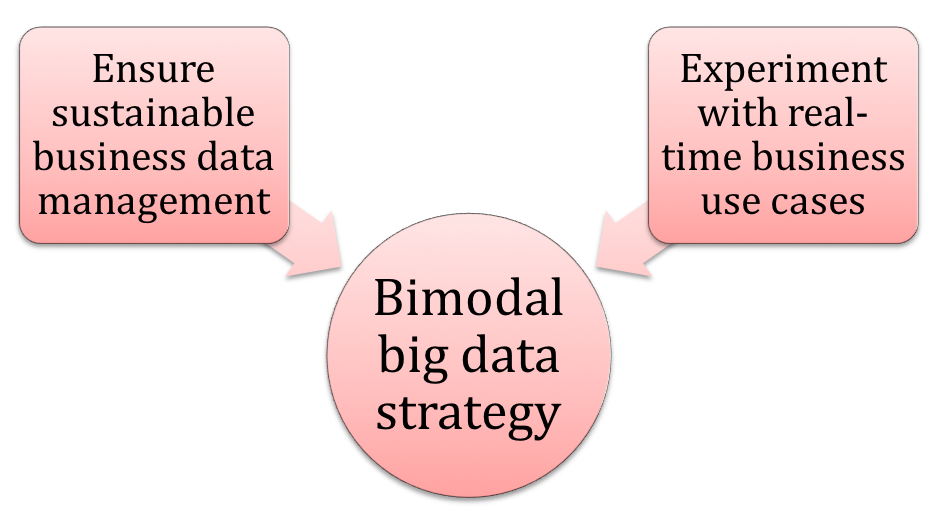
The traditional data strategy provides a restricted approach to data management. No doubt, it offers the best outcome for structured data but does not support unstructured data in varying formats. As a result, traditional data strategies limit the potential of big data in an organization, necessitating a strategy that allows the an organization to enjoy the complete potential of big data.
Having a bimodal big data strategy will help an organization employ both, traditional and experimental, approaches. The conventional method is a straightforward approach that involves the storage, use, and management of data stored in databases. The data is periodically checked for its security, accuracy, and performance. On the other hand, the experimental approach deals with continuous data coming in from multiple sources, both online and offline. Such an approach provides the oportunity to experiment with new business use cases in real-time.
When linked together, both these modes provide the correct direction to brace the data transformation happening in an organization and to attain optimal performance.
Why bimodal big data strategy is not optional anymore
The existing big data strategy contains takes care of a single aspect alone – data exploration. Such a strategy goes well for organizations that have only recently started exploring the big data technology. However, as time passes, the risk of a data breach only becomes more probable. Hence, the need for a bimodal big data strategy becomes a necessity to ensure safety, performance, compliance, and profits.
A bimodal big data strategy allows business leaders to improve the existing business operations, mitigate fraudulent activities, predict future upheavels, exploit fresh business opportunities, set new business objectives, and conduct overall business better.