

In this blog post, we will discuss the benefits of CSEM tools, its risk and evaluation factors.
I&O leaders can benefit from CSEM tools as they help in determining:
- Whether the organization has gained the appropriate services for the price paid for those services.
- The services they need against the expenses incurred, and to ascertain whether there are more efficient ways of obtaining the same required services.
- Whether the expenses incurred are being properly applied to real imperatives.
- Whether to build your own internal cloud services or buy them from an external vendor, having a deeper insight into these expenses is critical.
Let’s take a look at the risks involved in CSEM. The CSEM market poses several risks that I&O leaders must be aware of:
- Some tools are focused on the expenses that are owed to the provider. It does not include the internal and other costs required to provide the services. This masks the true cost of the service.
- Some CSEM tools can forecast future capacity requirements that can be used to pre-purchase cloud services at a discounted rate. The accuracy of these predictions is highly variable and depends on historical usage data that may not always be correct. A wrong pre-purchase decision can lead to unnecessary spending. Hence, it is important to evaluate these automatically generated recommendations.
- Many CSEM tools have the ability to cap spending by shutting down services, when a budget is exceeded. Unexpected automated actions can cause unintended consequences at times. Thus, such features should be only adopted when the organization is well aware of its spending patterns.
- Ownership of the cloud expenses and the CSEM tool may fall organizationally in a number of different places, such as with IT finance or cloud management personnel, which can create political tension.
Having seen the risks, let’s take a look at how to evaluate CSEM tools
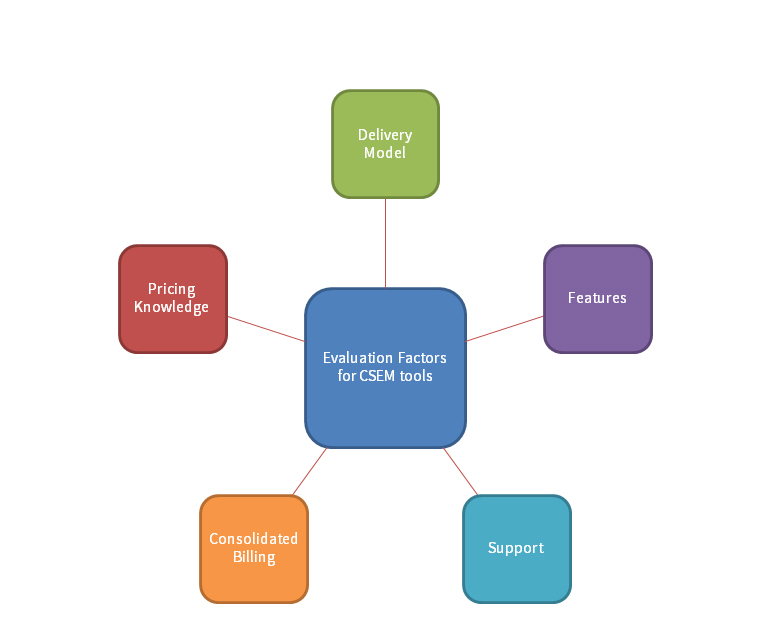
1. Delivery Model
You must first determine whether your organization prefers a SaaS or an on-premise approach.
2. Features
Different features like reporting, optimization capabilities, etc. are provided by the CSEM tools. You must decide which features are required by your business and select accordingly.
3. Support
Some CSEM tools are focused on a single cloud provider. This can prove appropriate for some organizations, but others will benefit from a single tool supporting multiple providers. For those with multiple provider support, you must check out for the tools that can integrate well into your organization.
4. Consolidated Billing
Your CSEM tool must have the ability to consolidate the billing procedure into an easy-to-understand format.
5. Pricing Knowledge
You must evaluate the tool’s ability to monitor pricing changes, CSP promotions and the expiration of discounts.
Before you select any CSEM tools, you must first work with your CMP and ITFM vendors to determine the current and future deliverables regarding cloud expense management capabilities in those tools. Also, before implementing IaaS and purchasing CSEM tools you must conduct a formal cloud expense management assessment for gaining optimum results.