
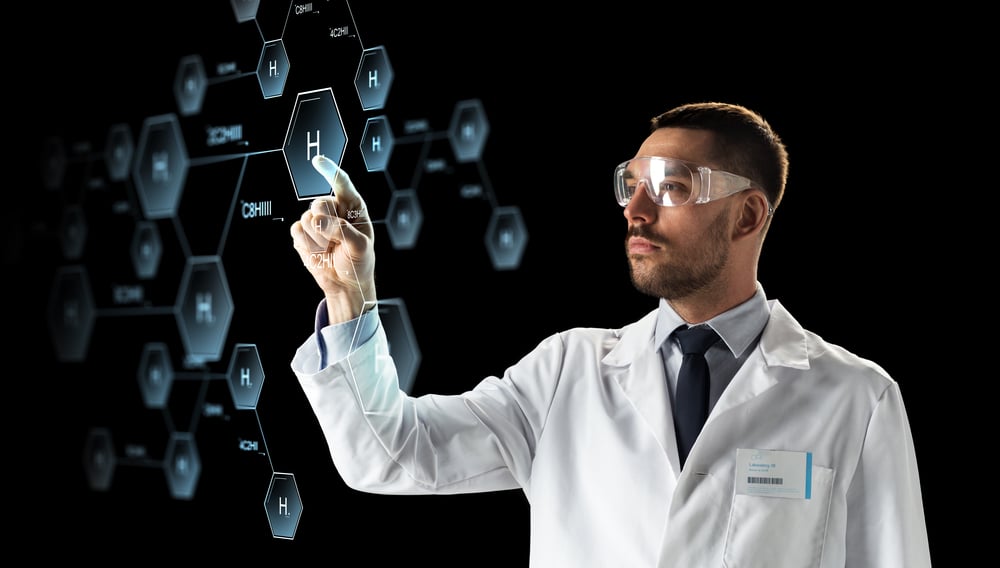
A professor at the University of Rochester conducted an experiment, wherein he used an AR platform to demonstrate before students and to make them understand the working of a chemical plant. With cameras, projectors, computers, and a glass pane, the professor transformed simple coffee mugs to 10 cubic meter reactors and popsicle sticks to pipes connecting them. With the help of AR software, the students could visualize real-life chemical reactions from within the four walls of their classroom. The chemical industry is the newest addition to this list of AR innovation. The example mentioned above, though on a small, indicates the significance of using AR in the chemical industry.
AR in the chemical industry
1. Training
AR, with the help of image and video capturing devices, overlaps the existing visuals with a programmed reality. The overlap can be used to converge real-time chemical plant environments with a programmed simulation to train and instruct new employees in the company.
It is necessary that the new employees know their job well, especially in an environment as precarious as in a chemical industry. Handling hazardous chemicals, operational settings of boilers and reactors, and dealing with varying temperature, humidity, and pressure conditions, should be demonstrated in real-time to the new staff. AR technology can help with such demonstrations. By programming the reactions and the chemical operations on AR software, industries can execute training sessions through AR handsets or tablets, which will run the appropriate videos by detecting the plant in its view.
2. Assembly
Another application of AR is the assemblage of complex machinery, plants, and reactors in the industry. Heavy machinery is usually a one-time investment and needs careful handling. Most of the heavy machines are exclusive to a single process or type of industry. For such machines, gaining an insight into the assembly arrangement is important. Wearable AR devices that offer instructions on the assemblage of chemical plants can be employed in chemical industries to help workers gain a better understanding of how equipment work.
3. Maintenance
Equipment used in the highly industrial sectors requires heavy maintenance. Relying on an expert technician for every minor fault or defect in a chemical plant is uneconomical. Besides, this can also lead to unnecessary delays in the manufacturing processes, if the technical support is not available immediately. To avoid such situations, chemical plants can invest in AR-enabled systems that offer DIY tutorials and videos to fix minor issues without expert aid.
It is quite evident that the AR technology is altering the way we visualize and interact with the operations and management aspect in any business unit. Improving the precision and accuracy of the underlying infrastructure and algorithms can further refine most of the AR applications, still in the trial phase.