
Decentralized AI is relatively a new concept that has gained a lot of attention for quite some time now. Not many are even aware of the term. For them, we will first explain what exactly decentralized AI is and why the need for it had arisen.
Not very long ago, we dreamt about machines behaving exactly like humans. Sci-fi movies encouraged our shackles of such imagination. And AI turned our sci-fi fantasies and thoughts into reality. Taking today’s scenario, we see several AI applications even in our day-to-day activities, that have become an inherent part of our life now. It’s pretty cool how virtual assistants help us make calls, schedule appointments, order foods, and do so much more. Through social media information, AI determines our preferences, interests, and demands, bombarding us with relevant ads. Likewise, it’s so surprising how Netflix gauges our movie choice and sends us recommendations on the same. And how much do we know about the background process happening behind these scenarios? Little. Or very little, to be more precise. And why is this so? That’s because of centralized platforms and the involvement of only big players. AI is increasingly shadowing our every move, trying to know us better each day. In the long run, as AI becomes more powerful, it can turn out to be dangerous too. We will not know who will consume our content and where it will be used.
From training AI models to its implementation, the systems or solutions rely on a single entity that functions under the assurance of people, ruling the data resources altogether. The rich entities get access to quality and relevant data. These companies hire skilled data science professionals with big fat salary packages. With the help of these experts, the companies then build AI models that influence commoners’ lives in myriad ways. That’s what is happening today. Centralized AI solutions offer a disproportionate data transparency level for different companies. For example, it is obvious that Google or Facebook will have more data and knowledge about their users than any other medium-sized company. Taking all these into consideration, one of the best solutions is to move towards a new frontier – decentralized AI, perhaps.
Advantages of decentralized AI
The concept of decentralized AI is pretty simple and straightforward. Let’s put it down in simpler words. Imagine there is a data set, that has no central authority or owner ruling or governing it. No specific owner drills down to a statement – anyone can use or access the data set. The dataset can be used by anyone (participants) to train AI systems. Plus, everyone involved in the project will be accountable for keeping the data accurate and clean.
Now, let’s check the advantages that we can encounter if decentralized AI goes mainstream.
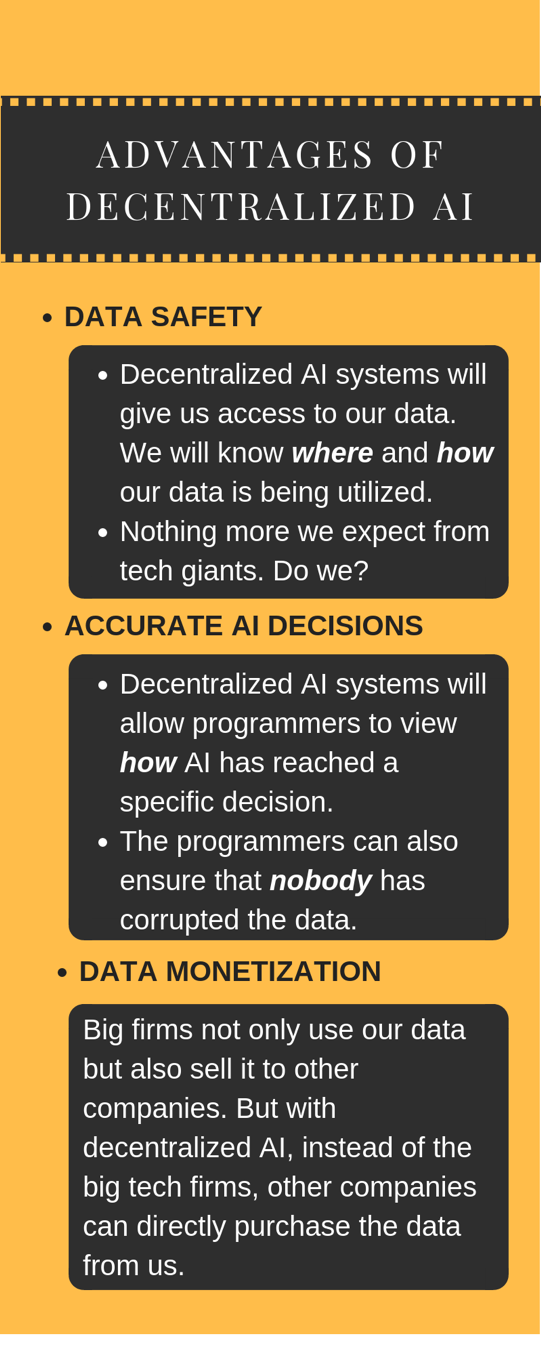
- Data safety – AI thrives on data, our data. More the data, more accurate and robust AI tools function. With the help of the inputted data, AI tries to look into our lives secretly without us even knowing about its moves, most of the times. Basically, as and when AI tools get our data, it improves itself. But, do we really want to share our data? Isn’t our data being compromised on privacy? Actually, it depends. Take, for example, Youtube, Netflix, or Spotify recommends us after determining our preferences. And we hardly care about these tech guys using our data, in this case. But now consider, what if fintech players checks our bank profile, or what if Facebook uses our photos? Would we like to give them access to our such sensitive data? Obviously, no. Now, let’s take the case of decentralized AIs. The data will be stored on the blockchain, and AI can access it only after going through the required procedures. Not a single company will have the entire power of our sensitive data. Now, that’s a winning situation for us, right? Nothing more we expect from tech giants when our data is already at safer hands. Do we?
- Accurate AI decisions – AI learns from data, and it improves with time. With AI getting more and more smarter and taking decisions on its own, there will be time when data scientist team (who had build AI models) don’t understand how the AI system approached to a particular conclusion. On the other hand, the data scientists team will always want to audit AI’s decisions to check how accurate, efficient, and unbiased the result is. With centralized AIs, this is not possible, whereas with decentralized AIs, it is. Decentralized AI systems will allow the programmers to view how AI has reached a specific decision. Right from data input to a conclusion, every single step can be viewed and assessed. Plus in this entire process, the programmers can ensure that nobody has corrupted the data. This will potentially solve the problem of the ‘black box’ that lies at the heart of AI. Transparency will increase if decentralized AIs becomes a reality.
- Data monetization – Did you know that our data is being consumed by big tech companies, and these organizations then sell our data to some other companies? This makes a good revenue sources for tech giants. And we, being the true owner of the data, are not even aware of this. But with decentralized AI, we can keep track of where our data is being utilized. And instead of the big tech firms selling our data to others (in an immoral or unsecured manner, maybe), those organizations can directly purchase from us.
Concerns with decentralized AI
Beyond the obvious deployment and technical hurdles, there are concerns with decentralized AI that should be addressed first, we feel
- Sometimes, there might arise situations where companies would want to purchase data from you for a specific purpose, but you might not want your data to be used for that purpose. What will be your decision in this situation?
- We mentioned earlier, AI models will be transparent to all the companies. But can we be 100% sure about this?
- Can these AI systems be appropriately shared and executed independently across thousands of millions of computers (nodes) or even more?
Well to be frank, as the term decentralized AI is new, there is no potential discovery or invention happened yet. Though we see a lot of attention from intellectuals, no pilot projects are happening yet. At one side, there are well-known personalities like Elon Musk, talking about threats that AI could possess, and on the other hand, we have concerns and challenges with a newly studied solution, decentralized AI.
However, decentralized AI will give revolutionary results; the only thing is we will have to consider the concerns and hurdles before-hand. And to achieve this, thorough planning is utmost important. Through regular experiments and testing, professionals can identify the best approach to bring the concept of decentralized AI into the limelight. How far decentralized AI will progress is of anyone’s guess, as of now. Let’s wait for a potential disruption to happen at this space.