There is no doubt that we are ‘wired to the wireless networks’ around us. Invisible cables running all around us transport our messages and bring information to us in no time. From the analog first generation (1G) technology, which hauled data at 2.4 Kbps to the current fourth-generation technology (4G) that nearly approaches 50 Mbps of upload and download speed, the communication technology has come a long way.
However, the technology around us is transforming. Enhanced mobility, collaborative processes, and faster access to information are changing the way we work and get work done. The data speed, however, obtained from the existing networks is struggling to keep up with the accelerated needs. Against such a backdrop, the dawn of the 5G era is expected not just to overcome the speed deficiency, but also elevate the quality of all existing services for man and machine.
With data speeds that can theoretically go up to 10 times that of the 4G networks, the fifth-generation network has already started making its mark in the industry and the society. The network has the potential to offer new use cases for customers and enhanced operations in enterprises. Thus, the 5G network is bound to revolutionize all value chain sectors of the economy that employ communication standards in any form. Having said that, the day is not far when we will witness a complete 5G transformation of industry and society.
5G transformation of industry and society
The 5G network is seen as one massive network that will cover the entire planet with waves of less than a millimeter in size. The network’s architecture is designed to carry data from one place to another with a delay of less than one millisecond. Advancement of this type in communication benefits not only personal networks but also reinforces industrial system synchronization.
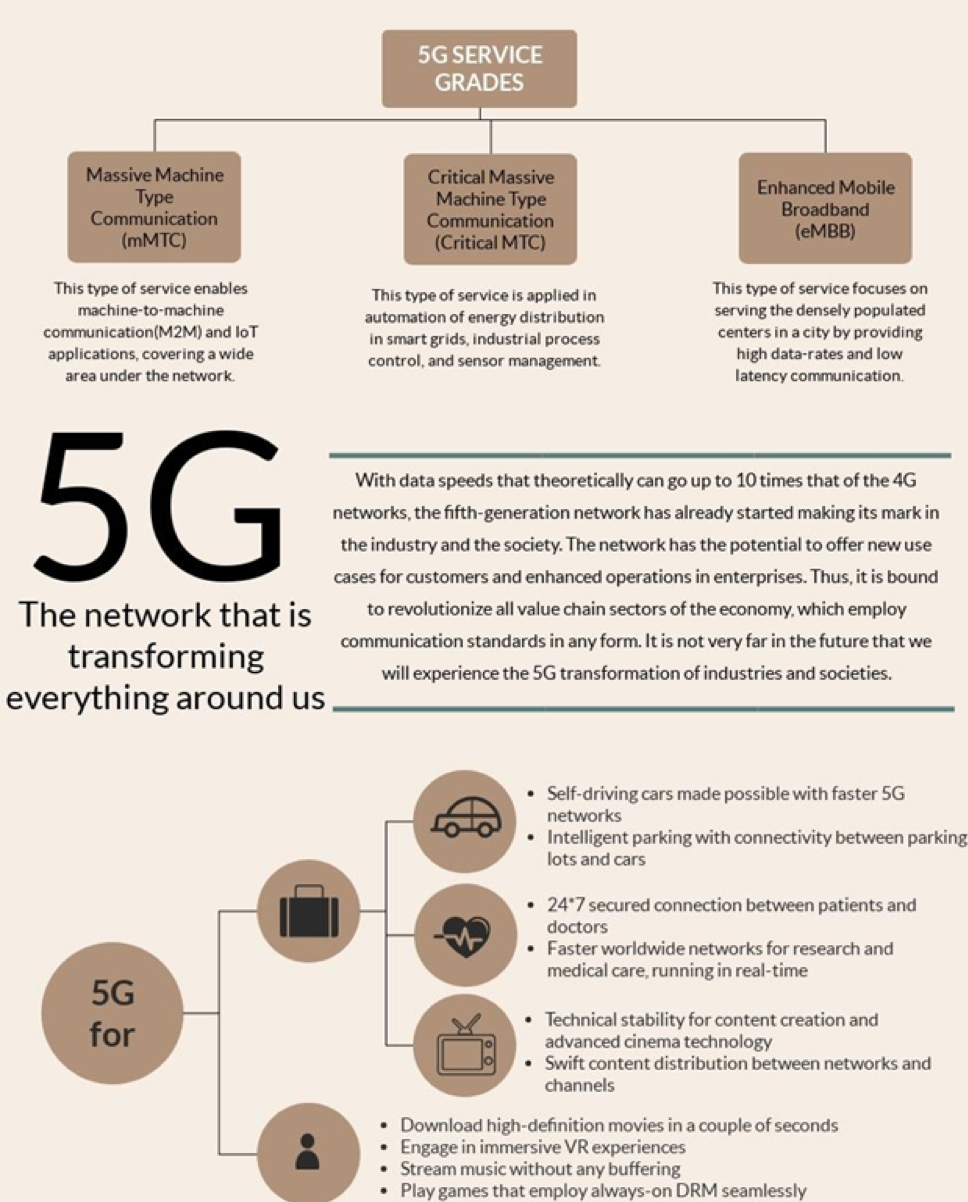
A major advantage of 5G networks over the 4G and other networks before is the customization it provides to its customers. Designers who created the 4G network proposed a single architecture to be used for both people and companies. The 5G network, however, takes into consideration the varying requirements of individuals and organizations. Keeping this distinction in mind, the 5G service can be classified into 3 essential service grades with distinct objectives and expectations from the network.
Massive Machine Type Communication (mMTC)
This type of communication is also known as Massive IoT. It enables machine-to-machine communication (M2M) and IoT applications, covering a wide area under the network, and allowing access to hundreds of thousands of devices per square kilometer of coverage. The examples of services that require this category of the 5G network include:
- monitoring and automation of infrastructure,
- smart agriculture,
- logistics, tracking, and
- fleet management.
Critical Massive Machine Type Communication (Critical MTC)
This type of application is also called Critical IoT or Ultra Reliable and Low Latency Communication (URLLC). While the bandwidth requirements are not very stringent, the latency required here is extremely low, and reliability is a must. The technology is applied in the:
- automation of energy distribution in smart grids,
- industrial process control, and
- sensor management.
Enhanced Mobile Broadband (eMBB)
This application focuses on serving the densely populated centers in a city. It is designed to provide high data-rates and low latency communication. Connectivity and bandwidth uniformly cover the area of operation. However, the capacity is limited, and the performance degrades if the number of users on the network increases.
5G services in personal life
One of the most striking features of the 5G network in personal life is the blazing data speed it offers. We are talking of speeds above 10 GB per second! This speed gives us the power to:
- download high-definition movies in a couple of seconds,
- engage in immersive VR experiences,
- stream music without any buffering, and
- play games that employ always-on DRM seamlessly.
The 5G network is built on an architecture that offers increased bandwidth to all its users. This means that all users on the network get more room for accessing the communication channel. So, users can say hello to faster loading progress bars on their web pages and goodbye to latency delays. The bandwidth also facilitates blistering Internet speed, allowing a user to stream videos or download music without overloading the channel.
Increased bandwidth also means smart devices are running faster without any disruption. The 5G network comes with an improvised architecture, designed to cover up the drawbacks of the existing networks. This means that communication via a 5G network will foster agility and consistency in mobile communication. Enhanced mobile overhauling and sturdy protocols for cellular handover will retain the channel between the base station and the cell site despite changing positions between the cell and the mobile tower. All these factors will elevate communication standards and systems to build better networks for the user.
5G network will also give rise to newer devices empowered with an architecture that will enable parallel processing and heterogeneous services. Facilities available on laptops or computers will be adopted in building smarter phones. VR technology will be extended to phones, opening new doors of opportunity and flexibility for smartphones.
5G services in the enterprise sector
According to a report by Qualcomm, by 2035 there will be around $12 trillion 5G based services in the commercial sector. Sectors like the automobile industry, health care services, and the media and entertainment domains, will heavily benefit from the implementation of 5G services in their operations.
5G services in the automobile industry
5G America, the wireless trade group, publishes a white paper in March 2018, announcing the implementation of autonomous cars with the emergence of 5G. Although many car companies have successfully manufactured self-driving cars, scientists say that the current 4G network is not fast enough to share the ride details and update routes while in transit. With the groundbreaking speed that 5G network would offer, sharing real-time traffic and route updates really fast would become possible. The network is also expected to improve parking systems with intelligent parking lots. A connection between the cars and the parking lots will give an insight into whether parking is available or not, thus reducing parking problems and avoiding the implementation of no-parking zones effectively.
5G services in the healthcare industry
According to a study by Qualcomm, the advent of 5G network in the healthcare sector will enable services amounting to almost $1 trillion. Connectivity that comes with the 5G network would facilitate a 24*7 secured connection between doctors and patients. Simple remote sensing devices with messaging applications will allow for the real-time transmission of a patient’s vital stats to the care providers, in no time. Doctors, in turn, can use the facility to suggest and prescribe appropriate medication to patients, especially in times of exigency. Clubbing this technology with big data further helps in the medical sector by maintaining a record of the data that can be used for medical research.
5G services in the entertainment industry
5G networks are expected to do wonders in the field of media and entertainment in the coming years. The Ericsson Mobility report predicts that by 2022 there will be over 550 million 5G subscriptions accessing the media. For media production companies, the 5G network would ensure technical stability in content creation and development. The architecture of the network is immune to minor network fluctuations, unlike the existing networks, ensuring reliable and swift content distribution between the network and a channel.
A man has always been looking for evolution and advancement in everything that makes its life easy. And we’re sure that there will be a future where the 5G network will fall short of meeting the demands of its users. Till then, however, the 5G era is almost here, all set to revolutionize our personal and professional lives.