

A line from Dante Alighieri’s famous work, Inferno, says,
“The darkest places in hell are reserved for those who maintain their neutrality in times of moral crisis.”
The words emphasize the importance of having an opinion, either for or against something. No wonder the entire world took a stand during the digital dilemma of adopting net neutrality. It may sound ostentatious, comparing the fate of net neutrality to something as serious as a moral crisis. However, considering our dependence on the Internet and the power that it bestows upon us, the question of neutrality does stand in comparison to the moral crisis Dante referred to.
The net neutrality debate has been on for a while now. People using the Internet services favored neutrality. People providing the Internet services, however, had a different story to tell. While the view that stood strong out in public was in favor of the neutrality, there is also a flip side to the debate and pretty strong one too, that sponsors for an anti-net neutrality view.
The issue of net neutrality
Net neutrality, in simple terms, is Obamacare for the Internet; or at least that’s how the American politician, Ted Cruz, referred to the net neutrality rules as proposed by the Obama administration. According to the theory, all Internet service providers must treat all Internet traffic equally. It means that service providers cannot change the prices, quality of the content, access rights, or the speed of access for the Internet service you invest in. The rules also extend to the Internet users and require the service providers to maintain neutrality despite the person using the services, the website owned by an individual, and the online activities (as long as they are legal) a user engages in.
For the net neutrality debate
This side of the debate brings out the convenience of implementing net neutrality across the world. The privilege of accessing the entire Web, a boost to the innovative processes, and the freedom from unreasonable limits placed on a user’s online activity are some of the attractive reasons that people across the world said a yes to net neutrality.
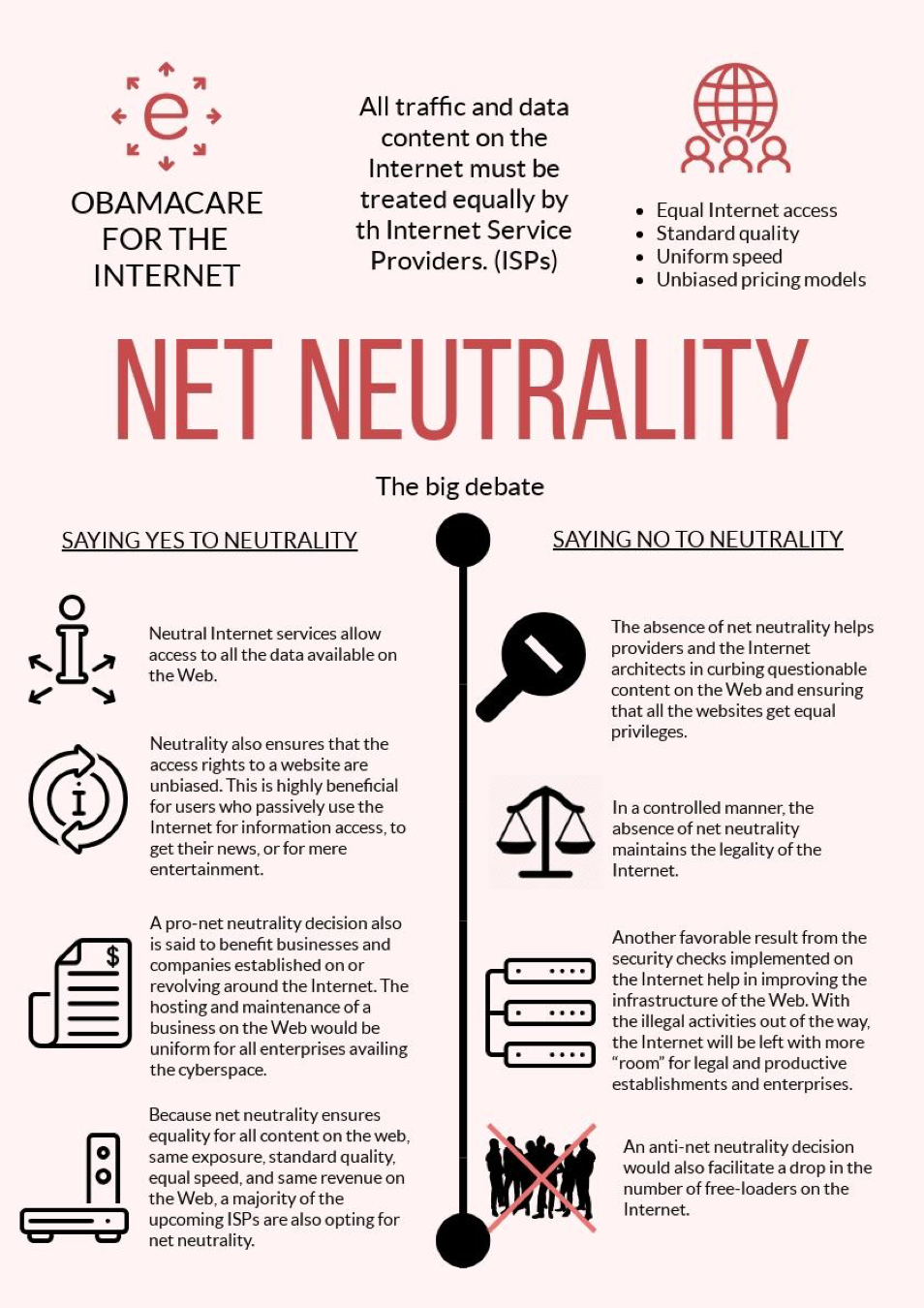
The common man, using the Internet in one way or the other, stood in favor of the net neutrality. Neutral Internet services allow access to all the data available on the Web. Be it Wikipedia, a well-known platform for information, or some not so famous YouTube channel, users are required to pay the same amount of money to access both of these sites. The popularity and the traffic on a website do not influence the quality and the speed of accessing the site. Neutrality also ensures that the access rights to a website are unbiased. This is highly beneficial for users who passively use the Internet for information access, to get news or for sheer entertainment. With standard and uniform rates, users get an all-access pass for all the content and services provided on the Web.
A pro-net neutrality decision is also expected to benefit businesses and companies established on or revolving around the Internet. The hosting and maintenance of a business on the Web would be uniform for all enterprises availing the cyberspace. Thus, a blogger who earns her living through the Internet gets the same privileges as Internet giants like Instagram or Pinterest get. Because net neutrality ensures equality for all content on the web, a blogger experiences the same exposure, standard quality, equal speed, and same revenue on the Web as other websites.
Majority of the upcoming ISPs also opted for net neutrality. This is because, there are limited options for a user to choose from when it comes to service providers. This limited supply in a highly demanding market result in a large entry barrier for the new ISPs. A high entry barrier in the form of a competition against the existing service providers and hosting the websites via their servers would make the establishment of a new ISP expensive and difficult. Google Fiber, an initiate by the mighty Google, for providing high-speed Internet and TV services also failed while trying to catch up with the existing ISPs in America. Thus, implementing net neutrality would boost innovation and open up new opportunities for businesses.