


Information today is undoubtedly the most important fuel that businesses run on. Millions of social media posts, intellectual property such as patents, consumer insights by way of analyzing a myriad of online transactions, etc. are just a few examples of the information assets that companies are leveraging today. However, with this prolific rise in data, the growing risks that surround the digital information are skyrocketing too. It’s time to give information governance the respect it deserves.
What is information governance?
Information governance is a holistic approach to the management of corporate information. This approach involves the implementation of multi-disciplinary structures, processes, metrics, control frameworks, policies and procedures at an enterprise level to manage information. Information governance supports an organization’s immediate, as well as future, legal, regulatory, risk, operational, and environmental requirements, making organizations more agile in response to a changing marketplace.
Information governance aims to provide employees with information that they can easily trust and access when making important business decisions. Information governance also delivers reduced storage cost, streamlines management of information assets, and enables regulatory compliance. This is why, in many organizations, the responsibilities for information governance are split among storage, security, and database teams.
What happens as information governance and big data come together?
The characteristics of big data – its “four Vs” of velocity, volume, variety, and variability – bring big challenges to the world of information governance. Corporations and their IT and legal departments are having to develop new policies and processes that can govern what data should be kept, for how long, and how best to manage it. The challenge lies in the economical handling of data at such extreme scales as big data. This is why the three primary stakeholders in information governance – business users, the IT department, and legal department – need to look at and handle big data in different lights.
How does information governance support big data?
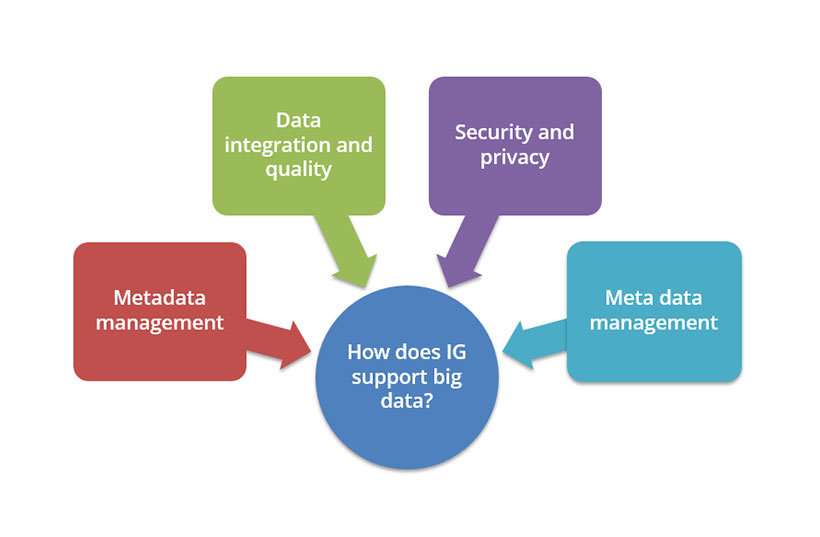
There are a quite a few areas where information governance for big data is critical. Some of these areas include metadata management, data integration and quality, security and privacy, and master data management.
Metadata management
While on the one hand there is a virtual avalanche of available information, on the other, only a negligible part of it is used in analytics. This is because most of this data is not tagged. With proper tagging, the addition of context, and implementation of information governance processes, a wealth of the available metadata can be used.
Data integration and quality
A successful big data project demands data that’s integrated and can be trusted. Information governance helps maintain the quality of data by providing data that fits the purpose. With information governance, your business can establish its data quality metrics to uncover quality issues and create remediation plans.
Security and privacy
A growing concern with big data projects is security and maintenance of privacy. Moreover, big data impacts security and privacy in several ways, such as legal, ethical, moral, competitive, and political. There is a growing recognition that information governance helps understand the different safety and privacy considerations that arise with big data, and manages in getting value out of it.
Master data management
Master data includes core information, such as information about customers, suppliers, employees, products, partners, accounts, and so on, that support critical business processes across the enterprise. Information governance helps extract insights from such data in context beyond what was previously possible.
Companies must, therefore, understand that while big data and the intelligence it delivers are great for your business, information governance is an aspect that needs to be embraced in parallel to avoid any potential sanctions and unnecessary costs.