Everywhere you turn, there is talk about AI taking over: writing emails, diagnosing diseases, doing things we once believed only people could do. With this wave of automation, it is easy to start thinking instinct, experience, and human judgment might soon be pushed aside.
That belief misses something essential. Machines are brilliant at spotting patterns in data, but they cannot feel empathy, catch a trembling voice, or see the hesitation behind someone’s eyes. In courtrooms, those subtle emotional cues matter. They help us understand not just what happened, but why it matters to the people involved. That kind of deep, human understanding is not something you can hand to a machine. It needs a person. A mind that can sit with complexity.
That is exactly why, in the justice system, AI should not take over what humans do. It should help us do it better. Used thoughtfully, AI can make it easier to work through complex information, catch things we might miss, and speed up routine work. But it should always be a helping hand, not the one making the final call. Because real understanding, especially when people’s lives are at stake, still needs a human.
So how can humans and AI work side by side in the courtroom?
Case management and triage support
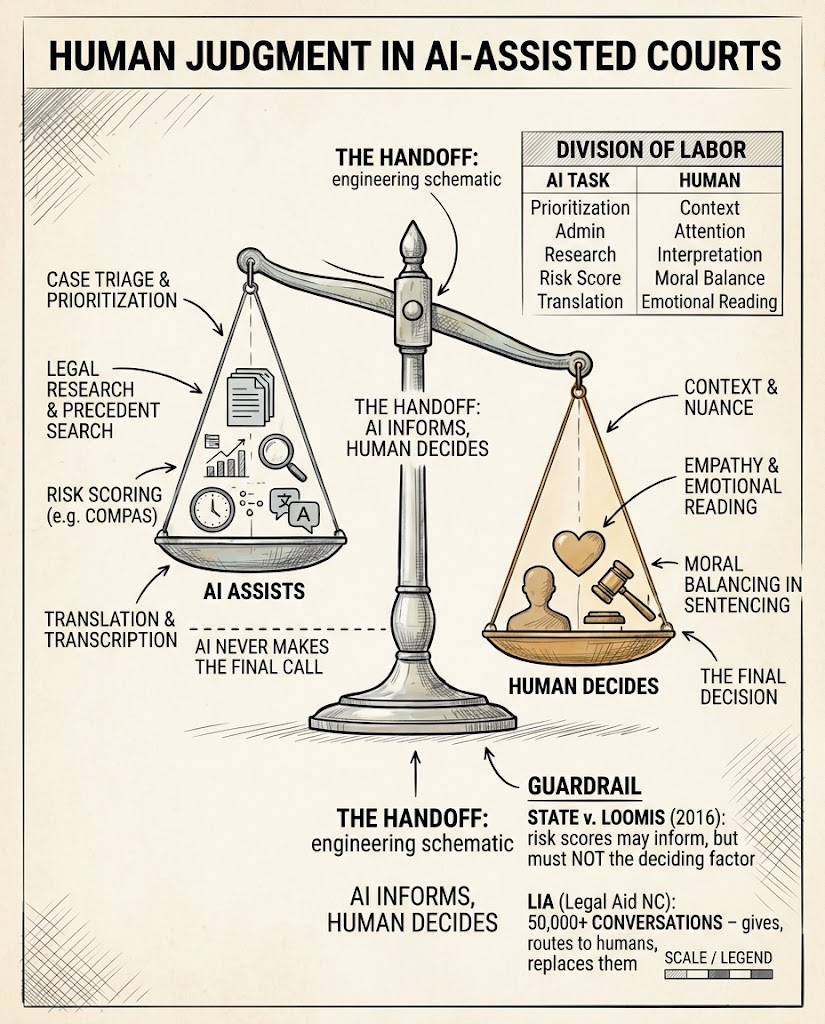
AI can improve the efficiency of court systems by helping prioritize cases by urgency or complexity. With large volumes of cases handled daily, AI can review the details of each one, such as the severity of the charges, time sensitivity, or legal complexity, and assign a priority level. That helps judges spend their time on the most critical matters instead of getting bogged down in less urgent ones. AI can also take on time-consuming administrative tasks like sorting legal documents, organizing case files, and scheduling hearings, freeing judges, lawyers, and court staff to focus on complex analysis and decisions.
Legal research and precedent identification
Legal research can feel overwhelming, with countless case files and statutes to review. AI helps by quickly scanning large volumes of data and surfacing relevant precedents that might otherwise take hours to find. Even so, the heart of the decision still rests with a human. AI can point to useful references, but it is the judge who brings an understanding of the case’s unique context, the emotions involved, and the specific circumstances. In complex cases, or those without clear answers, human judgment is what ensures the law is applied fairly, with compassion and wisdom.
Sentencing with data-driven insight
Sentencing forces judges to balance factors that are hard to quantify: the offender’s personal history, their remorse, the impact on the victim, the possibility of rehabilitation. AI can help by analyzing data to assess the risk of reoffending and flag patterns. Tools like COMPAS (Correctional Offender Management Profiling for Alternative Sanctions) weigh factors such as criminal history, age, and prior offenses to produce a risk score that can inform decisions about parole or community alternatives.
The limits of that approach are already settled law. In the 2016 case State v. Loomis, the Wisconsin Supreme Court allowed COMPAS scores to be used in sentencing but warned judges not to treat them as the deciding factor, citing concerns about the tool’s proprietary methods and its reliance on group data rather than the individual. That caution is the whole point. A score does not capture the offender’s emotional state or their capacity to change. Even with AI’s help, it is the judge’s responsibility to make sure the sentence is fair, compassionate, and true to the situation.
Improving accessibility with human sensitivity
AI can widen access by offering real-time translation and transcription, helping non-native speakers and people with hearing impairments follow proceedings as they happen. That makes legal processes more inclusive and reduces misunderstandings from language barriers. But while AI captures and translates words accurately, it cannot grasp the full meaning behind them. Tone, pauses, and gestures often carry emotional or cultural weight that only a human can interpret. That is where the judge’s role matters: to read between the lines, understand intent, and make sure every voice is not just heard but understood.
Public engagement and access to legal information
For many people, approaching the legal system feels intimidating. AI-powered virtual assistants and chatbots can ease that first step by answering common questions in plain language, like what documents a case needs, how to file them, or what to expect at a hearing. Legal Aid of North Carolina shows how this works in practice. Its assistant, LIA (Legal Information Assistant), launched in 2024 and now in a 2025 voice-enabled version, answers common civil-legal questions in English and Spanish across areas like domestic violence, child custody, and landlord-tenant disputes, then points people to the right resources. In its first year it handled more than 50,000 conversations. Notably, LIA is built to give legal information, not legal advice, and it routes people toward human help rather than standing in for it.
That design choice matters. When a situation is more complex, involving emotional stress, personal disputes, or serious legal consequences, a human becomes essential. A lawyer offers more than information. They bring empathy, ask thoughtful questions, and help someone feel seen. They know that behind every case is a person with a story, and they tailor their advice accordingly. AI can help people take the first step, but it is the human who guides them through the rest with care.
Justice needs both: the power of AI and the human mind
| AI’s role | Human judgment |
|---|---|
| Case prioritization | Context evaluation |
| Admin automation | Individual attention |
| Legal research | Nuanced interpretation |
| Precedent identification | Compassionate application |
| Sentencing suggestions | Moral balancing |
| Risk assessment | Personal insight |
| Translation support | Emotional reading |
AI can make the judicial process more efficient and help us see patterns we might otherwise miss, but it can never replace the human touch that is so vital in the courtroom. Judges bring more than legal knowledge. They bring empathy, understanding, and the ability to navigate the complexities of human emotion. That combination of technology and humanity is what keeps justice not just fair, but thoughtful and compassionate. Used well, AI and human judgment together can build a justice system that is both smart and deeply human. That balance, AI for efficiency and humans for judgment, is the same principle we bring to every public-sector AI program we help design.
Sources: Legal Aid of North Carolina: LIA launch (2024) · LIA 2.0 (2025)