
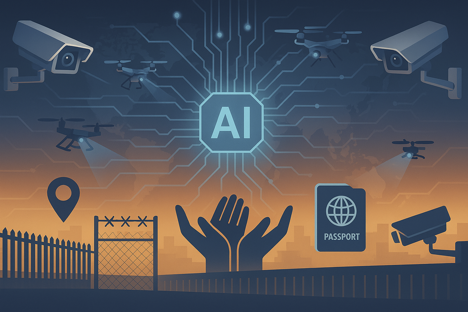
Border security has once again taken center stage in U.S. politics, emerging as one of the most debated issues in the recent presidential elections. The scale of the challenge is staggering—over 5,500 miles of land borders, thousands more along the coast, and an ever-growing influx of people, vehicles, and shipments crossing daily. While existing systems play a role in enforcement, they are struggling to keep up with the evolving landscape of border security. Human patrols, physical barriers, and outdated surveillance technologies simply aren’t cutting it.
Customs and border control officers face an immense responsibility—identifying threats, verifying documentation, and enforcing regulations, all while ensuring the smooth flow of legitimate trade and travel. It’s a delicate balancing act, and in an era of sophisticated smuggling networks, cyber threats, and political pressure, relying on traditional methods is no longer enough.
Here is where one of the most advanced digital technologies comes in—Computer Vision. Although it isn’t a magic fix, it is a huge step forward in making border security and customs control more efficient, accurate, and scalable. It allows officers to work smarter, not harder, focusing on real threats instead of wasting time on inefficient manual processes. Of course, there are still challenges, privacy concerns, cybersecurity risks, and ethical issues but if used responsibly, AI-powered border security could make a big difference in keeping countries safe while keeping trade and travel moving.
Challenges to Overcome
One big issue is gaps in coverage. Traditional border security relies heavily on fixed checkpoints, cameras, and patrols, but smugglers and illegal crossings don’t happen in predictable places. There are vast stretches of remote land where people can sneak in without detection.
On top of that, human resources are stretched thin, border agents can’t be everywhere at once, and manually watching hours of surveillance footage isn’t the most effective use of their time.
Then there’s the issue of technology lagging behind. Many border security systems are reactive rather than proactive; they detect breaches after they happen, rather than preventing them. Smugglers are getting smarter, using drones, tunnels, and even AI-driven methods to bypass traditional security measures. And let’s not forget political and budget constraints, which make large-scale improvements slow and complicated.
How Computer Vision Can Change the Game
This is where computer vision comes in as a game-changer. Unlike traditional surveillance, which relies on human monitoring, AI-powered cameras, drones, thermal imaging, and smart sensors can provide 24/7, real-time detection across vast areas.
Another huge advantage? Computer vision eliminates single points of system failure. Right now, if a guard station is understaffed or a surveillance tower goes down, it creates a weak spot. But an AI-powered system is decentralized—multiple drones, cameras, and sensors working together mean that if one fails, others can pick up the slack. Plus, AI doesn’t get tired, distracted, or miss subtle details the way humans do.
Automating Border Patrol
Imagine drones patrolling remote areas, automatically identifying unusual activity like groups moving at night or vehicles stopping in suspicious locations. Or smart cameras at checkpoints that scan vehicles for hidden compartments in seconds, reducing wait times while improving security. Instead of border patrol agents reviewing hours of footage, AI can flag only the moments that matter, so officers can focus on actual threats.
Of course, no technology is perfect. Ethical concerns, privacy issues, and cybersecurity risks have to be managed carefully. But if used responsibly, computer vision can make border security faster, smarter, and more efficient and help agents focus on what matters most while closing the gaps that are exploited.
AI-powered cameras and drones can monitor vast areas in real time, spotting unusual activity without human bias. Smart sensors can detect movement, differentiate between people, animals, and vehicles, and even predict patterns of illegal crossings. Facial recognition and license plate tracking can speed up legal processing at checkpoints, reducing wait times while enhancing security. Plus, automating surveillance can free up border agents to focus on more critical tasks rather than spending hours scanning footage or patrolling remote areas.
Computer vision gives unmanned vehicles “eyes” and intelligence, allowing them to detect, track, and respond to threats at borders and customs checkpoints. This reduces human workload, improves efficiency, and enhances security.
Smart Drones for Aerial Surveillance
Drones are already being used for border monitoring, but computer vision makes them much more than just flying cameras. With real-time image analysis, they can:
- Detect unauthorized crossings by spotting humans, vehicles, or boats in restricted areas.
- Identify smuggling routes by tracking movement patterns over time.
- Monitor for environmental changes like newly dug tunnels or broken fences.
For example, a computer vision-powered drone can scan desert areas and flag unusual heat signatures (like groups of people hiding) or track fast-moving vehicles that might be smuggling goods.
Ground Vehicles for Patrolling & Inspections
Unmanned autonomous ground vehicles (AGVs) can patrol borders or scan cargo areas without needing constant human control. With computer vision, these vehicles can:
- Recognize and verify license plates to check if a vehicle is authorized.
- Scan cargo containers to detect illegal substances, weapons, or even hidden people.
- Identify anomalies in border fences (like cuts, damage, or tampering).
Imagine an AGV patrolling a border fence. Instead of waiting for a human to review security footage, the computer vision system automatically detects a breach and alerts officers—saving critical response time.
Underwater & Maritime Surveillance
For coastal borders or waterways, unmanned underwater or surface drones with computer vision can:
- Track suspicious boats or submarines used for smuggling.
- Scan ships for illegal cargo hidden below deck.
- Monitor ports for unauthorized movements.
These systems analyze vessel behavior, recognizing if a boat is acting suspiciously (like circling a border area repeatedly) and flagging it for investigation.
Avoiding a Single Point of Failure
While border technologies and agents’ skills have become increasingly sophisticated, a critical aim of the new generation of interconnected border technology is to reduce the single point of failure problem.
A potential threat could slip past an airport checkpoint, evading detection by an overworked security officer. But with AI-powered facial recognition and sensor systems, real-time data can flag the individual as a known risk, instantly alerting multiple security points. Before they reach the gate, agents are already in position to intervene—stopping the threat before it escalates.
Integration with Alert Systems
At the core of any computer vision system is real-time object detection. Advanced AI models (like YOLO, Faster R-CNN, or SSD) analyze video feeds from cameras, drones, or X-ray scanners and classify objects based on pre-trained datasets. So, if a camera spots an unrecognized vehicle, a group of people moving in restricted areas, or a package with unusual density, the system flags it instantly. When abnormalities are found, the computer vision system can be connected to alarm systems to send out notifications. This makes it possible for security staff to look at any threats more quickly.
Instead of bombarding security teams with every little alert, AI can prioritize incidents based on severity. The system can even auto-generate reports, summarizing when and what was detected in a timely format.
Watching the eGates
eGates, or automated border control gates, are revolutionizing how people move through international borders. Instead of waiting in long lines for a manual passport check, travelers can use self-service kiosks that scan passports, verify identities, and grant entry within seconds. eGates are already proving themselves for border control, but computer vision is what makes them truly smart. Without it, these automated gates would just be fancy doors that scan passports. With computer vision, eGates can verify, compare your face with the photo stored in your passport’s biometric chip, and adapt to new fraud techniques by analyzing previous border breaches and enhancing security all while speeding up the border clearance process.
While there are still concerns around privacy and false positives, there’s no denying that computer vision is shaping the future of smarter, safer border control.
How Computer Vision is Transforming Customs Control
Customs control plays a crucial role in regulating trade, ensuring security, and preventing illegal activities at borders. However, traditional customs inspections are prone to human error. With the rapid increase in global trade and travel, manual inspections alone aren’t enough to handle the sheer volume of goods and passengers moving across borders.
One of the biggest challenges customs officers face is efficiently screening shipments and travelers without causing long delays. Computer vision-powered X-ray and scanning systems can analyze cargo images in real time, automatically detecting hidden contraband, weapons, or counterfeit goods without the need for manual inspections. This not only speeds up the process but also reduces the risk of human oversight, ensuring that even the smallest irregularities don’t go unnoticed.
Another critical issue is identity verification and fraud prevention. Airports and border checkpoints now use computer vision-powered facial recognition to cross-check travelers’ faces with passport photos and law enforcement databases. This significantly reduces the chances of fake passports, identity fraud, or overstayed visas going undetected, while also speeding up the immigration process for legitimate travelers.
Smuggling and document fraud have always been major concerns in customs enforcement. Computer vision technology can analyze shipping documents and match them with the actual cargo, flagging inconsistencies that might indicate illegal activity. It can also track vehicle license plates and shipping containers, making it easier to identify high-risk shipments based on past records and suspicious travel patterns.
What the Future Holds
As technology advances, computer vision will become even more powerful in detecting and preventing illegal trade activities. Future customs systems may use AI-powered risk prediction models, which analyze trade routes, historical data, and suspicious behavior to identify high-risk shipments before they even reach customs checkpoints. This would allow authorities to focus inspections on the most likely threats, rather than randomly screening shipments. Additionally, blockchain technology could be integrated with computer vision to create a tamper-proof record of goods, ensuring transparency and authenticity throughout the supply chain.
Computer vision is reshaping customs control by automating inspections, improving accuracy, and reducing security risks. With AI-driven advancements, customs agencies will be able to process shipments and travelers more efficiently while staying ahead of smugglers and fraudsters. As technology takes center stage in border security, the conversation may shift—from heated political debates to swift, data-driven action. But with algorithms making more decisions, one question remains: Will automation bring real security or just the illusion of control?