
 What if you could plan your city infrastructure and make daily decisions using geographic information systems (GIS), remote sensing satellite and aerial imagery, and public engagement tools to better understand the current and future community needs? These technologies can provide invaluable insights to administrators, but they need a bridge between raw, real-time data and actionable decisions. That bridge is computer vision—a transformative tool that extracts, interprets, and contextualizes visual information at unprecedented speed and scale.
The real-time analysis capabilities of computer vision help create a living, breathing digital model of your city. It allows you to identify patterns, predict potential bottlenecks and anticipate areas in need of improvement, all with unprecedented speed and precision.
What Computer Vision Is
On the surface, computer vision is quite human-like. It enables computers to interpret and understand visual information by capturing images or video feeds from cameras, drones, satellites, or other sensors placed throughout an environment. These visual inputs are then processed using algorithms that detect patterns, objects, or specific features (like faces, vehicles, or roads). Once the data is processed, computer vision algorithms analyze the patterns and use machine learning models to make predictions or detect anomalies for real-time decision making.
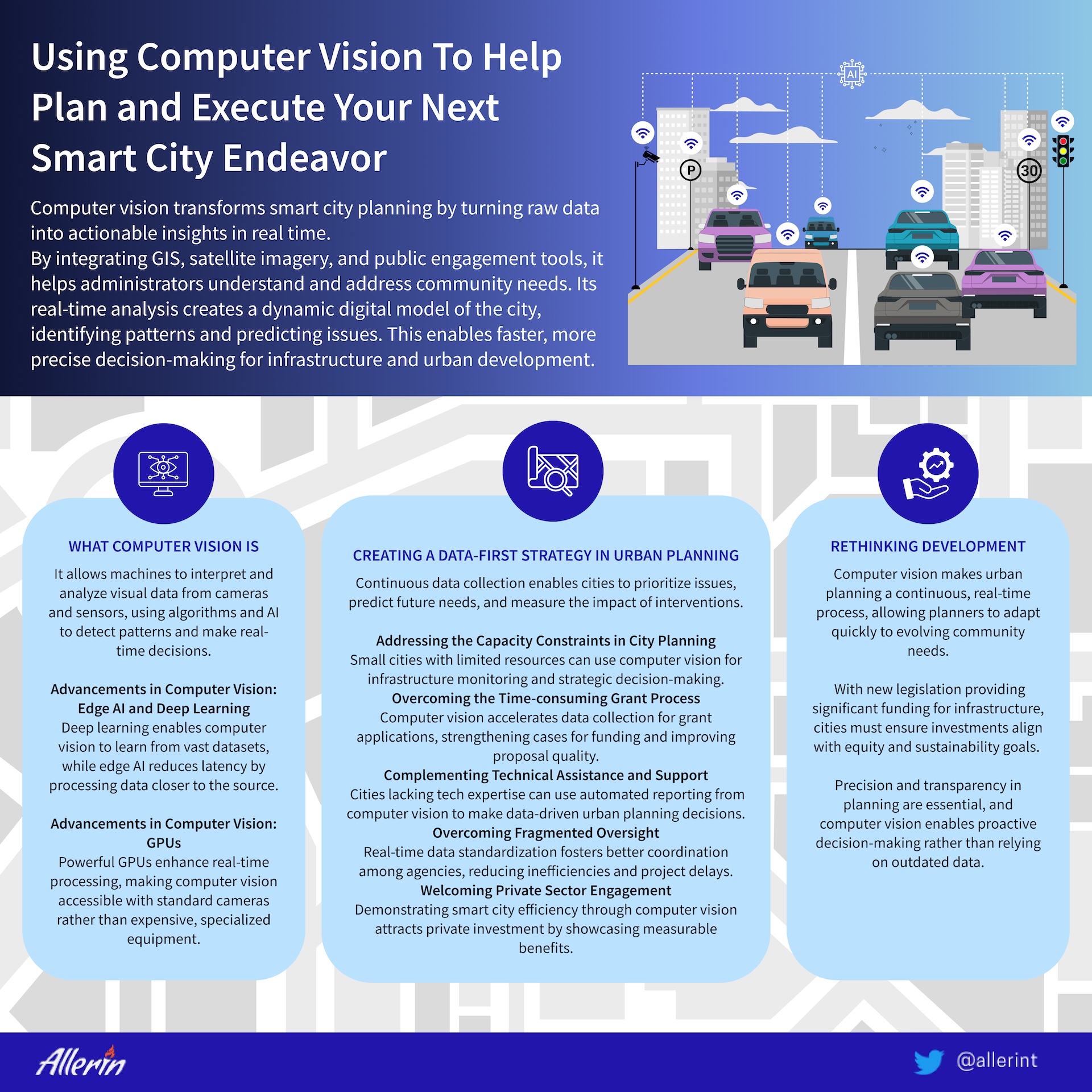
The real power of the technology lies in its ability to process and extract meaningful data at a much faster pace and on a much larger scale in real-time.
A few years ago, it required significant computational power to process and interpret complex visual data, making it slow and costly. However, today, advancements in deep learning and neural networks have revolutionized computer vision. These systems can now process large amounts of real-time data with remarkable accuracy and speed.
Advancements in Computer Vision: Edge AI and Deep Learning
Two of the most transformative innovations are edge AI and deep learning, which have enabled computer vision systems to evolve into something far more powerful and adaptable.
Deep learning, a subset of machine learning, uses neural networks to model complex patterns in large datasets. What sets deep learning apart is its ability to learn from massive amounts of data without needing explicit instructions for every possible scenario. Instead of relying on rule-based algorithms, deep learning allows computer vision systems to process complex and varied visual data, such as identifying faces in crowds, detecting traffic congestion, or recognizing objects in cluttered scenes.
Before edge computing, data collected by devices like cameras and sensors had to be sent to centralized cloud servers for processing and analysis. This created latency, meaning there was a delay between data collection and actionable insights, which was problematic for time-sensitive applications. Additionally, as large volumes of data had to be transmitted over the network, it led to higher bandwidth usage. This slowed down overall system performance and increased costs.
What edge computing does is bring artificial intelligence closer to the source of data by processing it on local devices rather than relying on cloud servers. So now systems can gather, store and process vast amounts of data continuously.
Advancements in Computer Vision: GPUs
Another key development is the advancement in hardware, particularly the use of powerful GPUs (Graphics Processing Units). With GPUs, computer vision systems can process thousands of frames per second, extract valuable information, and deliver results in real-time. This makes it possible to deploy computer vision in complex, high-demand environments, such as autonomous vehicles, surveillance systems, and industrial automation.
Moreover, deep learning now works without needing special, expensive imaging equipment. In the past, computer vision systems required high-end, specialized cameras to capture high-resolution images for analysis. Today you can use any standard digital camera—whether it’s a webcam, smartphone camera, or even standard CCTV cameras that are already installed in cities or businesses. The quality of the data doesn’t need to be top-tier for deep learning algorithms to produce accurate results. This makes computer vision much more accessible and scalable, enabling it to be deployed across a wider range of environments for creating a city master plan.
However until we start putting that information out from the database to project level planning, the potential of computer vision will continue to be undermined.
Creating A Data-First Strategy In Urban Planning
By continuously capturing and processing real-time data from all corners of the city, computer vision helps create a dynamic and actionable database. This data can not only be used to identify problems but to prioritize them, predict future needs, and assess the effectiveness of interventions over time. Here’s how you can gain better insights into your city and leverage computer vision to get things moving.
Addressing the Capacity Constraints in City Planning
In many small cities, the absence of dedicated planning units means that the responsibility of development falls on a handful of individuals, often overworked public departments. The lack of resources makes it challenging to design and implement comprehensive smart city projects. This gap hinders the city’s growth.
Here computer vision can act like another resource. By deploying cameras and sensors throughout the city, computer vision systems can monitor infrastructure health, assess traffic flow, and evaluate the usage of public spaces. This continuous stream of data provides insights that were previously unattainable and allows local leaders to focus on strategy rather than firefighting.
Overcoming the Time-consuming Grant Process
Securing federal grants is often a lifeline for municipalities aiming to fund smart city initiatives. However, the application process is notoriously complex, requiring detailed project plans, comprehensive data, and the involvement of various stakeholders.
A recent example of successful federal grant acquisition is Nashville’s recent funding to remove barriers to housing development.
The city received this grant by showing that its goals aligned with federal priorities—specifically, the need to update zoning laws, modernize building codes, and improve infrastructure to make housing more accessible. Nashville provided clear plans on how the funds would be used to speed up development and increase affordability. Additionally, the city highlighted how infrastructure improvements, such as better roads and utilities, would support new housing projects.
However, for small cities with limited staff, this process can be overwhelming, leading to missed opportunities and stalled projects.
Computer vision can alleviate this burden by rapidly gathering and analyzing the necessary data to support grant applications. For example, by documenting deteriorating roads and bridges, lead pipes and water systems and power grids, the technology provides a factual basis for proposed projects. This strengthens the credibility of applications and demonstrates a commitment to evidence-based planning, thus making a compelling case to funding bodies. Moreover, the efficiency of computer vision systems allows municipalities to meet tight application deadlines with well-prepared proposals.
Complementing Technical Assistance and Support
The journey toward becoming a smart city requires not only financial resources but also technical expertise. Many small municipalities lack access to specialists in data management, urban analytics, and technology integration. In fact, adults with poor literacy tend to live in communities with fewer resources.This deficiency can lead to underutilization of available technologies and suboptimal project outcomes.
By implementing computer vision systems, cities can bridge this expertise gap. These systems offer real-time monitoring and automated reporting, providing actionable insights without the need for extensive technical know-how. For instance, the system can generate reports on pedestrian flow in public parks, helping planners design spaces that better serve the community. Local governments can thus make informed decisions based on accurate data, all while minimizing the need to hire large technical teams. This approach democratizes access to advanced urban planning tools, enabling smaller cities to punch above their weight in terms of innovation and efficiency.
Overcoming Fragmented Oversight
Infrastructure projects often involve multiple federal, state, and local agencies, each with its own mandates and priorities. This fragmented oversight can lead to conflicting directives, delays, and inefficiencies, particularly when there is no centralized authority to streamline processes.
Computer vision can serve as a unifying tool, creating a standardized framework for monitoring and managing urban infrastructure. By providing consistent, real-time data on various aspects of the city’s operations, it facilitates better coordination among agencies. For example, data on traffic congestion can be shared between transportation departments and emergency services, ensuring a coordinated response to incidents. This unified approach reduces bureaucratic hurdles and accelerates project timelines, ultimately leading to more responsive and effective governance.
Welcoming Private Sector Engagement
Private investors possess substantial capital that could be instrumental in developing smart city projects. However, the perception of the infrastructure sector as cumbersome and lacking clear investment opportunities often deters private sector involvement.
Demonstrating the tangible benefits of smart city technologies is key to attracting private investment. Computer vision provides clear evidence of improvements in efficiency, cost savings, and urban planning effectiveness. For instance, by optimizing traffic light patterns based on real-time traffic data, cities can reduce congestion and emissions, showcasing a commitment to sustainability. These measurable outcomes make a compelling case for investment, as they indicate a high potential for return. By leveraging computer vision, municipalities can present themselves as forward-thinking and capable partners, ready to collaborate with the private sector to enhance urban living.
Rethinking Development
With computer vision, planning is no longer a process based on intuition or historical data alone. It’s an ongoing, real-time activity. Planners can see how their decisions are impacting the city on a continuous basis, enabling them to adapt quickly and align their strategies with the evolving needs of the community.
This approach becomes imminent as recent legislations such as those from the Inflation Reduction Act and the Infrastructure Investment and Jobs Act, are delivering billions of dollars in grants, loans, and tax credits to local communities. These funds offer an unprecedented opportunity to build more equitable and sustainable cities, but ensuring they are directed toward projects that truly advance social equity and decarbonization goals requires precision, transparency, and evidence-based planning.
By leveraging computer vision, agencies and local governments can make urban planning more proactive and responsive, rather than reactive and limited by the data that is outdated by the time it’s analyzed.