
The difference between a human mind and a machine mind is that the results it provides will be more nuanced for the former and ‘information gathered’ for the latter. The human mind offers refined and personalized results, while machines excel at pattern recognition and repetitive tasks. Machine learning algorithms are specifically designed to improve upon recognized patterns, making them valuable tools for various purposes.
These are called decision intelligence platforms. They aim to effectively and efficiently solve recurring issues, routine problems, and pattern recognition. Decision intelligence platforms are game-changers that revolutionize decision-making by leveraging data, analytics, and artificial intelligence. These platforms enable businesses to harness vast data and transform it into valuable insights and actionable recommendations.
With decision intelligence platforms, organizations can move beyond relying solely on gut instinct and make decisions based on concrete evidence and objective analysis. These platforms employ sophisticated algorithms and advanced analytics techniques to extract meaningful insights from complex and diverse datasets.
By integrating and analyzing data from multiple sources, decision intelligence platforms provide decision-makers with a comprehensive view of their business landscape. This enables them to understand trends, identify patterns, and make predictions.
Understanding decision intelligence platforms
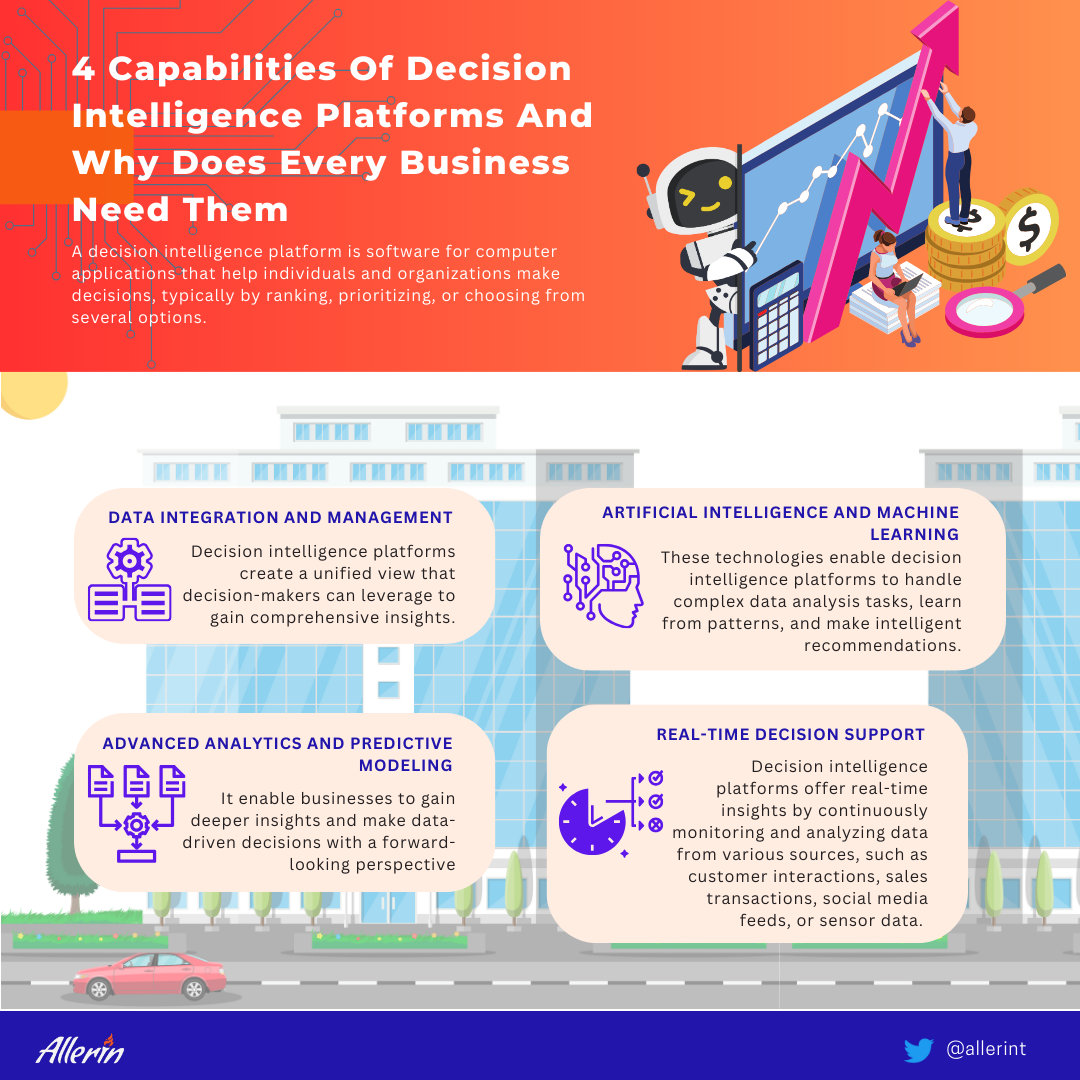
A decision intelligence platform is software for computer applications that help individuals and organizations make decisions, typically by ranking, prioritizing, or choosing from several options. The software analyzes a problem and generates a list of solutions it thinks will solve it. Providing this list of solutions enables businesses to access, research, and derive insights from diverse data sources, empowering decision-makers to make informed choices.
Their capabilities will only get better over time. Here are some of them:
1. Data integration and management
Decision intelligence platforms excel in collecting and integrating data from various sources, ensuring data quality and accessibility. These platforms employ robust data integration techniques that enable businesses to aggregate data from disparate systems, databases, and external sources. By harmonizing and transforming data, decision intelligence platforms create a unified view that decision-makers can leverage to gain comprehensive insights.
Moreover, decision intelligence platforms prioritize data quality by implementing data cleansing, validation, and enrichment processes. This ensures that the data used for analysis and decision-making is accurate, reliable, and up-to-date. Data governance frameworks often establish data standards, policies, and procedures, enhancing data integrity and consistency.
Decision intelligence platforms also address data accessibility challenges by providing user-friendly interfaces and self-service capabilities. This empowers decision-makers, analysts, and data scientists to explore and extract insights from the integrated data without requiring extensive technical expertise. The platforms may offer intuitive data visualization tools, interactive dashboards, and ad-hoc query capabilities, enabling users to interact with data and uncover valuable patterns and relationships.
2. Advanced analytics and Predictive modeling
Decision intelligence platforms use advanced analytics techniques to extract valuable insights from data and employ predictive modeling to anticipate future outcomes. These platforms go beyond basic reporting and descriptive analytics, enabling businesses to gain deeper insights and make data-driven decisions with a forward-looking perspective.
Advanced analytics techniques, such as statistical analysis, data mining, and machine learning, are employed to uncover patterns, correlations, and trends within the data. Through exploratory data analysis, businesses can identify hidden relationships and better understand the factors influencing their operations, customer behavior, market trends, and more. These insights enable decision-makers to identify areas of improvement, optimize processes, and develop targeted strategies.
Predictive modeling is a key component of decision intelligence platforms, allowing businesses to forecast future outcomes based on historical data and patterns. These platforms can predict various scenarios and their potential impact by applying sophisticated algorithms and statistical models. For example, businesses can use predictive modeling to forecast demand, optimize inventory levels, predict customer churn, or anticipate market trends. These insights empower decision-makers to make proactive decisions and take pre-emptive actions to mitigate risks or exploit opportunities.
3. Artificial intelligence and Machine learning
Decision intelligence platforms use the power of artificial intelligence (AI) and machine learning (ML) algorithms to automate decision processes, uncover hidden insights, and improve decision accuracy. These technologies enable decision intelligence platforms to handle complex data analysis tasks, learn from patterns, and make intelligent recommendations.
Artificial Intelligence refers to the simulation of human intelligence in machines. In the context of decision intelligence platforms, AI algorithms automate repetitive decision processes, freeing up valuable time for decision-makers to focus on more strategic tasks. For example, AI algorithms can automate routine decision-making tasks, such as approving loan applications or recommending personalized products to customers based on their preferences and past behavior.
Machine Learning is a subset of AI that enables machines to learn from data without being explicitly programmed. Decision intelligence platforms utilize ML algorithms to analyze large volumes of data, identify patterns, and make predictions or classifications. These algorithms are trained on historical data, and through an iterative learning process, they can make accurate predictions or identify meaningful insights from new and unseen data.
4. Real-time decision support
Decision intelligence platforms excel in providing real-time insights and recommendations to decision-makers, enabling them to make timely and informed decisions in response to changing business dynamics. Real-time decision support is crucial in today’s fast-paced and dynamic business environment. Traditional decision-making processes often rely on historical data or periodic reports, which may reflect something other than the current state of the business or market conditions. This delay in accessing and analyzing information can hinder effective decision-making and limit the ability to seize opportunities or mitigate risks promptly.
In contrast, decision intelligence platforms offer real-time insights by continuously monitoring and analyzing data from various sources, such as customer interactions, sales transactions, social media feeds, or sensor data. These platforms use advanced data processing techniques and algorithms to analyze real-time data, providing decision-makers with up-to-the-minute information and actionable insights.
Why every business needs decision intelligence platforms
1.Improved decision-making efficiency
Decision intelligence platforms streamline and accelerate decision processes, enhancing efficiency and agility. These platforms provide decision-makers access to real-time data, advanced analytics, and intuitive dashboards, enabling them to make informed decisions quickly and confidently.
By automating repetitive and time-consuming tasks, such as data collection, analysis, and reporting, decision intelligence platforms free up valuable time for decision-makers to focus on strategic thinking and problem-solving. The seamless integration of data and analytics within a single platform eliminates the need for manual data manipulation and cross-referencing, leading to faster and more efficient decision-making.
2. Enhanced data-driven decision-making
Decision intelligence platforms enable businesses to leverage data for informed decisions, extracting actionable insights from vast datasets. These platforms provide robust data analytics capabilities, allowing companies to explore, analyze, and visualize large volumes of data from diverse sources.
By harnessing advanced analytics techniques, such as data mining, machine learning, and predictive modeling, decision intelligence platforms uncover hidden patterns, trends, and correlations within the data. This enables decision-makers to gain deeper insights into customer behavior, market dynamics, and business performance. With the ability to extract actionable insights from complex datasets, businesses can make data-driven decisions grounded in objective analysis and evidence, reducing the reliance on subjective judgment or gut instinct.
3. Adaptability and scalability
Decision intelligence platforms possess the flexibility to adapt to evolving business needs and can scale with growth, accommodating various industries. These platforms are designed to be agile and customizable, allowing businesses to configure and tailor them to their specific requirements. Decision intelligence platforms can integrate seamlessly with existing systems and processes, enabling companies to leverage their existing data infrastructure and workflows.
This adaptability ensures a smooth implementation and minimizes disruption to ongoing operations. Additionally, decision intelligence platforms are built to scale, capable of handling large volumes of data and growing with the expanding needs of the business. Whether a company experiences increased data sources, a surge in user demand, or a need for expanded analytics capabilities, decision intelligence platforms can scale up to meet these requirements. They can handle diverse data types, such as structured, unstructured, and semi-structured data, and accommodate the growing complexity and diversity of data sources.
Wrapping up
In the fast-paced and data-driven business landscape, decision intelligence platforms have emerged as essential tools for businesses to make informed and effective decisions. These platforms empower organizations to leverage data, analytics, AI technologies, and machine learning to optimize efficiency, enhance decision-making processes, and gain a competitive edge.
Implementing decision intelligence platforms offers numerous benefits, including improved decision-making efficiency, enhanced data-driven decision-making, and a competitive advantage in the data-driven landscape. These platforms optimize operational processes, increase productivity, and enable organizations to make more informed and strategic decisions. By embracing decision intelligence, businesses can navigate the complexities of the digital age and adapt to evolving customer demands and market trends.
In conclusion, adopting decision intelligence platforms is essential for businesses to thrive in the data-driven era. These platforms provide the tools and capabilities to make data-driven decisions, optimize efficiency, and gain a competitive edge. By harnessing the power of data, analytics, and AI, organizations can unlock valuable insights, make informed decisions, and drive sustainable business success. Embracing decision intelligence platforms and paving the way for a future of data-driven excellence is the logical way to go.