 Most natural disasters are inevitable. These disasters take a heavy toll not only on our finances and other resources but also on human lives. Be it the Australian bush fire, Cyclone Idai, or the erratic Indian monsoon, these incidents have brought along substantial damages. They have caused massive destruction to whatever came in their path. Similarly, human errors, once in a blue moon, lead to manmade disasters like the Chernobyl plant explosion. We have always relied on the governments’ disaster management mechanisms to deal with these incidents. But, disaster management has always been a challenge as our efforts to salvage the situation always fall short in some form. IoT can assist with disaster management techniques to minimize the damages done by natural disasters. It can even stop a manmade disaster from happening in the first place. The use of IoT in disaster management can help transform our current reactive disaster management approach into a proactive one.
The current reactive model in disaster management
Our current disaster management techniques are, for the most part, reactive. This means that we take action only after a disaster has occurred. Also, disaster management processes are inefficient. Disaster management teams, no matter how quickly they respond, lose valuable time in carrying out rescue procedures. There are also instances of delays in communication that can make a situation go from bad to worse. Then, there’s also the risk of putting the lives of disaster management personnel in danger. Some might even lose their lives while saving those of others. The introduction of IoT aims at minimizing these risks and if possible, avert a disaster from happening in the first place.
A predictive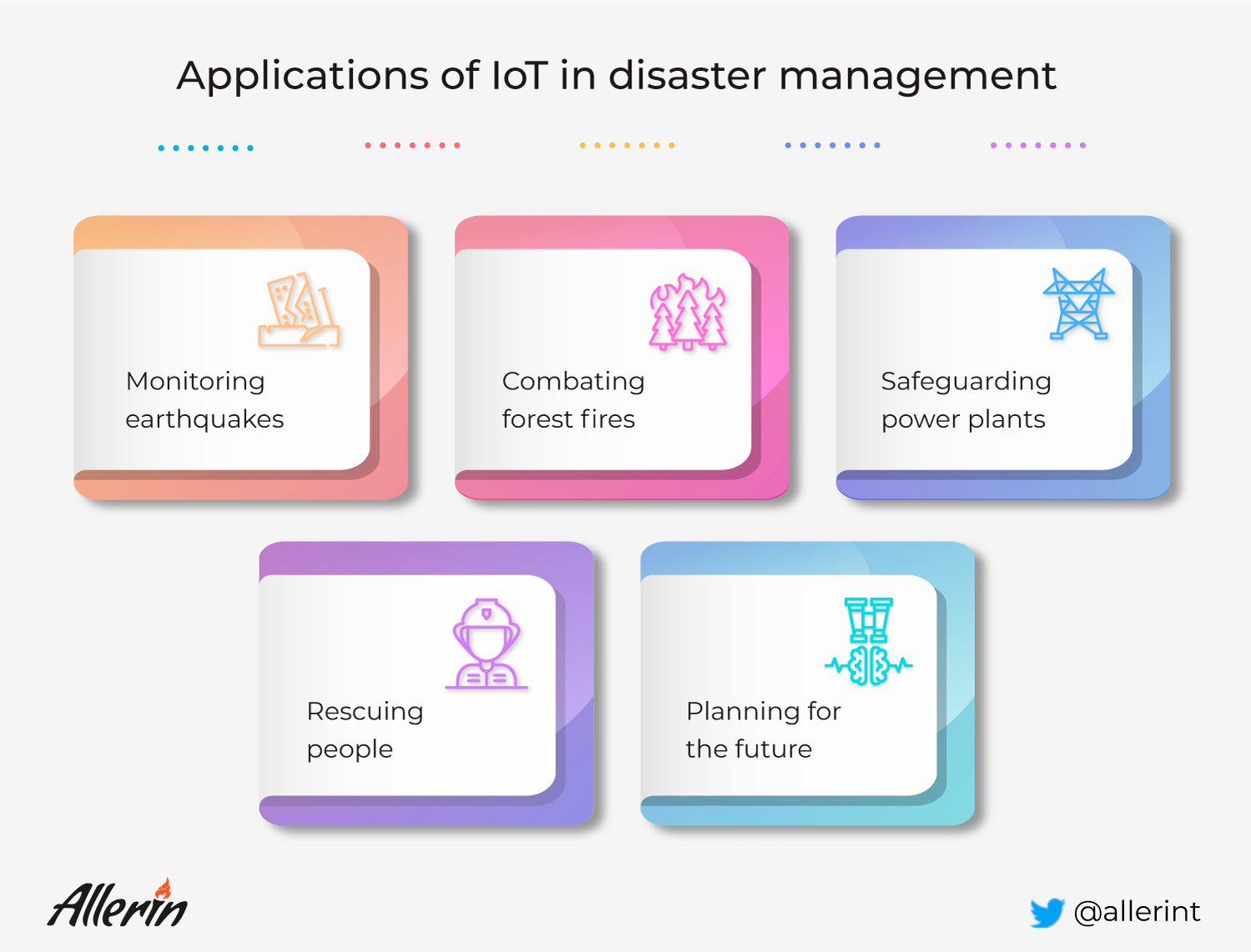 model with IoT in disaster management
IoT devices hold the power to transform the reactive disaster management techniques into predictive ones. The use of IoT devices in the form of sensors, robots, and unmanned vehicles can help in better preparedness and responsiveness to natural calamities like earthquakes, floods, and wildfires. It can also help avert manmade disasters such as the explosion of reactors. IoT can be used for the following purposes in disaster management:
Monitoring seismic activity
Smart sensors can be attached to buildings, bridges, and other places. These devices can gather and analyze data to help in monitoring seismic activities. If these devices identify patterns that predict an earthquake, they can send alerts to individuals and government authorities on mobile devices at the earliest, warning them of the same. Similarly, these devices can be connected to public announcement systems to warn individuals and guide them with the necessary steps to be taken. Thus, IoT devices can help save lives and minimize the costs spent on relief measures. They can also make the rescue operations easier for emergency services personnel. For example, a free mobile application has been developed that uses acceleration sensors to predict earthquakes. If a large number of mobile devices register the signals associated with earthquakes, it alarms individuals and authorities. The application leverages artificial intelligence technology for its operation and can identify an earthquake measuring more than 5 on the Richter scale.
Combating forest fires
We are all aware of the damages caused by forest fires such as the Amazon forest fires, the California wildfires, and the recent Australian wildfires. IoT devices can help avert such instances or alert authorities so that such incidents can be controlled at the earliest. IoT sensors can be attached to trees to monitor parameters such as temperature, humidity, and CO2 levels. They can help in the early detection of wildfires and alert authorities quickly. This can help stop the spread of fire at an early stage. With the help of GPS coordinates of the devices, firefighters easily locate the area under fire. They can, thus, start taking appropriate measures quickly. Additionally, if the wildfires have reached levels where direct human intervention is risky, unmanned vehicles can be used to bring the situation under control.
Safeguarding power plants
Man-made disasters can be equally, if not more, devastating than natural calamities. The Chernobyl incident is a prime example of such a catastrophic event. To avert any such incident, IoT sensors can be used that continuously gather data regarding various parameters in hazardous environments. Artificial intelligence systems and data recording tools can help detect any abnormalities. The information is recorded and analyzed in real-time and thus can help stop a major disaster waiting to happen. The IoT systems can be programmed to alert authorities about any malfunctioning by providing them with detailed alerts. Similarly, the systems can also be programmed to automatically shut down operations, in case it detects any faults in the working operations.
Rescuing people
IoT devices can help in search and rescue operations. They can help locate and rescue people trapped due to earthquakes, floods, and hurricanes, and other calamities efficiently. For instance, GPS sensors can provide rescue teams information regarding the shortest route to reach the location. With smart traffic management systems, traffic can be cleared to avoid any delays rescue personnel might encounter en-route. Once at the site of a disaster, unmanned vehicles can be used to scan the area remotely. They can be used to reach places where humans find difficulty such as locating people trapped in rubble during an earthquake. Similarly, remotely controlled robots can be used to assist manpower in rescue operations. They can be used to clear obstacles in the path of rescue teams such as debris or even reach locations where humans can’t reach and assist people. For example, unmanned vehicles with attached cameras, GPS, and AI technologies can be used to rescue people stuck in their homes during floods or other emergencies where human lives are at risk. They can also be used to provide temporary medical aid and essential supplies with remotely controlled vehicles if rescue is not possible.
Planning for the future
Artificial intelligence and data analytics tools can be used for predictive analysis. These tools help to predict the type of disasters, the severity, and the time it can strike with higher accuracy. Thus, authorities and rescue personnel will be better prepared to take suitable measures. The losses, in terms of financial and human lives, can be reduced significantly through predictive analysis. Similarly, IoT devices can also be used to improve manual disaster management techniques and help decrease the risk exposure of rescue personnel. Augmented and virtual reality devices can be leveraged to provide training to disaster management forces. Various real-life scenarios can be simulated using these technologies to train individuals about the due course of action. These devices help minimize risks and injuries caused during traditional training sessions and also improves the effectiveness of training procedures.
You can’t stop certain disasters from happening. But you can become better prepared to handle them. IoT can help overcome inefficiencies in the reactive approach currently used in disaster management procedures. IoT devices can even help avert crisis altogether that caused due to human errors. Governments across the world need to increase the use of IoT in disaster management considering all the benefits and improvements they bring. And the improvement in technologies such as AI, robotics, computer vision, data analytics, and machine learning will help further improve IoT’s capabilities in disaster management. It will make disaster response more efficient, thereby helping minimize substantial losses.