
 Despite many myths about cloud computing, it is widely accepted across many industries by businesses to deploy their web applications. Mostly all the web applications developed have two major components, which are a relational database and a server-side application. And, even the web applications deployed on the clouds have these two components. The server-side application carries out heavy tasks of processing the server request and providing an accurate response. Web-based server-side applications can be created on many different architectures depending on the complexity of applications. One of those architectures is microservices and the other is monolith architecture.
Both monolithic and microservices have their own benefits and disadvantages. But before getting into the pros and cons of monolith and microservices architecture, let’s understand what they mean and how they differ from each other. The former architecture is a standard way of creating server-side applications where all the services and components are created as a single package. The latter, on the other hand, is a recently emerged architecture that allows creating, packaging, and deploying each service and component individually.
Choosing microservices vs. monolithic architectures
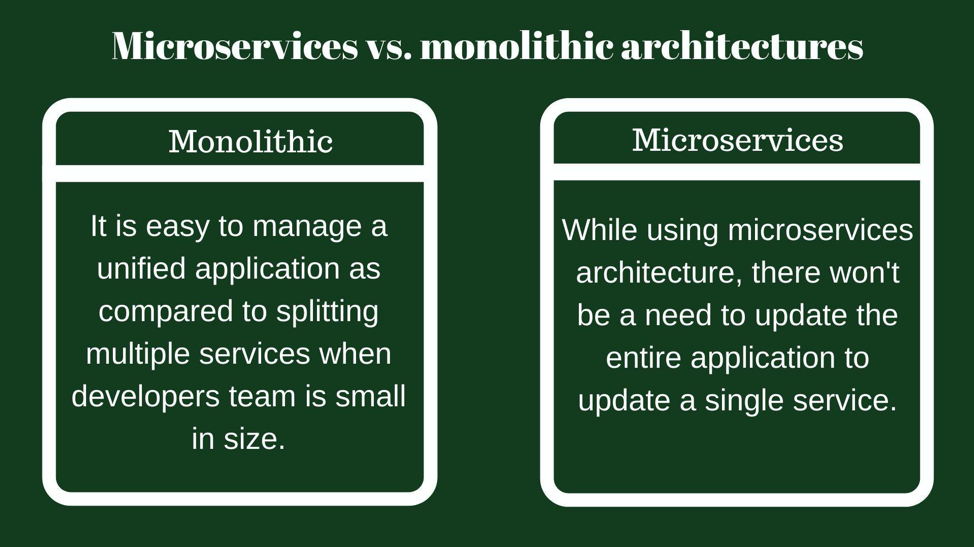 Many startups don’t need microservices and instead prefer monolith as it is simple to handle with less operational overhead to operate monolith architecture applications. Since all the services of a monolith architecture are created as a single package, the programming language used to create all services is also the same. The use of a single programming language makes it easy for engineers to operate and handle web-based cloud applications as they have only to know the language used to create the application. Whereas microservices architecture allows the creation of all services independently, and all these services can be created using different programming languages. The use of microservices architecture would mean the need for developers to know all the programming languages that are used to create the application. In simpler words, when the development team is small in size, it is easier to manage a unified application instead of splitting everything in microservices. But, along with benefits, there are limitations of monolith services that can be tackled by microservices architecture.
While a monolithic architecture provides ease of managing and operating applications, it reduces the flexibility that should be a part of the agile development process. For instance, all services and components of monolithic architecture use the same memory, which makes it less flexible. Another drawback of monolithic architecture that is tackled by microservices is that to update a single service of the application in monolithic architecture, developers will have to update the entire package. Whereas, with a microservices architecture, developers will have to update only the service package that has to be updated and not the entire application. By distributing the application into multiple microservices, developers can eliminate the susceptibility of applications to a single point failure.
As application development trends evolve, the debate on microservices vs. monolithic architectures will become more pronounced. The end benefit of using monolithic or microservices to businesses completely depends on their needs. It is developers who have to decide on the correct architecture for different enterprises based on their needs to provide optimal benefits to businesses.