


A well developed mobile application instantaneously appeals to consumers and communicates company’s brand and vision. In a previous blog post, we discussed the key challenges in mobile application development and also how to create a correct roadmap. An application roadmap is a guideline that plans out your application landscape and strategy over a given time frame. Thus, by creating and building the roadmap, you can plan out an application development strategy and implement the actions that will allow you to fulfill your application’s objectives.
In this post, we present you with 4 things that you need to evaluate before you finalize the application development roadmap:
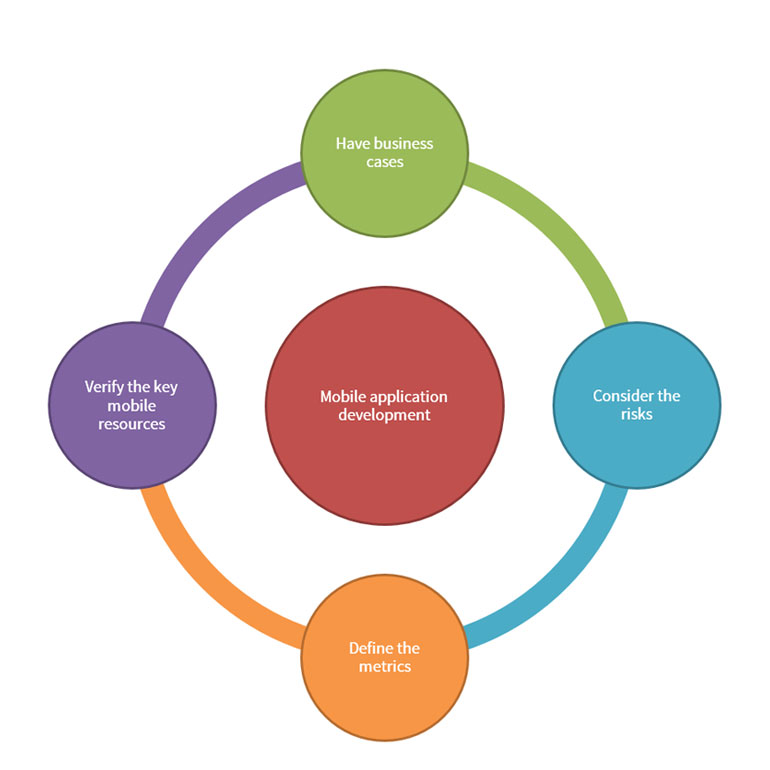
1. Have business cases
The majority of organizations deploy their mobile apps without a business case. Gartner has predicted that through 2016, 75% of mobile apps will be developed without a positive business case or with no business case at all. Business cases are important as they help in app prioritization. Without a mobile business case, it becomes difficult to access the potential revenue, cost savings and economic value of a mobile app or service. A business case will take into account the costs of mobile development and operation, which are different from conventional application development. Thus, it is necessary to have a business case before you start application development.
2. Consider the risks
The app you develop is likely to make use of cloud services. This makes it open to a number of security and privacy risks. You must work on keeping user data secured and also guard it against malware or malicious software.
3. Define the metrics for mobile application development
Before you start with application development, you must define the metrics that will measure the proposed benefits achieved from app utilization. These metrics can be Key Performance Indicators (KPIs), Return on Investment (ROI) and/or Value on Investment (VOI). You can use the results from these metrics to refine the app for improved benefits or discontinue it if the expected benefits have not been realized. Assessing the potential impact of a mobile app before development helps ensure that the highest-priority apps are developed first and helps in increasing the chances of success.
4. Verify the key mobile resources
You must determine what the significant resources which are required for timely completion of activities and deliverables expected are. Also, you can implement the existing and new mobile metrics that will help in producing the desired tangible results.
As you can see, developing a mobile app involves creativity, forward-thinking, and a strong foundation of research and planning. Even if you have all the resources in this world, a concrete roadmap can make or break your mobile app development project.