
Augmented reality (AR) is the integration of digital information with a user’s environment, whereas VR is the computer-generated recreation of the real-world environment. AR and VR are similar in technology and entertainment, but they differ in their purpose and delivery methods. AR and VR are blended to enhance user experience. Their hardware comes in many forms, ranging from devices you carry to devices you wear. Common AR applications include video games and television to name a few. One of the popular video games that uses AR technology is the Pokemon Go. AR and VR innovations help various industries, including commercial, marketing, education, training, travel and tourism, as well as the food industry. AR and VR in food industry allow marketers to engage and retain their customers, and masses to boost their personal experiences.

Benefits of AR and VR
There are numerous benefits of AR and VR. In constructing buildings, AR help project managers to identify work progress in real time. Moreover, it helps managers to save a lot of time by using digital maps, and the final construction of the building can be analyzed by just pointing to the device into a location. VR help customers to improve their loyalty and satisfaction by enabling them to view their products in 3-dimensional. This helps marketers to retain their customers, and achieve more profit. AR and VR help medical students to understand human anatomy better, try their first surgery without injuring their patients, and make it more interesting. AR and VR technologies bring new possibilities for educations and training process. Using GPS mobile apps with AR can show tourist routes and desired destinations. Additionally, AR in museums helps to enhance users cultural experience. Moreover, AR and VR help marketers a new whole level, where they can attract more customers, retain their old customers, which helps to provide their customers something that competitor businesses are lacking.
VR and AR in food industry
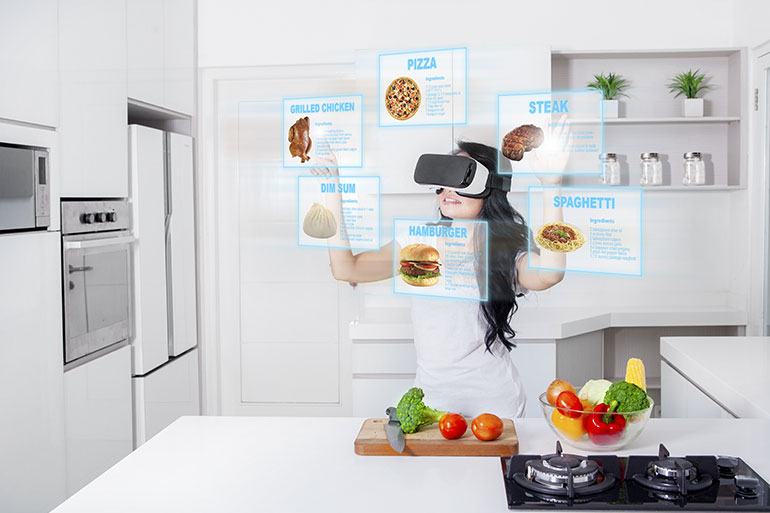
The food industry runs on customer experience, loyalty, and satisfaction. The more the customers are satisfied, the more a business will flourish in the food industry. The Boursin Sensorium uses VR technology to sell soft cheese. Bars are employing the VR and AR technology to increase customer experience by showing them the making process of an alcohol or the footage of visitors complementing food. The technology can be used by restaurants to train their workers to have a better understanding of their customers. Moreover, people can scan food products on their smartphones and get a clear idea about the health benefits and calories in them. VR and AR can also help marketers in the promotion of a product by playing some promo games while their customers have placed an order for their food and are waiting for it to arrive. Additionally, AR and VR technologies can be helpful to people visiting restaurants to get recipes of their favorite food dishes before ordering it. This helps restaurants to attract more customers and make tremendous profits. Furthermore, these technologies can be used to change the color of certain foods that are healthy but are not pleasing or delicious-looking.