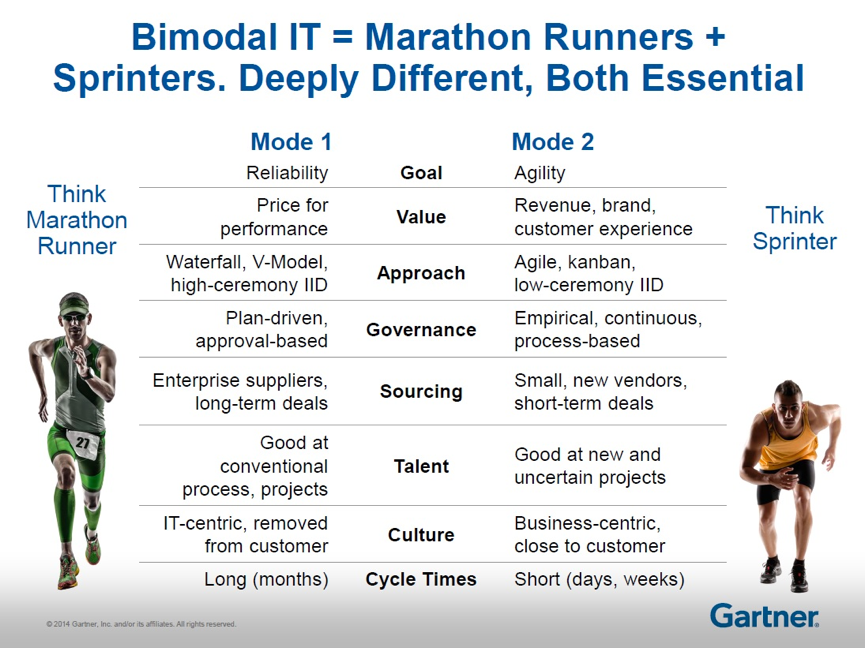
Bimodal IT is a term coined recently by various IT analysts and media that describes a new paradigm for CIOs and for IT as a whole. Peter Sondergaard, senior vice president at Gartner and global head of research, said last November that while CIOs might not be able to transform their existing IT department into a digital startup, they could turn it into a bi-modal IT organization.
Untapped potential
Gartner’s bimodal IT recommendation is a statement of how IT must be organized to meet the burgeoning requirements being forced upon it by business units. While there is discussion about what the Mode 2 IT organization will build, it is usually focused on the consumer of the technology — the business units and what they want to accomplish with agile, fast-to-market applications. The bimodal model is correct in saying that a different set of expectations and approaches is probably necessary for IT to respond to the demand, but it does not address the fundamental and enormous change in technology and process required to deliver Mode 2 applications. Stated straightforwardly, Mode 2 IT is a DevOps world, and it will require new tools and processes.
Some IT organizations have cottoned on to this and are seeking to emulate the leaders on the frontier of the industry: Facebook, Etsy, and a few others. This is what has led to the birth of the Innovation Lab movement, and is the root cause of the coming war for developers. The bottom line is that the organizational recommendations associated with bimodal IT are only a portion of what needs to be done to move IT capabilities to where they will need to be in the future; said another way, bimodal IT is necessary but not sufficient for what enterprise IT will look like going forward.
Agility is critical
Many corporate IT departments are in the process of shifting—or have already made the leap—to agile application development processes in order to better support the speed of all things Internet. Spurred by such high-profile app developers as Uber, which releases new iterations of its titular app on an almost daily basis, many companies are looking for ways to speed up their software development cycle, particularly for mobile apps. In other words, if a company competes directly with another company that is continually releasing iterative software updates, the development teams may struggle to compete in that market. However, it might still be a mistake to assume that ditching established development processes that have served well in the past will automatically make applications best-of-breed compared to competitors. There must be a way to offer a shortened development cycle to the users or customers, while still delivering well-tested, stable application releases.
Feasibility
While there are definite advantages to both the Mode 1 and Mode 2 development models, the jury is still out on whether bimodal IT is a feasible solution. The answer may be that bimodal IT will work in some IT shops but not in others. Its success may depend on intangibles such as developer buy-in to bimodal processes, the ability of the IT organization to run two vastly different development methodologies simultaneously, and the need to have the right staff skillsets to allow each approach to flourish.
Too neat a distinction
It probably hasn’t escaped people’s notice that the bimodal IT model neatly mirrors the bifurcated application types described as systems of record and systems of engagement, with Mode 1 IT responsible for systems that keep track of transactions, and Mode 2 responsible for externally-facing applications that interact with important constituencies.
In this formulation, each type can stick to its knitting and focus on delivering what is expected. However, it’s likely that these two different IT groups will clash with one another for power; more importantly, despite the neat separation implied by the model, they will need to cooperate.
For Mode 2 applications to really deliver value, they need to interact with transactional systems. For example, just to have a mobile application that lets people interact with a loan officer is not sufficient, users should be able to use it to submit their documents, track the loan progress, and even sign off on the loan. This means the Mode 2 application being used has to integrate with a back-office Mode 1 application, which means the two IT organizations will need to work together.
So, there will also be a need for coopetition as the two groups warily collaborate, perhaps under the watchful eye of a senior executive to force them to work together sullenly.
One can say that Gartner has accurately identified a crucial tension in the proliferating demands on IT, and prescribed a model to enable IT to respond to them. The success of an IT team, although, still hangs in the balance, so CIOs should consider starting with a small Mode 2 development project and then expanding their bimodal efforts if that approach bears fruit.