

Digital transformations make companies more efficient, agile, and up-to-date. It enables companies to deliver innovative products and improved services to customers and partners, via multiple channels. However, to handle such complex processes and overlook the systems associated with them, companies appoint an enterprise architect group or department.
Who is an enterprise architect?
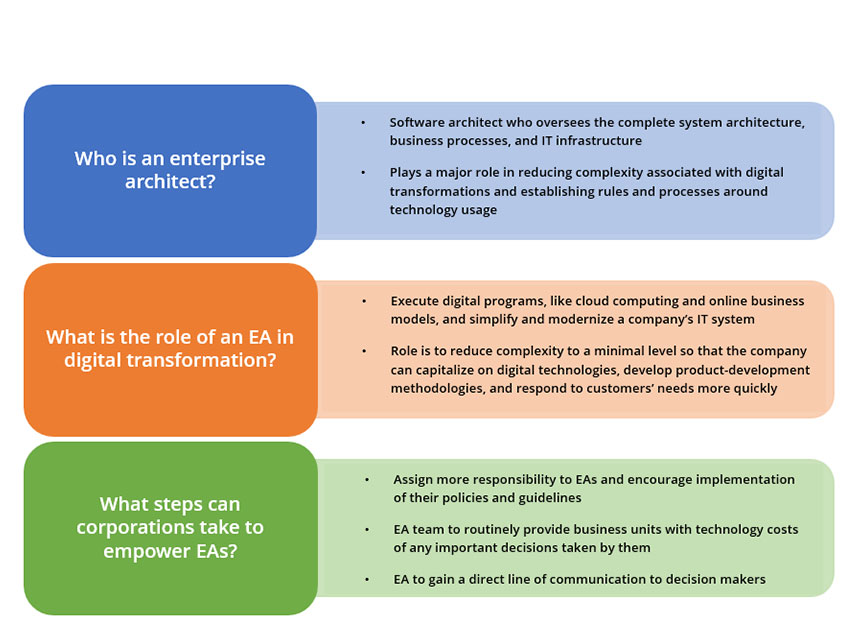
An enterprise architect is a software architect who oversees the complete system architecture, business processes, and IT infrastructure of a particular corporation. Usually, a single enterprise architect does not suffice, therefore companies appoint a group of enterprise architects or assign an EA department for the task. These architects play a dominant role in reducing the complexity associated with digital transformations and establishing the rules and processes around technology usage, across business units and functions, to ensure consistency.
What is the role of an EA in digital transformation?
An enterprise architect, in case of a traditional company, ensures that the technology infrastructure and operating models are updated to suit the current trends. This they mostly do by executing digital programs like cloud computing, with an aim to simplify and modernize a company’s IT system.
A company’s business unit and its IT department need to have somewhat common goals and an equal consensus over their products and processes. It is the EA department’s responsibility to help create a mutual agreement and a unified set of objectives between the two. Digital transformation is a complex and continuous process. Therefore, reducing complexity to a minimal level so that the company can capitalize on digital technologies, develop product-development methodologies, and respond to customers’ needs more quickly, is the EA’s job.
What steps can corporations take to empower EAs?
There is a general lack of awareness amongst organizations when it comes to EA groups. Hence, it is the duty of a CEO or CIO to increase awareness and empower them. There are two ways corporations can empower EAs:
1) Assign more responsibility
There exists a general misconception across companies that the EA group, compared to other technology-oriented groups, has only a limited impact on company-wide initiatives. This is because the other groups may have larger budgets and higher accountability for core operational areas. Apart from establishing the trust factor, this perception can be reversed if CEOs and CIOs assign more responsibility to EAs for taking certain major decisions and encourage implementation of their policies and guidelines.
2) Measure performance
In corporations, a lot of the daily work centers around individual business units and depends on factors such as changing strategy, budget decisions, and more, making it difficult for CEOs to determine the EA group’s contribution to overall performance. However, the enterprise-architecture team should routinely provide business units with the cost of technology for any important decision taken by them. For instance, tradeoffs in cost, quality, time, opportunity loss, etc. The enterprise architects would gain a direct line of communication, simultaneously ensuring that the business teams get the information they need to make critical decisions.
An enterprise architect is not just essential for limiting risk and protecting the company from potential challenges and the downsides of digital transformations, but also for ensuring the formation of a close and lasting partnership between business and IT.