


Once organizations have ensured that they have the necessary technology, tools, skill sets and architectural concepts to facilitate a sound data integration roadmap, they need to constantly evaluate market offerings and inculcate new capabilities. This helps them in evolving and expanding their data integration capabilities.
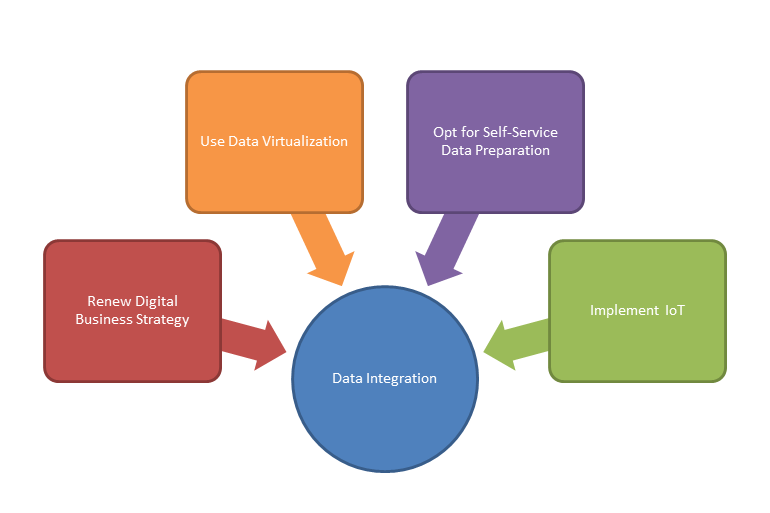
Renew Digital Business Strategy
An effective digital business strategy facilitates the enterprise to draw on ways to collect, manipulate and repurpose data. Increasing the scalability and flexibility of data integration is necessary to provide the right data to the right people at the right time. Data integration capabilities are at the heart of powering the frictionless sharing of data across all organizational and system boundaries, which is critical to enabling digital business strategies.
However, integrating data is a challenging task as it involves many applications, including legacy systems. Therefore, data and analytics leaders must position data integration as a strategic discipline at the core of the information infrastructure in enterprises, fulfilling a critical role in the integrated, digital business.
Use Data Virtualization
Familiar data integration patterns that are centered on physical data movement are no longer a sufficient solution for enabling a digital business. Data virtualization allows flexibility and agility in data access through the creation of a single logical view of data from varied data silos.
Thus, data and analytics leaders need to consider data virtualization capabilities as important components of their overall data integration portfolio.
Opt for Self-Service Data Preparation
Several analytics users spend most of their time preparing their data for analysis. Self-service data preparation is an iterative agile process for exploring, combining, cleaning and transforming raw data into datasets for data science, data discovery, and BI and analytics. Analytics and data leaders must study the workflows and uses cases for self-service data preparation as well as differences from traditional data integration approaches. One limitation of self-service data preparation is that it can assist in agile data delivery for analytics but cannot replace a well-governed and comprehensive data integration program that caters to not just analytics but also many other use cases. Thus, keeping this in mind, data and analytics leaders must evaluate vendors and choose the most appropriate self-data preparation tools based on capabilities, integration points, and pricing.
Implement IoT
There has been an increase in utilization of diverse and highly distributed data from IoT solutions. This high-volume data is adding complexity to data integration. Thus, integration and information leaders must effectively leverage distributed IoT architectures, typically involving IoT endpoints, IoT platforms, back-end systems and other sources of data.
Activities that are listed in this blog post will help information and integration leaders to review their existing data integration practices and assist them in evolving them further.