

Recently, Goldman Sachs has started leveraging neural networks and machine learning to create AI-powered robots for stock market predictions and trading. The experts at Goldman Sachs found that AI-powered bots displayed better accuracy compared to human traders, which led to 99% of their traders being fired. Similarly, while artificial intelligence is getting better with time, the chances of robots taking white-collar jobs in other sectors are also high.
Today, artificial intelligence is so advanced that it is being used for various applications, right from creating music and art to diagnosing life-threatening disorders like cancer. According to McKinsey & Company, robots will take over 800 million jobs by 2030. Multiple tech experts have warned about the darker side of artificial intelligence and the tendency of major organizations to replace their employees with AI. But, is the rise of AI and other advanced technologies really threatening our employment opportunities? If yes, then which jobs will be affected the most?
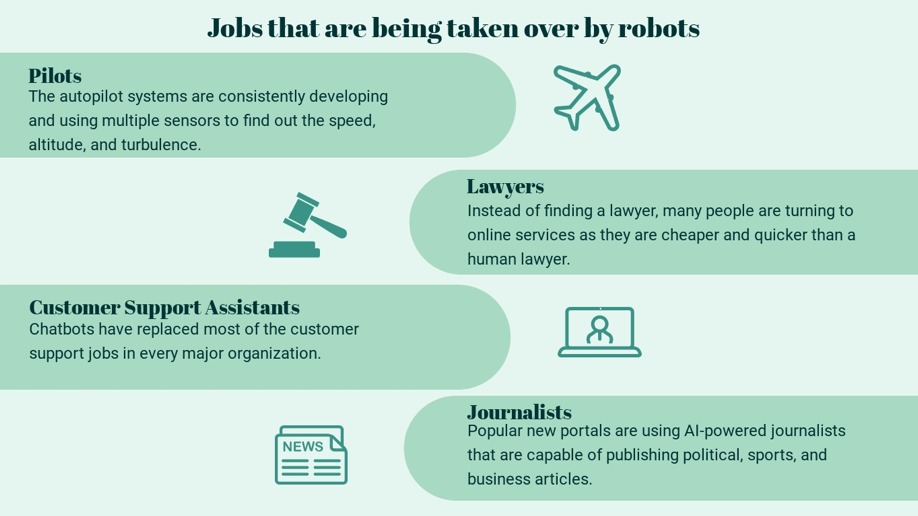
Which jobs can be replaced by robots?
Pilots
Commercial airline pilots fly most parts of a journey with the help of autopilot, except during take-off and landing. The autopilot system is already so advanced that a major part of flying is handled automatically. For flying the airplane correctly, the autopilot system uses multiple sensors around the airplane to determine speed, turbulence, and height. And, the autopilot systems are only getting more advanced. For example, the Defense Advanced Research Projects Agency (DARPA) from the U.S Department of Defense is testing a robot pilot called Aircrew Labor In-Cockpit Automation System or ALIAS, for flying and navigation. ALIAS uses multiple cameras to monitor gauges and switches, and a robotic arm to operate the navigation throttles. With ALIAS, the defense organization is planning to take care of flying automatically, while the pilot can focus on other mission objectives. Although further developments in technologies like AI can automate the entire flying experience, robots taking white-collar jobs like that of pilots can be a grim reality.
Lawyers
Finding and affording good lawyers for grievances redressal and litigation can be tricky. Paying a reputed lawyer’s fee can turn out to be an expensive affair. The multiple issues involved in finding and paying lawyers is giving rise to online services that help appeal against parking tickets, determine compensation for flight and train delays, report discrimination, and other civil issues. Numerous AI-powered lawyer services have come into existence, which provide legal advice for various grievances and have a high success rate. Hence, the robots taking white-collar jobs of lawyers have made the struggles even worse for the already struggling budding lawyers. Since the online alternatives are cheaper and quicker than a human lawyer, the demand for lawyers may be seen declining.
Customer Support Assistants
Before artificial intelligence went mainstream, every organization hired individuals whose only job was to provide solutions for customer queries. But, with the rise of artificial intelligence came chatbots. Chatbots have replaced most of the customer support jobs in every major organization. Deploying a chatbot is much cheaper as compared to paying wages to an employee and chatbots are more efficient as they can resolve queries faster than humans. Additionally, social media platforms like Facebook have created a landscape for commercial chatbots that are used by multiple brands. The chatbots on Facebook Messenger can resolve customer queries as well as suggest products and services, which has reduced the requirement for customer support assistants. Thus, experts are anxious about the robots taking white-collar jobs such as customer support.
Journalists
If you think jobs like journalism cannot be invaded by robots, then think again! With advanced artificial intelligence and machine learning technologies available today, computers are capable of researching and writing articles on numerous topics. For example, the Associated Press publishes multiple political, sports, and business articles that are written by AI. The algorithms created for AI journalists can automate the task of research, fact-checking, and generate reports and stories based on raw data. And, experts say that artificial intelligence algorithms are getting so advanced that AI journalists may be able to carry out investigative journalism as well. If AI keeps evolving at this rate, the number of journalism jobs in the market will come down drastically.
But, how did we get here?
Although technologies such as artificial intelligence and machine learning are growing in various sectors, concerns about robots taking white-collar jobs are also rising. But, how did we arrive here?
Since the dawn of advanced technologies, researchers have dreamt of machines being our perfect companions. To fulfill this dream, researchers have worked tirelessly to develop numerous technologies, including artificial intelligence. Modern technologies have indeed made our lives simpler. For example, Amazon has opened a unique convenience store called Amazon Go in the basement of their headquarters in Seattle. What makes the store unique is that the customers scan their phones and pick what they want and after the customers leave a receipt of their purchase pops up on their phone.
AI has consistently proved that it can outperform humans in many industry sectors. With AI gaining more popularity in the tech world, the researchers started finding ways to exploit the technology for maximum benefit. Today, AI can be seen used extensively for numerous applications in healthcare, finance, art, education, and much more. In multiple sectors, AI has automated the mundane and tedious tasks that are involved in the everyday functioning of any organization.
Moreover, systems based on artificial intelligence and machine learning perform more efficiently and produce precise results for meticulous tasks. Hence, multiple organizations have started deploying artificial intelligence and neural networks, which has led to robots taking white-collar jobs. Furthermore, organizations have found that deploying robots is cheaper than paying the hourly wages to employees and AI-powered robots are also capable of working 24×7, unlike the human personnel. Experts have suggested that AI has the potential to make machines smarter due to the ability of self-learning.
But, developers got so carried away building advanced AI applications for commercial purposes that they forgot about the potential of robots taking white-collar jobs, altogether. And, when big players started adopting modern technologies to face their competitors, developers gained extra motivation to rapidly develop these technologies further. Hence, we now exist in a world where multiple tech experts are worried about the potential of robots taking white-collar jobs.
And, can we stop the robots from taking white-collar jobs?
Artificial intelligence can already do multiple tasks that humans have been doing for ages and AI has outperformed humans on most occasions. Additionally, researchers and developers are clubbing AI and other advanced technologies like machine learning, blockchain, and big data, together to make the existing technology even better. And, looking at the potential of these technologies, multiple brands have shown a keen interest in adopting them.
Multiple organizations are already leveraging advanced technologies such as AI, due to better efficiency and high performance. The phenomenon of constantly deploying modern technologies can lead to robots taking white-collar jobs. But, organizations need to understand that AI is not as advanced as we think. Even after adopting AI for various applications, human supervision is still needed, and artificial intelligence is currently incapable of handling emergency situations and system failure. Hence, AI is not advanced enough to handle things by itself. Organizations need to understand the flaws of AI and figure out how to use AI efficiently to become an industry leader. Additionally, business owners and employees need to be informed about modern technologies to make conscious decisions about the applications of the technology and improve their skill set accordingly.
Instead of using AI or any other modern technology to replace human employees, companies can benefit by using advanced technologies, such as artificial intelligence, for handling tedious and mundane tasks in the workplace. Tasks such as recordkeeping and data entry can be carried out by AI, which can help employers focus on the other more important tasks. Alternatively, AI can also be used to assist employees in the workplace. For example, HR chatbots can solve simple employee queries, while HR executives can continue working on other tasks. Consciously deployed applications of AI can reduce the concerns about robots taking white-collar jobs. Hence, organizations need to be mindful of how modern technologies are being deployed.