
 According to the disability statistics report of 2017, around 40 million people in the United States are reported to have one or more forms of disabilities. Assistive devices embedded with technology promotes greater independence for such people by enabling them to perform tasks that they were formerly unable to perform or had great difficulty in completing. Assistive devices are helping disabled people to carry out their day-to-day tasks with unprecedented ease. Following are some of the uses of assistive devices that help empower disabled people:
Uses of technology-enabled assistive devices
There is already a wide variety of assistive devices available to help the disabled. Incorporating digital technologies in devices like wheelchairs, hearing aids, etc. can significantly enhance the usability of these devices and provide greater assistance to people. These technology-enabled devices significantly reduce the dependence on other people and allow people with disabilities to lead an independent life.
-
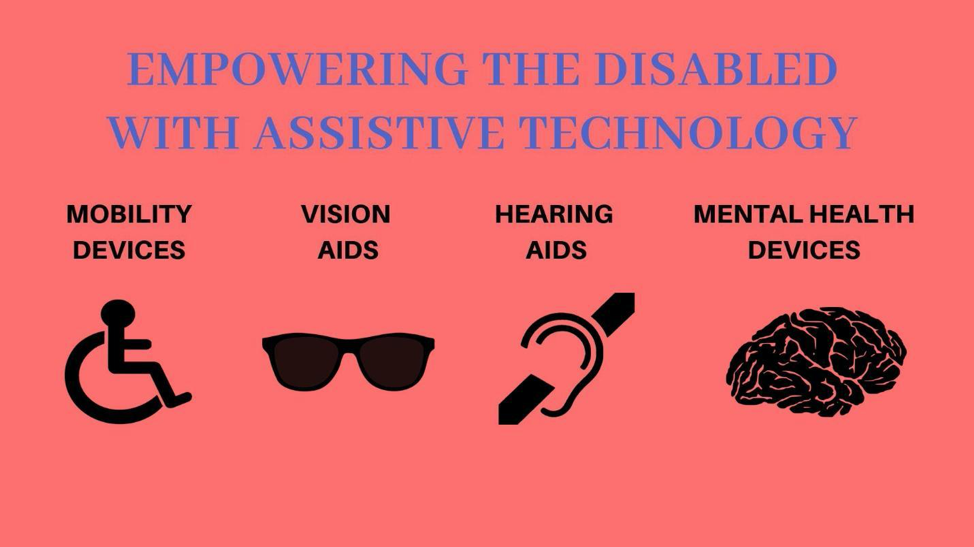
Smart mobility devices
Assistive devices like wheelchairs have proved highly beneficial for people with mobility issues. Incorporating technologies will help push the assistive devices industry forward helping businesses as well as the people in need. One such example of a smart assistive device for improving the mobility of disabled persons is a tech-enabled wheelchair. The standard electric wheelchair has minor levels of motor control with the help of a joystick. Although these wheelchairs help with movement, it is dependent on physical human input.
A smart wheelchair is equipped with sensors, cameras, and computer-based systems that can significantly help to assist people with movement. An AI-enabled smart wheelchair can automatically help with movement using audio or visual cues. The need for controlling the wheelchair using a hand-held joystick is eliminated, which can prove highly beneficial for people suffering disabilities that restrict their hand movements.
An advanced concept of a smart wheelchair is the integration of advanced technologies like computer vision, artificial intelligence, and machine learning. Such an advanced smart wheelchair can sense obstacles in the path of commute using computer vision. It can then guide the user intelligently on the most favorable path. An autonomous smart wheelchair uses technology to make smart decisions on behalf of the user. However, such an idea still takes some time to materialize as research on smart wheelchairs is still ongoing.
Businesses attempting to design smart wheelchairs must have advanced robustness in motion control, perception, and control techniques. Businesses should invest heavily in the research and development of smart wheelchairs that can be completely autonomous with minimum to complete independence of human input. Such assistive devices cannot be made available to users unless the technology incorporated is foolproof and can be depended upon completely. Even a small error rate can cause fatal accidents for the people concerned, which is not desirable.
-
Smart vision aids
Smart vision assistive devices are wearable navigation aids for visually impaired persons. It can guide the users to their destination by helping them in negotiating paths, sidewalks, and corridors while avoiding obstacles. Smart vision aids can help in both indoor and outdoor situations. The user can be assisted along their path and be alerted to hazards.
An advanced smart vision aid can be implemented by using a combination of multiple technologies. A camera can be worn at chest height with a computing device and a speaker. The system can guide the person with his commute without any inconvenience as the system is highly unobtrusive. With the inclusion of smart hearing aids in the system, the unwanted noises can be filtered out to give the user instructions in a clearly audible manner. The use of smart hearing aids in conjunction with smart vision devices is not a necessity. However, it can prove highly beneficial over standard sound output devices.
-
Smart hearing aids
Smart hearing aids are growing as a popular and effective treatment option for people suffering from various degrees of hearing loss. The automatic functionality in smart hearing aids automatically filters out background noises to enhance the desired sound in real-time. Smart hearing aids make the hearing restoration process as natural as possible as it is wireless. While most smart hearing aids have controls for manual adjustments, AI-enabled devices can learn the user’s listening preferences over time. It can then begin to make adjustments automatically with advanced machine learning algorithms. This can help minimize the need for human intervention, even completely eliminating it. Users can also control smart hearing aids wirelessly through smartphone apps to adjust the device according to user preference.
-
Smart devices for mental health
Mental health is one of the most ignored health aspects. Assistive devices can not only help physically disabled but also help people suffering from mental health disorders. A device as common as the smartphone can help people suffering from mental health disorders. Various apps are designed to provide a calm environment to reduce the rage and anxiety levels of the person. Smart wearables can detect human behavior right from mood and behavior to the sleep cycle to monitor and analyze the mental state of the user. They can also track passive components like breathing and pulse to determine if the user needs professional medical assistance.
-
Smart devices for the elderly
People’s capabilities and movements get restricted with age. They become dependent on others for carrying out even the basic tasks. Technology can step in to assist the elderly by lowering their dependency on other people. As the elderly are mostly restricted to their homes, businesses can develop technologies to ease their daily chores.
Assistive devices embedded with cognitive computing and AI architecture can prove the most beneficial to the elderly as it can better understand and carry out the tasks as required. An excellent example of assistive devices for the aged is the network of smart home solutions that can be employed to ease their daily lives. Smart devices can help to control every aspect of the smart home right from security solutions in the form of smart locks to a simple task like switching the lights on or off with the help of voice commands. This significantly lowers their need for physical movement and proves very useful.
Barriers to technology-enabled assistive devices
The assistive devices sector faces major challenges to widespread adoption. Major issues like lack of awareness amongst people and inadequate government policies needs to be overcome for the technology to become mainstream and beneficial to a large number of people. Some of the barriers faced by the sector are described below:
-
Lack of awareness
There is a lack of awareness among the common citizen regarding smart assistive devices. It becomes the moral responsibility of medical professionals, governments, and other international organizations working towards the betterment of the disabled people to spread awareness regarding assistive devices.
-
Lack of governance
Very few governments have a robust framework and legislation in place for the differently-abled. Governments should have a moral responsibility regarding the welfare of all citizens, especially the differently-abled. In addition to ensuring that these assistive tools are easily available, governments should also have a highly accessible infrastructure in place. From the availability of ramps at public places to easily accessible and affordable healthcare institutes, governments should prioritize the needs of the disabled people while framing infrastructure plans and policies.
-
Lack of products
The smart assistive device market is already very low, with very limited products available. The industry needs a paradigm shift by designing and developing a large array of assistive devices. With proper investment in the research and development phase, businesses can design and deliver useful products that can help a large number of people with varying disabilities.
-
Financial barriers
Financial barriers pose a huge threat not only to businesses but to the users as well. Organizations need to invest heavily in the research and development of dependable smart assistive devices. Also, the cost of such devices proves to be costly to the end-users as well and may not be affordable to every user. The industry has a long way to go before these devices are affordable to a larger population. Governments, local and federal, can offer subsidies to the companies involved in the development of smart assistive devices. As with most technologies, smart assistive devices can get cheaper and more affordable for businesses as well as to users with time, eliminating their dependence on subsidies and eliminating the financial barrier.
 As assistive devices become more commonplace, they will benefit people with disabilities as well as everyone who supports and interacts with them. People who interact with the disabled will have an easy time communicating with and assisting the disabled. This can prove beneficial in improving the quality of life for disabled people. Businesses should, hence, strive to make assistive devices available on a large scale not only for the potential financial benefits but also from a point of moral responsibility.