 The adoption of IoT has transformed industries such as telecom, healthcare, manufacturing, agriculture, and retail. And, IoT adoption is going to increase exponentially as studies show that the number of IoT connections is expected to reach 3.5 billion by 2023. However, a majority of businesses that implement IoT use cloud computing for storing, processing, and analyzing data. The utilization of cloud computing has given rise to multiple challenges in areas such as latency, bandwidth, security, and reliability. Hence, organizations need to look for an alternative to cloud computing.
Network architectures such as fog computing, edge computing, and mist computing can be feasible solutions to cloud computing challenges. These network architectures can work with low latency and minimal bandwidth requirements and offer greater security for sensitive data. However, understanding the differences between these network architectures can be immensely complicated. Hence, business leaders have to be informed about network architectures like fog computing, edge computing, and mist computing and their use cases to implement these network architectures to their maximum potential.
What is fog computing?
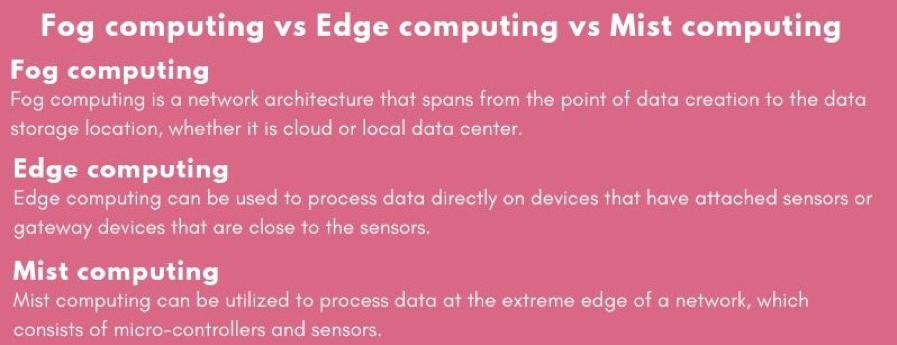
Fog computing is a network architecture that spans from the point of data creation to data storage location, whether it is cloud or local data center. Fog computing architecture consists of various components such as gateways, routers, and cloud services. Essentially, fog computing is the extension of the cloud to the edge of the network. Fog computing allows decentralized computing by processing data at the fog node. For this purpose, any device capable of storage, computing, and network connectivity can be used as a fog node.
Fog computing can be of great utility to smart cities, where many devices use real-time data to perform various tasks. Along with smart cities, fog computing can also be used in autonomous vehicles as data processing needs to be performed in real-time. Similarly, fog computing can be used for multiple business applications that require instant data processing. However, business leaders must analyze the pros and cons of fog computing in their specific situation before adopting the network infrastructure.
Pros
Fog computing enables real-time data analysis, which can make IoT applications work quicker. By processing data at fog nodes, businesses can reduce the costs of storage and computing. Additionally, confidential data can be secured as it can be stored at the fog node.
Fog computing can also be used to develop low latency networks between analytics endpoints and devices. Using such networks can lead to reduced bandwidth requirement compared to cloud computing. Also, fog computing can process larger volumes of data compared to edge computing as it is capable of processing real-time requests.
Cons
Fog computing is dependent on multiple links for transferring data from the physical asset chain to the digital layer which can be potential points of network failure.
What is edge computing?
Edge computing can be used for processing data directly on devices that have attached sensors or gateway devices that are close to the sensors. Hence, edge computing can enable devices to process data without relying on the cloud or fog. By processing data closer to the edge, edge computing can enable devices to process data in near real-time. Hence, edge computing can reduce overhead at the centralized cloud.
Edge computing can be used in connected homes to perform tasks like turning on the heater or lights in near real-time. Also, edge computing can simplify predictive maintenance in organizations by sending instant alerts about possible defects in equipment. To utilize edge computing for applications like these, business leaders need to analyze various advantages and disadvantages of the network.
Pros
Edge computing can simplify internal communication by wiring physical assets to IoT devices for collecting and processing crucial data. After processing the necessary data, IoT devices can determine which data needs to be stored locally and which data needs to be sent to the cloud for analysis. In this manner, sensitive data can be stored discretely at its source. Also, devices that use edge computing can provide near real-time analytics that can help in optimizing performance and increasing uptime.
Cons
Edge computing is less scalable compared to fog computing. Also, edge computing supports little interoperability, which might make IoT devices incompatible with certain cloud services and operating systems. Also, multiple tasks and operations performed by IoT devices and cloud cannot be extended to an IT team. In addition to these disadvantages, edge computing does not support resource pooling.
What is mist computing?
Mist computing is utilized at the extreme edge of a network which consists of micro-controllers and sensors. By working at the extreme edge, mist computing can harvest resources with the help of computation and communication capabilities available on the sensor. Mist computing infrastructure uses microcontrollers and microcomputers to transfer data to fog computing nodes and eventually to the cloud. Using this network infrastructure, arbitrary computations can be processed and managed on the sensor itself.
Mist computing can be incredibly useful for IoT in public transportation as the devices may not be stationary and may only serve a singular purpose. For instance, IoT sensors that notify commuters about the status of a bus. Along with such use cases, business leaders also need to be informed about the pros and cons of mist computing.
Pros
Mist computing can enable local decision-making with the help of micro-controllers and sensors. Mist computing can help in conserving bandwidth and battery power as only essential data is transferred to the gateway, server, or router. Additionally, mist computing enables utilization of data access control mechanisms that can ensure data privacy at a local level.
Cons
Microcomputers and sensors used in the infrastructure of mist computing can only be used for lightweight data processing and a narrow range of tasks. Hence, these devices can be used for limited applications.
How can businesses decide on a suitable alternative?
Business leaders need to understand that selecting a suitable networking infrastructure will be dependent on its application. Specific computing architectures are useful for a certain variety of IoT applications. To identify a suitable alternative, business leaders can analyze the strengths and weaknesses of fog, edge, and mist computing.
- Fog computing: Fog computing can be beneficial in applications that require real-time data analysis for performing tasks instantly. Also, operations handled by devices in fog computing can be managed by IT teams. Therefore, business leaders can use fog computing for applications that require real-time data processing.
- Edge computing: Edge computing can be utilized to secure sensitive data at the edge of the network. However, as edge computing lacks support for interoperability, it may not be compatible with a wide range of devices and networks. Hence, business leaders can utilize edge computing in applications that need to offer near real-time results and do not require interoperability.
- Mist computing: The devices that use mist computing are compatible with fog computing and cloud platforms. Also, mist computing allows sensors and microcontrollers to process data locally. Hence, business leaders can utilize mist computing to perform singular tasks efficiently.
Business leaders must understand that fog computing, edge computing, and mist computing have their own set of strengths and weaknesses. Understanding and using these paradigms correctly will help in ensuring that the growing number of IoT devices can work efficiently. Also, businesses can utilize fog, mist, and cloud computing together to utilize their strengths and minimize their limitations. As these networking architectures complement each other, businesses can use them to design secure, reliable, and highly functional IoT solutions.