
 Virtual Reality gives the term ‘world-building a whole new meaning. As we know, the technology is highly useful to create simulations for fields as diverse as occupational safety, law enforcement, and healthcare. As we may have already seen, the immersive simulations also allow researchers to ‘reach’ places where humans otherwise cannot go. All in all, the technology has several fascinating applications and promises to keep evolving with time.
Robotics is the crux of automation in big organizations everywhere. Robotics, like VR, can be used in several fields including manufacturing and national defense. The AI-powered tool is generally used to accurately execute repetitive tasks on a large scale without lag or gaps.
VR and robotics complement each other remarkably well when they are used as a combination. In this blog, we will analyze some of the real-world applications that use the best of VR and robotics.
VR and Robotics: Military Training
Military training is a key application area for both VR and robotics. An example of the combination being used in military training is the ‘virtual battlefield’ system used by the Russian army for training soldiers as well as testing drones and robots. The tool, developed by Kronstadt, a Russian engineering company, is highly flexible and possesses the ability to “integrate with other developers’ synthetic trainers.”
The tool serves multiple purposes, such as providing a simulated environment for soldiers to carry out physical training sessions on their own as well as test their hand-to-hand or weaponry-based combat abilities. Additionally, with the help of “virtual models,” the system also allows the Russian army to assess the speed, movement, and attack capabilities of their battle-ready robots and drones.
The VR-based system allows soldiers to control the movement and functions of the drones with the help of specialized VR headsets. The headsets are integrated into their military gear helmets (codenamed ‘Svarog’), and can provide a high-definition view of a battle terrain and enemy targets that need to be taken down. According to the developers, the headset allows soldiers to have greater positional awareness on a battlefield and have a better understanding of approaching or stationary enemy soldiers nearby.
When the technology was newly introduced, it was the first time the Russians had used VR and robotics for mainstream military operations. The helmets allow soldiers to maneuver the battle drones with their heads, meaning that a slight craning of the neck would make the drone change its direction, and other similar gestures would direct it to shoot down an enemy target. Looking at a particular target would send instantaneous signals to the drones to commence firing at it. The 400 lbs-weighing helmets contained dual VR screens for soldiers’ viewing. For greater clarity in vision, the screens had an ultra-high resolution (5120 X 2180, much higher than your average computer screen). Gyroscopes fitted in the helmets allow soldiers to get the location coordinates of the attack drones in the air.
As you know, on a battlefield, every minute saved can be instrumental in a mission. And so, aircraft pilots can use the VR-based helmets to launch ballistic missiles at a target by merely looking at it, thereby shaving off several seconds off the process and not giving the enemy any time to react. More importantly, an aircraft does not need to be moved a lot to carry out an attack, hence, its exposure to threats is reduced.
As we know, drones can be considered as a type of semi-autonomous robotic application and using AR to control it can be of great use to the army during warfare. In the nuclear age, nations have used technology to make themselves stronger from a military point of view.
Such high-tech weaponry may not be used on a daily basis by the Russian army, but having the robotics and VR-powered tools in their arsenal is hugely reassuring for them. As we know, most big and powerful weapons act as a deterrent for other nations.
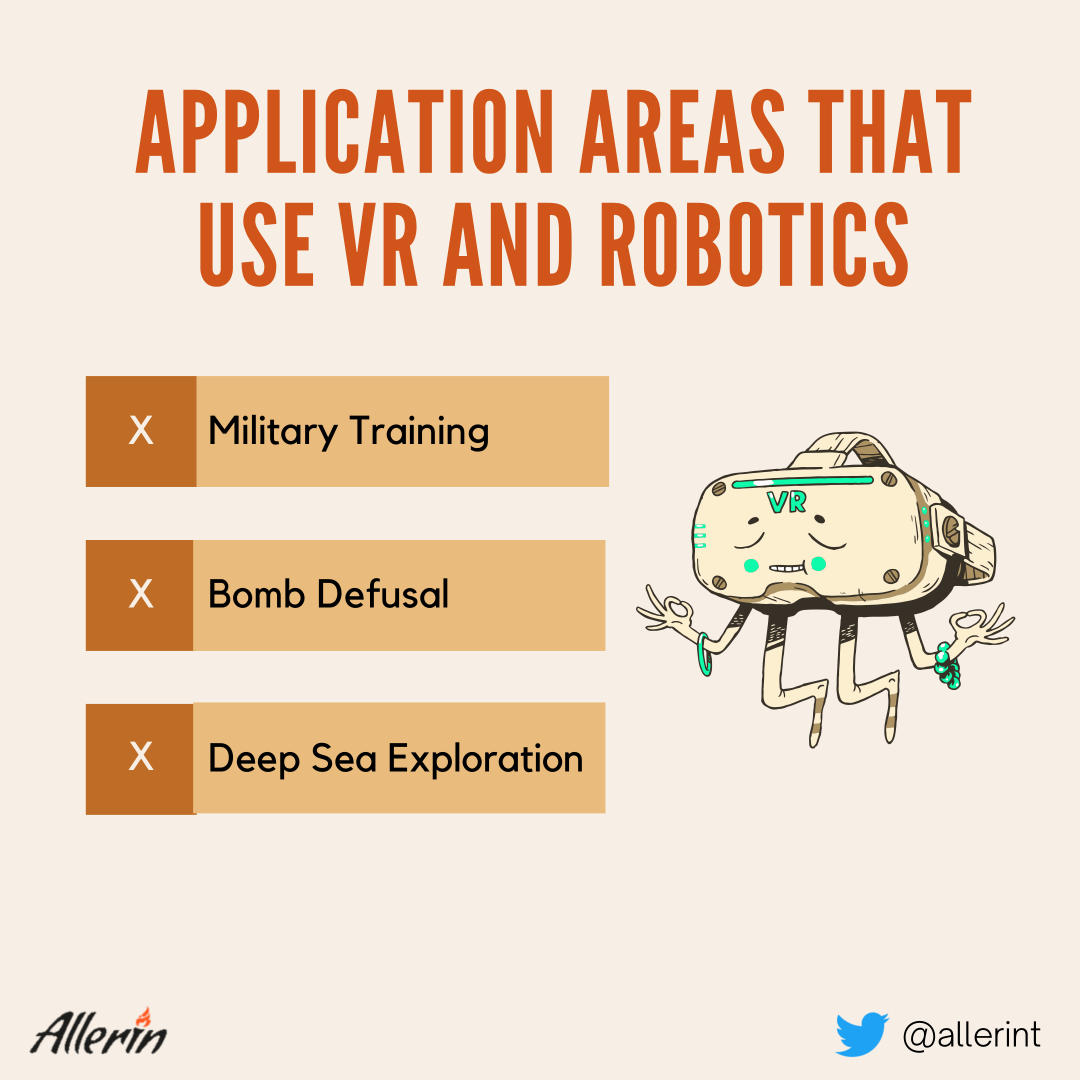
VR and Robotics: Bomb Defusal
Defusing a bomb is possibly the most nerve-wracking exercise for any person, no matter how well-trained or experienced they are. The possibility of several people losing their lives on the back of a single mistake can place fear in anybody’s head. Unfortunately, fear and nerves are two of the main reasons why such persons might doubt their decision-making, and, as a result, second guess themselves during the operation, to equally disastrous results.
To avoid these problems, specialized robots can also be used for the task of defusing bombs. Bomb defusal robots were born during the 1970s, and have undergone several developments since then. Today, modern bomb defusal robots use VR and advanced sensory feedback to get their job done with maximum efficiency. VR gives operation directors greater control over the process of bomb defusal.
One of the prime examples of modern VR-based bomb defusal robots is the Taurus, created by SRI International. As we know, VR allows users to control robots remotely. The Taurus also provides the same option to bomb defusal operators along with a perfect view of the entire simulation of the actual process being carried out.
The Taurus can be controlled via a VR headset that is worn by the expert who has been assigned the task of defusing an explosive device. Apart from the headset, Taurus is controlled with the help of handheld controllers. The helmet and controllers vibrate when the robot senses a hostile device or person in the operation spot.
The handheld controllers and helmets are light and portable to aid bomb defusal officers. Also, the batteries used in the robots and the controllers are lithium-ion instead of the acid batteries used in the earliest bomb defusal robots. Weight reduction is a key aspect of such robots and the developers of Taurus have taken every effort to make the robot as nimble as possible. At the same time, the robot, as well as the batteries, are built to be rugged and indestructible. Most importantly, the batteries are tested extensively so that they would not run out of power during an all-important operation.
Bomb defusal robots are one of the most significant uses of VR and robotics working together to save as many lives as possible.
VR and Robotics: Deep Sea Exploration
As stated at the beginning VR is often used to create simulations of places where humans may be unable to go for now. A good example of such a place is the vents found at the bottom of the deepest seas and oceans. At that depth, the water pressure is so high that human beings will be crushed by it. As a result, only robots can be used to carry out exploratory activities.
In March 2016, a deep-sea VR robot named Remotely Operated Platform for Ocean Science (ROPOS) was dispatched to explore an undersea volcano near Samoa. The operation was carried out by the researchers at the Schmidt Ocean Institute. The robot was fitted with VR cameras that could create 3D simulations of the terrain on the seabed. The movements of ROPOS were controlled with the help of VR headsets and handheld controllers.
The robot’s simulations were highly informational for scientists everywhere, while the entire process could be viewed in real-time by the general public as it was streamed live on YouTube. The entire process allowed the VR cameras to capture a part of the underwater terrain and then recreate the other half with the help of simulation.
Operations like these are an instrumental tool for understanding the geology and ecology of deep seas and oceans. And therefore, by using robots that use VR, the process of research is simplified for experts. Using the data generated from such research, scientists and deep-sea researchers can publish studies about the various rock formations found in the seabed as well as the flora and fauna of the location.
Robots are useful for going to places where human life may be at risk. And at the same time, such robots can collect more useful information than any human ever could. It is hard to overstate how useful the combination of VR and robotics is because we are still at the tip of the iceberg and plenty of future applications of this combination are yet to arise.