
What is cloud orchestration?
Cloud computing handles a prodigious amount of data and processes across multiple systems. This heterogeneity makes manageability and coherence a major challenge in cloud computing. The solution to this challenge lies in implementing a tool or a product that can manage these interconnections and interactions among cloud connected units. We call this solution, cloud orchestration.
Cloud orchestration is one of those ambiguous concepts in cloud computing, that have multiple definitions to them. However, in a nutshell, we can say that cloud orchestration involves the end-to-end automation and coordination of multiple processes to deliver a desired service to its clients.
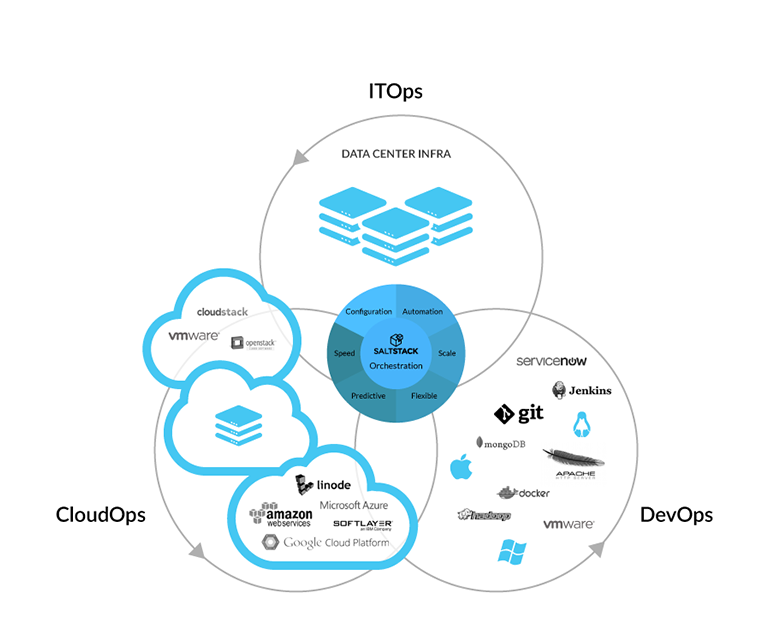
source: www.saltstack.com
How is cloud orchestration different from cloud automation?
More often than not, cloud orchestration is used interchangeably with cloud automation. Therefore, in order to get a clear and pellucid understanding of what cloud orchestration is, we need to highlight how it’s different from cloud automation. Here’s how:
|
Parameters |
Cloud automation |
Cloud orchestration |
|
No. |
It |
It |
|
Pre-requisites |
Automated |
Orchestration |
|
Error-proneness |
Cloud |
Cloud |
|
Resource |
Automated |
Cloud |
|
Example |
Launching |
Combining |
Cloud orchestration focuses on process optimization. One of the simplest ways to do so is to remove the repetitive steps to eliminate redundancy. It identifies the automated tasks that make up a process, and ensures their reusability across operations. Orchestration, therefore, takes advantage of the building blocks (read as automated tasks) by reusing them.
Well-orchestrated processes help in the creation of templates that meet developer requirements. This helps lower the IT cost and avoid any mismatch between system and development teams’ approach.
Tools like VMware’s vRealize and AWS CloudFormations can be used to create such templates.
So here’s the key takeaway – cloud automation codifies tasks, cloud orchestration codifies processes. Both offer their individual benefits. Their combination, however, reflects the collaboration between development and operations. This collaboration eventually leads to a more robust cloud computing infrastructure.