

Web 3.0, the next generation of the World Wide Web, is gaining momentum in diverse sectors, leaving an indelible mark on industries far and wide. The aviation sector is a prime example, where the emergence of Web 3.0 has become a game changer. Incorporating Web 3.0 in aviation will play a vital role in transforming the aviation industry, particularly in the sphere of airline maintenance, repair and overhaul (MRO) operations. Web 3.0, often referred to as the “Semantic Web,” brings a new dimension to the digital landscape by enhancing data interoperability, machine learning, and decentralized systems.
Further, we will explore the remarkable benefits that Web 3.0 brings to the aviation sector, specifically focusing on how it can significantly reduce overhead costs and streamline operations within airline MRO.
Benefits of Web 3.0 in Aviation in Reducing Overhead Costs and Streamlining Airline MRO Operations
In the asset-rich field of civil aviation, where even slight enhancements in asset functionality hold immense value, the benefits of Web 3.0 shine. This extends to airlines and maintenance, repair and overhaul (MRO) entities, providing them with unprecedented advantages.
Let us discuss some of these advantages in detail.
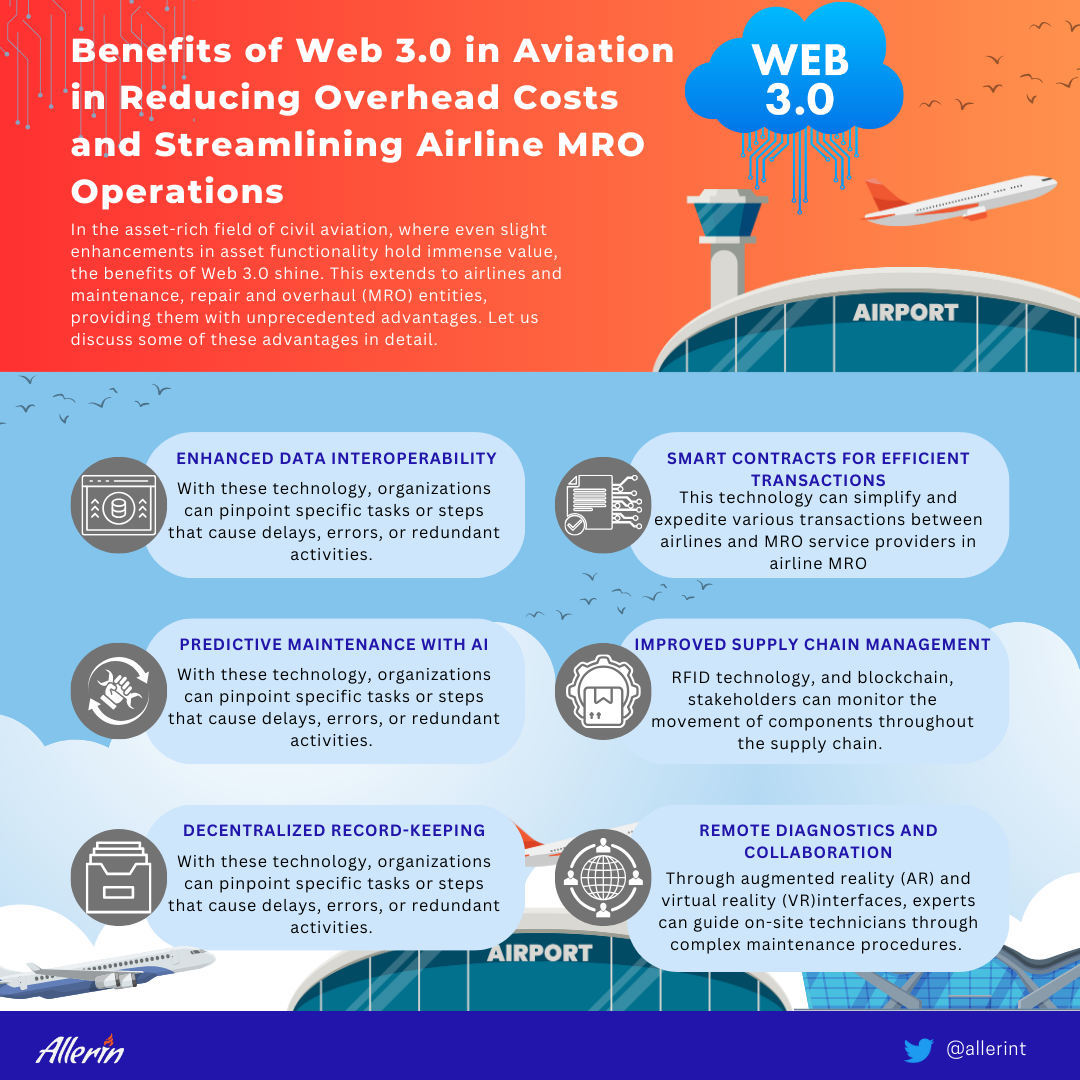
1. Enhanced Data Interoperability
Data fragmentation can lead to inefficiencies and errors in the traditional airline MRO setup. Web 3.0 addresses this challenge by enabling seamless data interoperability. Through the use of standardized formats and linked data, various stakeholders can access, share, and analyze critical maintenance information effortlessly. For instance, aircraft manufacturers, MRO providers, and airlines can collaborate more effectively, reducing duplication of efforts and improving decision-making. This interoperability paves the way for optimized inventory management, accurate forecasting, and better resource allocation.
2. Predictive Maintenance with AI
Web 3.0’s integration with artificial intelligence (AI) fosters predictive maintenance capabilities, transforming how airlines manage their fleet’s upkeep. Machine learning algorithms analyze vast amounts of real-time and historical data to predict potential failures or maintenance needs. This proactive approach minimizes unscheduled downtime, prevents costly disruptions, and ensures aircraft are in peak condition. By embracing predictive maintenance, airlines can extend the lifespan of their assets and reduce the frequency of major repairs, resulting in substantial cost savings.
3. Decentralized Record-Keeping
Web 3.0 introduces the concept of decentralized systems, which can revolutionize record-keeping in airline MRO. Traditionally, crucial maintenance records are stored within centralized databases, leading to concerns about data integrity and security. With Web 3.0’s blockchain technology, maintenance records become tamper-proof and transparent. Each maintenance event is recorded in a secure and immutable manner, preventing unauthorized alterations and reducing the risk of fraud. This innovation streamlines regulatory compliance and auditing processes, ultimately minimizing administrative overhead.
4. Smart Contracts for Efficient Transactions
One of the hallmark features of Web 3.0 is the integration of smart contracts, which are self-executing agreements with predefined conditions. This technology can simplify and expedite various transactions between airlines and MRO service providers in airline MRO. For instance, when an aircraft arrives for maintenance, a smart contract could automatically trigger the ordering of required parts, track work progress, and execute payments once the tasks are completed and verified. This automation reduces manual intervention, accelerates processes, and eliminates the need for intermediaries, consequently cutting costs and enhancing efficiency.
5. Improved Supply Chain Management
The aviation industry relies on a complex global supply chain to ensure the availability of necessary parts and materials. Web 3.0 can enhance supply chain management by introducing transparency, traceability, and real-time updates. By utilizing IoT sensors, RFID technology, and blockchain, stakeholders can monitor the movement of components throughout the supply chain. This visibility prevents bottlenecks, reduces lead times, and minimizes the risk of delays caused by part shortages, all of which contribute to cost savings and smoother operations.
6. Remote Diagnostics and Collaboration
Web 3.0 facilitates real-time remote diagnostics and collaboration among MRO teams, experts, and aircraft engineers. Through augmented reality (AR) and virtual reality (VR) interfaces, experts can guide on-site technicians through complex maintenance procedures. This capability minimizes the need to fly in specialized personnel for every maintenance task, thereby reducing travel costs and turnaround times. Furthermore, cross-border collaborations have become more accessible, allowing airlines to tap into a global talent pool while saving on travel and accommodation expenses.
Implementing Web 3.0 in aviation will lead the sector on a transformative journey. In the realm of airline MRO, Web 3.0’s potential to reduce overhead costs and streamline operations is particularly promising. By embracing predictive maintenance, leveraging decentralized systems, and integrating smart contracts, airlines can optimize their resources, enhance safety, and ensure a seamless travel experience for passengers. As Web 3.0 continues to evolve, the aviation industry stands to reap the rewards of a more efficient, cost-effective and interconnected future.